'%3e%3cpath%20d='M34.1406%205.85938C30.3906%202.10547%2025.3047%200%2020%200C14.6953%200%209.60938%202.10547%205.85938%205.85938C2.10938%209.61328%200%2014.6953%200%2020C0%2025.3047%202.10547%2030.3906%205.85938%2034.1406C9.61328%2037.8906%2014.6953%2040%2020%2040C25.3047%2040%2030.3906%2037.8945%2034.1406%2034.1406C37.8906%2030.3906%2040%2025.3047%2040%2020C40%2014.6953%2037.8945%209.60938%2034.1406%205.85938ZM37.0117%2023.543H31.1602V13.5391H27.6328V19.9414C28.1211%2020.6914%2028.3711%2021.582%2028.3711%2022.5625V22.625C28.3711%2023.668%2028.1172%2024.6055%2027.6328%2025.4297V26.6094H36.082C33.4883%2032.9375%2027.2891%2037.3789%2020.0039%2037.3789C10.3711%2037.3789%202.62109%2029.6289%202.62109%2020C2.62109%2010.3711%2010.3711%202.62109%2020%202.62109C29.6289%202.62109%2037.3789%2010.3711%2037.3789%2020C37.3789%2021.1484%2037.2617%2022.2656%2037.0508%2023.3477C37.0391%2023.4141%2037.0234%2023.4766%2037.0117%2023.543Z'%20fill='white'/%3e%3cpath%20d='M22.3086%2018.5352C20.4336%2018.125%2019.9531%2017.8398%2019.9766%2017.1836V17.1406C19.9766%2016.6992%2020.3477%2016.2148%2021.4023%2016.2148C22.582%2016.2148%2023.8867%2016.6797%2025.0781%2017.4766L26.8516%2015.0195C25.4453%2013.8906%2023.707%2013.3398%2021.5547%2013.3398C18.5195%2013.3398%2016.4375%2015%2016.4063%2017.4766V17.5352C16.3633%2020.2617%2018.5859%2020.9805%2021.293%2021.6016C23.0391%2021.9766%2023.5703%2022.3164%2023.5703%2022.9609L23.5469%2022.9766C23.5469%2023.3906%2023.2578%2023.7031%2022.7852%2023.8359C22.5742%2023.9062%2022.1289%2023.9727%2021.5156%2023.9727C20.7617%2023.9727%2019.7539%2023.8633%2018.6328%2023.4844C18.0898%2023.2891%2017.4727%2023.0039%2016.8047%2022.6133L20.1406%2026.625C20.2813%2026.6602%2021.0977%2026.8516%2021.7734%2026.8516C25.0039%2026.8516%2027.0859%2025.2461%2027.1094%2022.6328V22.5703C27.1602%2020.1133%2025.2148%2019.1719%2022.3086%2018.5352Z'%20fill='white'/%3e%3cpath%20d='M5.24219%2013.5664V26.6133H8.75391V23.7578L10.2969%2021.9531L14.2031%2026.6133H18.3867L12.3555%2019.5195L17.4023%2013.5664H13.4531L8.75391%2019.0586V13.5664H5.24219Z'%20fill='white'/%3e%3c/g%3e%3cdefs%3e%3cclipPath%20id='clip0_97_2430'%3e%3crect%20width='40'%20height='40'%20fill='white'/%3e%3c/clipPath%3e%3c/defs%3e%3c/svg%3e)


- Salt Lake City officials deem the 2026 legislative session a success, citing collaboration.
- Many bills targeting the city didn't pass, alleviating concerns about municipal funding impacts.
- Successful measures include $23 million for homeless resources and downtown revitalization funding adjustments.
SALT LAKE CITY — Angela Price never had room for failed bills on her one-page handout of proposed laws that could impact Utah's capital city since she took over as Salt Lake City's top legislative affairs official a few years ago.
However, after better conversations with state leaders and the help of "cool beans" who stepped up to thwart other bills, this year became a little more about what didn't happen than what did.
Many bills that would have drastically impacted municipalities' funds failed to clear the Utah Legislature this year. Some bills targeting Salt Lake City, such as renaming its Harvey Milk Boulevard, didn't even make it to a committee hearing.
"I think this was one of our most successful sessions since well before the inland port," Price said, sitting in front of a whiteboard outlining some of the key elements of the 2026 legislative session on Wednesday. "There were a lot of bills ... that would have had really profound impacts on Salt Lakers, so we're grateful that leaders really focused on sound policy this year."
Salt Lake City Mayor Erin Mendenhall agrees, calling 2026 one of the most productive sessions in recent memory for the city.
It's a complete 180 from last year, when she called the 2025 session "punitive" based on all the bills that appeared to target the city. The mayor thanked Gov. Spencer Cox and legislative leaders for working with the city — sometimes for months — on key issues that were addressed this year, which helped set a different tone during and after the session.
"We have good relationships with state leadership," Mendenhall said. "We've been able to get through this session ... because they have worked with us more than they worked against us."
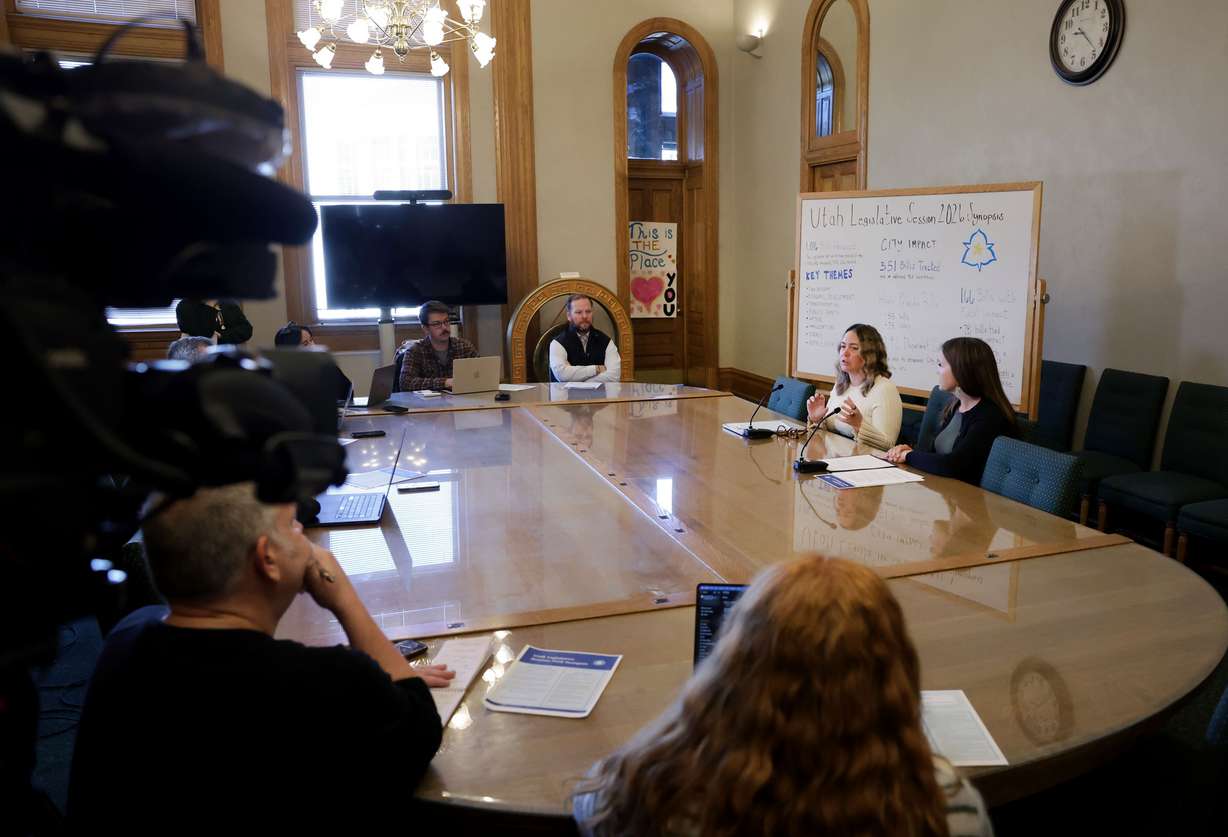
Utah's capital city ended up tracking 351 of the record-setting more than 1,000 bills and resolutions that were introduced this year, as well as hundreds of more substitutions. Many of these addressed city functions, like tax reform, economic development and transportation. Some of them branched out into broader issues in and around the city, like public safety, immigration and homelessness.
Bills limiting cities' property tax collection, like SB97, fizzled in the Senate amid concerns brought up by towns and cities across Utah. Bills that would have required votes on tax increases or capped how much money municipalities can have in their general fund reserve account also went nowhere.
Many of these would have cut off incentives for cities to grow because growing cities wouldn't be able to capture the funding needed for infrastructure and services needed to account for the gains, Mendenhall explained. HB501 could have raised fees for water users to secure state funds for water projects, but that dried up in the Senate.
The city took a neutral stance on HB302, which sought to clean up Utah's flag wars that originated from a 2025 fight. It would have forced Salt Lake City to pick just one city flag but would have allowed it to fly alternate ceremonial flags — like the three it adopted in 2025 — outside of City Hall. It was never considered in the Senate after clearing the House.
SB242, an omnibus transportation bill that limits Salt Lake City's ability to implement lane-reduction projects without state say on most of the city's biggest roads, ended up receiving the most attention, but that wasn't as bad as the city initially feared.
"It ended in a much better place than where we sat at the end of the 2025 session," Mendenhall said, noting that it provides greater clarity of what to plan around and not ripping out recent projects.
That's not to say this year was a success because bills didn't pass. Mendenhall and Price said they're thrilled about some of the bills that passed this year, including $23 million in one-time funds for homeless resources and new measures that could require other cities to invest in services.
There were dozens of bills that addressed items wrapped in the city's public safety plan, potentially allowing it to grow. HB296, which Salt Lake City advocated, allows water to be directed to the Great Salt Lake in water conservation plans.
HB492 closed a key funding concern on a massive redevelopment surrounding the Delta Center. It directs $50 million of the $300 million for 300 West improvements to convention plans, but it also clarifies that interest from the public infrastructure district will go toward county projects.
Utah also tweaked its alcohol laws to allow cities to approve some businesses to set up shop next to parks, which Mendenhall said could allow for new economic opportunities.
In the end, the year's session may force lawmakers to zero in on good policies over throwing bills out there and seeing what sticks, city officials said.
"I think that's really a testament to leadership and (the Rules Committee) of looking at what policies need to advance in this state and to really address problems," Price said.