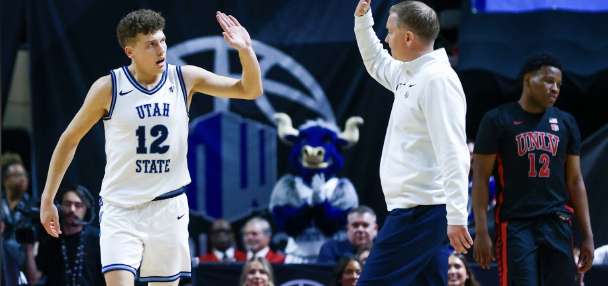
- Utah State's defense struggles as they prepare for postseason play despite strong start.
- The Aggies allowed 80+ points in four of their last five games.
- Coach Calhoun notes defensive issues, emphasizing the need for improvements in March.
LOGAN — Utah State started its season with a 15-1 record to land the team inside the Associated Press Top 25 and set itself up for what could be its best NCAA Tournament seed in program history.
Suffering back-to-back losses to Grand Canyon and UNLV after that hot start, the Aggies ripped off another eight wins in a row and won 23 of its first 26 games.
In those 26 games, the Aggies allowed over 80 points in regulation just three times. But in the final five games, of which they lost three, the Aggies gave up 80 or more points in four of the five.
The lone win in those four was Saturday night's 94-90 win over New Mexico, a result that crowned Utah State the Mountain West outright regular season champion.
"With this group of guys, coaching staff, I'm fortunate to say that I'm a champion; that's something that nobody will ever forget," senior guard MJ Collins Jr. said. "It's just an unbelievable achievement to be able to carry it out."
The Aggies' win on Saturday came down to the final seconds, as New Mexico, led by freshman Jake Hall and his 32 points, gave Utah State about all it could handle on the defensive end. The Lobos finished the game shooting 48% from the floor and 45% from 3-point range.
Utah State saved itself by shooting 50% from the floor, and getting 27 points from Collins — 21 of which came in the second half. The Lobos' scoring outburst nonetheless continues a concerning defensive trend for Utah State as the season comes to a close and the page turns to postseason play.
"I thought, defensively, we just really missed up a lot of switches. Our switching was terrible — really, really bad," Calhoun said. "It was more about the defense. … In the conference tournament, NCAA Tournament, giving up 90, you would usually lose."
Under Calhoun, Utah State has been known for playing a tricky matchup zone defense that causes confusion and forces errors from opposing offenses. That style of defense is designed to get the Aggies more steals and deflections, which lead to easy transition buckets.
As the season has gone on and conference opponents take on the Aggies for a second time, the matchup zone proves less effective. During conference play, Utah State conference opponents averaged 68.3 points per game in the first contest. In the second matchup of the year, conference opponents averaged 77.5 points per game.
Boise State and Grand Canyon were the only two teams in nine repeat opponents to score less against Utah State the second time around.
Similarly, Utah State's conference opponents shot 40% from the field in the first matchup and 47.7% the second. A similar trend is seen in turnovers forced by Utah State.
"We may have to look at different pick-and-roll coverages, the way we're guarding certain actions, but it's — it's not a recipe to win in March," Calhoun said. "We've got to get back to our ways."
While a team playing better in a rematch due to some additional familiarity is not a novel concept, the rate at which repeat opponents improve goes beyond what may be typically expected.
For reference, Utah State scored an average of 81.8 points in the first matchup compared to 77.5 in the second meeting.
Beyond familiarity, many additional factors can contribute to the team declining defensively as the season goes on, including injuries, home and road splits and player fluctuations, among others.
One potential looming factor for Utah State is additional fatigue stemming from the lack of a bye-week during conference play, as the Aggies opted to take on Memphis in mid-February rather than have a week off.
"We played Memphis. We had no byes the entire basketball season; that's hard," Calhoun said. "Every other team in the league had a bye week."
As Mountain West teams now close the book on the regular season and look toward the Mountain West Tournament, teams will be playing each other for a third time. If Utah State is to accomplish its goal of winning two championships in one season, changes and improvements are going to be needed on the defensive end.
"We want two of these and not one," Collins said. "We want two rings, not one."