'%3e%3cpath%20d='M34.1406%205.85938C30.3906%202.10547%2025.3047%200%2020%200C14.6953%200%209.60938%202.10547%205.85938%205.85938C2.10938%209.61328%200%2014.6953%200%2020C0%2025.3047%202.10547%2030.3906%205.85938%2034.1406C9.61328%2037.8906%2014.6953%2040%2020%2040C25.3047%2040%2030.3906%2037.8945%2034.1406%2034.1406C37.8906%2030.3906%2040%2025.3047%2040%2020C40%2014.6953%2037.8945%209.60938%2034.1406%205.85938ZM37.0117%2023.543H31.1602V13.5391H27.6328V19.9414C28.1211%2020.6914%2028.3711%2021.582%2028.3711%2022.5625V22.625C28.3711%2023.668%2028.1172%2024.6055%2027.6328%2025.4297V26.6094H36.082C33.4883%2032.9375%2027.2891%2037.3789%2020.0039%2037.3789C10.3711%2037.3789%202.62109%2029.6289%202.62109%2020C2.62109%2010.3711%2010.3711%202.62109%2020%202.62109C29.6289%202.62109%2037.3789%2010.3711%2037.3789%2020C37.3789%2021.1484%2037.2617%2022.2656%2037.0508%2023.3477C37.0391%2023.4141%2037.0234%2023.4766%2037.0117%2023.543Z'%20fill='white'/%3e%3cpath%20d='M22.3086%2018.5352C20.4336%2018.125%2019.9531%2017.8398%2019.9766%2017.1836V17.1406C19.9766%2016.6992%2020.3477%2016.2148%2021.4023%2016.2148C22.582%2016.2148%2023.8867%2016.6797%2025.0781%2017.4766L26.8516%2015.0195C25.4453%2013.8906%2023.707%2013.3398%2021.5547%2013.3398C18.5195%2013.3398%2016.4375%2015%2016.4063%2017.4766V17.5352C16.3633%2020.2617%2018.5859%2020.9805%2021.293%2021.6016C23.0391%2021.9766%2023.5703%2022.3164%2023.5703%2022.9609L23.5469%2022.9766C23.5469%2023.3906%2023.2578%2023.7031%2022.7852%2023.8359C22.5742%2023.9062%2022.1289%2023.9727%2021.5156%2023.9727C20.7617%2023.9727%2019.7539%2023.8633%2018.6328%2023.4844C18.0898%2023.2891%2017.4727%2023.0039%2016.8047%2022.6133L20.1406%2026.625C20.2813%2026.6602%2021.0977%2026.8516%2021.7734%2026.8516C25.0039%2026.8516%2027.0859%2025.2461%2027.1094%2022.6328V22.5703C27.1602%2020.1133%2025.2148%2019.1719%2022.3086%2018.5352Z'%20fill='white'/%3e%3cpath%20d='M5.24219%2013.5664V26.6133H8.75391V23.7578L10.2969%2021.9531L14.2031%2026.6133H18.3867L12.3555%2019.5195L17.4023%2013.5664H13.4531L8.75391%2019.0586V13.5664H5.24219Z'%20fill='white'/%3e%3c/g%3e%3cdefs%3e%3cclipPath%20id='clip0_97_2430'%3e%3crect%20width='40'%20height='40'%20fill='white'/%3e%3c/clipPath%3e%3c/defs%3e%3c/svg%3e)


Estimated read time: 6-7 minutes
This archived news story is available only for your personal, non-commercial use. Information in the story may be outdated or superseded by additional information. Reading or replaying the story in its archived form does not constitute a republication of the story.
Utah is famously known for its unique baby names and unusual spelling conventions. And it seems like this tendency toward strange nomenclature began with some of its geographic locations.
Several places — including Bountiful, Manti, Nephi and Brigham City — have roots in The Church of Jesus Christ of Latter-day Saints culture, while names such as Uintah and Tooele and many others are inspired by Native American words.
But even if you think you know the history behind some of these Utah towns and cities, you might be surprised. Some of them are odd, some are sad and others are complete mysteries. Here are just a few of them.
Moab
Moab is among the most popular and beloved cities in Utah thanks to its national parks and abundant recreation. While it's certainly not a lush paradise, both name theories stem from water.
According to Britannica, the general understanding is that it's named for the biblical Moab, which means "land beyond the Jordan." But another theory suggests it comes from a Paiute name meaning "mosquito water." Either way, you might want to pack some repellent before visiting.
Panguitch
Panguitch is a tiny town in Garfield County, off of Highway 89, just east of Paragonah. The town is home to about 1,700 people, according to the 2020 census report. Utah History To Go claims the town was founded in 1864 by four pioneer families.
Despite sounding remarkably similar to those Antarctic-dwelling birds, Britannica says Panguitch gets its name from a Paiute Indian word that means "abundant fish." This was because the nearby Panguitch Lake provided excellent fishing for Indians and pioneers alike.
Loa
Not many people would describe Utah as a tropical paradise, and yet it does have at least one thing in common with Hawaii. The Wayne County city of Loa was named after Mauna Loa, the big Hawaiian volcano. Utah History Encyclopedia says local resident Franklin W. Young suggested the name after living in the Hawaiian Islands.
According to Utah History To Go, the town was established in 1878 by about 40 families. It sits at about 7,000 feet and is much lower than the Hawaiian mountain which is more than 13,000 feet above sea level.

St. George
The southern Utah city of St. George is among the many places with a Church-inspired name. According to Greater Zion, the city was named in honor of the Latter-day Saint apostle, George A. Smith.
He was known as the "Potato Saint" because he encouraged settlers to eat raw potatoes to cure scurvy. Smith didn't settle St. George, but he was responsible for sending out many of the pioneers who did.
Hurricane
Located just north of St. George is the small city of Hurricane. This southern Utah city's name has no doubt been a head-scratcher for many since the state's climate isn't particularly prone to hurricanes. But as Hurricane City's website states, "Legend has it that one windy day in the 1860s Mormon leader Erastus Snow had a whirlwind blow the top off a buggy he was driving. He reportedly said, Well, that was a Hurricane. We'll name this the Hurricane Hill."
Just make sure you pronounce it as "her-ah-kun" and not "her-ah-cane" if you want to sound like the locals.

Castle Dale
Since there was no such thing as autocorrect in the late 1800s, the would-be city of Castle Vale was forever named Castle Dale after a slight typo. [FamilySearch](Tudoran Andrei) reports that even though the community wanted the former name for its city, the post office listed it as Castle Dale and never changed it. The "castle" portion of the name comes from the castle-like rock formations in the area.
Duchesne
Taking the prize for possibly the most difficult Utah name to pronounce at a glance, Duchesne (pronounced "doo-shane") used to be called by many different names. It was originally Dora and then changed to Theodore, in honor of President Theodore Roosevelt.
But, according to Utah History to Go, when the neighboring town adopted the name of Roosevelt, people thought the two names were too similar. So they settled on Duchesne, which came from the river that runs through the town. The river was likely named after Mother Teresa Duchesne, who founded the School of the Sacred Heart near St. Louis, Missouri.
La Verkin
How the small town of La Verkin in Washington County got its name is anyone's guess. The town's website states that it may derive from a Spanish phrase that means "the virgin." Some say it comes from a Native American name that means "beautiful valley."
Historical records show the name may have evolved from Beaver Skin Creek to LeaverSkin, Lavinksking and ultimately La Verkin. No one may ever know its true origin story.
Bicknell
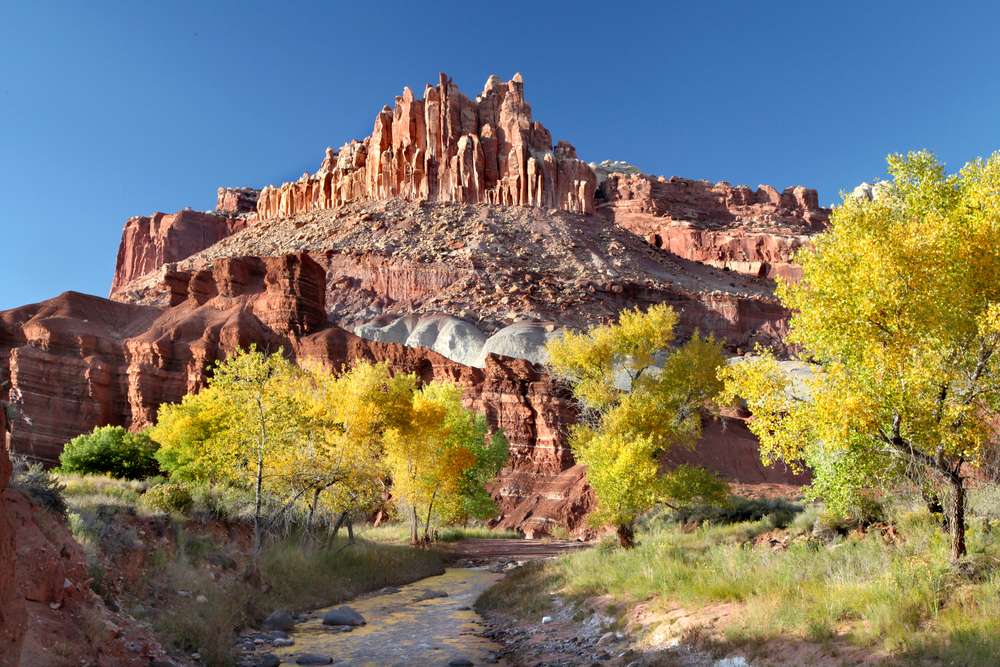
Some Utah places have an amusing history, and Bicknell is one of them. Once upon a time, this south-central Utah town was called Thurber after A.K. Thurber, the first person to build a house in the area. Capitolreef.org says it kept its name from the late 1800s to 1914 when a wealthy man named Thomas Bicknell offered to give a library with 1,000 books to any town that would change its name to his.
Both Thurber and Grayson, Utah, wanted the library. So Thurber became Bicknell and Grayson became Blanding, which was Mrs. Bicknell's maiden name. The two towns shared the library.
Elmo
Before the furry Sesame Street character came onto the scene, there was the agricultural community of Elmo, just eight miles north of Huntington. According to Emery County's website.), this place was named by combining the first letter from the last name of the first four families who settled there (Erickson, Larsen, Mortensen and Oviatt). That means it could have just as easily been named "Mole."
Here are 6 ways Utah benefitted from the 2002 Olympics
More than two decades after Salt Lake City stepped into the international spotlight as the Winter Games host city, the community is still reaping benefits. The 2002 Olympic Games kickstarted a transformative wave of economic growth, and the ripple effects of that growth changed the state's landscape forever! Here are six ways Utah benefited from hosting the Olympic Games that permanently changed the state's identity and future.Siegfried & Jensen
Since 1990, Siegfried & Jensen have been helping the people of Utah and surrounding states who have suffered needless injuries and death caused by car accidents, truck accidents, medical malpractice, defective drugs, dog bites, wrongful death, and other types of personal injury.
The firm is committed to keeping Utah families and communities safe by ensuring wrongdoers are held accountable. While a lawsuit isn't always the answer when it is needed having someone on your side can mean the difference between declaring bankruptcy and rebuilding your life and moving forward, especially when you're up against an insurance company or a hospital.
Siegfried & Jensen has represented more than 35,000 clients and recovered over $1.2 billion for them.