Estimated read time: 5-6 minutes
This archived news story is available only for your personal, non-commercial use. Information in the story may be outdated or superseded by additional information. Reading or replaying the story in its archived form does not constitute a republication of the story.
In recent years, the medical world has been studying the effectiveness of the anesthetic agent ketamine in treating depression — and the findings have been promising.
A 2019 study published on PubMed Central found that ketamine "has a robust and rapid effect on depression" that was immediately evident and sustained at the end of one month. A 2022 study published in The BMJ also found that "ketamine is rapid, safe in the short term, and has persistent benefits for acute care in suicidal patients."
While this is potentially good news for anyone suffering from debilitating depression, it's tough to quantitatively measure ketamine's effectiveness from person to person. That's because depression itself is difficult to measure.
Writing for WebMD, Dr. Debra Fulghum Bruce says, "A depression diagnosis is often difficult to make because clinical depression can show up in so many different ways. For example, some clinically depressed people seem to withdraw into a state of apathy. Others may become irritable or even agitated." In short: It can look different in each person.
But there is one way to potentially gauge how well ketamine is working.
'The interval' of effectiveness
Ketamine SLC, a Utah-based clinic that has performed more than 40,000 individual ketamine treatment sessions, uses something called "the interval" to measure the drug's overall effectiveness. The clinic defines this as "the time period between the completion of a given ketamine treatment and the return of depression, anxiety or PTSD.
Patients may experience other side effects — such as nausea or hypertension — but the interval mainly focuses on the return of depressive symptoms. If a patient has a short interval between treatment and the return of symptoms, that might make it difficult to sustain long-term treatment.
You never know until you try
If you're wondering which camp you'll fall into — the long interval or a short one — the only way to find out is to undergo treatment to see how you respond.
"It is obvious that one treatment for $300 every 100 days is preferable to the same treatment required every two weeks," Dr. Robert Hiemstra with Ketamine SLC says. "Predicting who gets the 100 days of freedom from depression and who must come in every two weeks is as unpredictable as the nausea; we just don't know before giving the medicine."
For patients whose intervals are shorter, the clinic may prescribe other methods — such as dissolvable lozenges taken multiple times per week — to optimize the response.
The 'Holy Grail of Depression'
If you respond well to treatment, Hiemstra says you could potentially enjoy more than three months of freedom from depression. For maximum effectiveness, Ketamine SLC strictly adheres to a 13-step Ketamine Intramuscular Stepped System for Depression (KISSD).
"KISSD is a process of optimization where every opportunity is taken to ensure patient comfort and response during this potentially very challenging treatment," the clinic says. Hiemstra adds that, in general, "maximizing the dose of ketamine also maximizes the immediate antidepressant response as well as the duration of effect."
In clinical trials, Hiemstra found that one dose of ketamine led to 10 to 12 days of freedom from depression. Two doses increased the results to three weeks. Four doses went to six weeks. With six doses, the expected duration of freedom from depression rose to 12 weeks. And while this won't be the case for everyone, clinical trials indicate that the odds are in your favor.
"The average depressed patient treated with the KISSD process achieves 100 days of freedom from her depression," Hiemstra reports. "These 100 days we at Ketamine SLC refer to as the Holy Grail of Depression; it is achieved by 75% of KISSD-treated patients."
If you're among the 75%, you could be living three months depression-free with no side effects and no other drugs in your system.
At Ketamine SLC this interval defines the future care of the patient. If this interval is too short, practical considerations may lead to the use of ketamine troches which are lozenges dissolved in the mouth and are taken multiple times per week in a manner that optimizes patient response. KISSD is a process of optimization where every opportunity is taken to ensure patient comfort and response during this potentially very challenging treatment. An important truth that has come from
this optimization is that generally maximizing the dose of ketamine also maximizes the immediate antidepressant response as well as the duration of effect.
The Genuine Measure of the Effects of Ketamine
This maximized dose of ketamine leading to a maximized duration of effect is dramatically obvious in the following table which displays the 100-day interval of freedom from depression which can be achieved if the kissed protocol is adhered to:
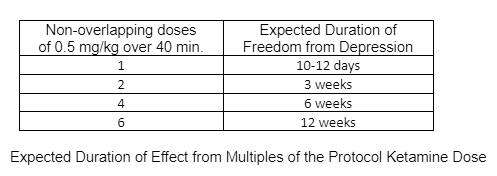
This table demonstrates how, in the context of careful optimization of patient response, the KISSD process produces the longest intervals of freedom from depression in the industry. When every step in the KISSD 13-step process is appropriately optimized, 75% of patients treated achieve the 100 days of freedom from depression.
Request a free consultation
Ketamine treatment isn't for everyone — but it may bring some welcome relief if you've dealt with treatment-resistant depression. You may want to discuss this treatment option with your primary care provider or other healthcare professionals who know your history.
As with any medical treatment, there are always risks involved. For maximum safety and effectiveness, the drug must be administered under proper medical care — and that's where Ketamine SLC can help. To learn more about how ketamine can help treat mental health and mood disorders and to see if this treatment may be right for you, request a free consultation at Ketamine SLC today.