
Estimated read time: 14-15 minutes
This archived news story is available only for your personal, non-commercial use. Information in the story may be outdated or superseded by additional information. Reading or replaying the story in its archived form does not constitute a republication of the story.
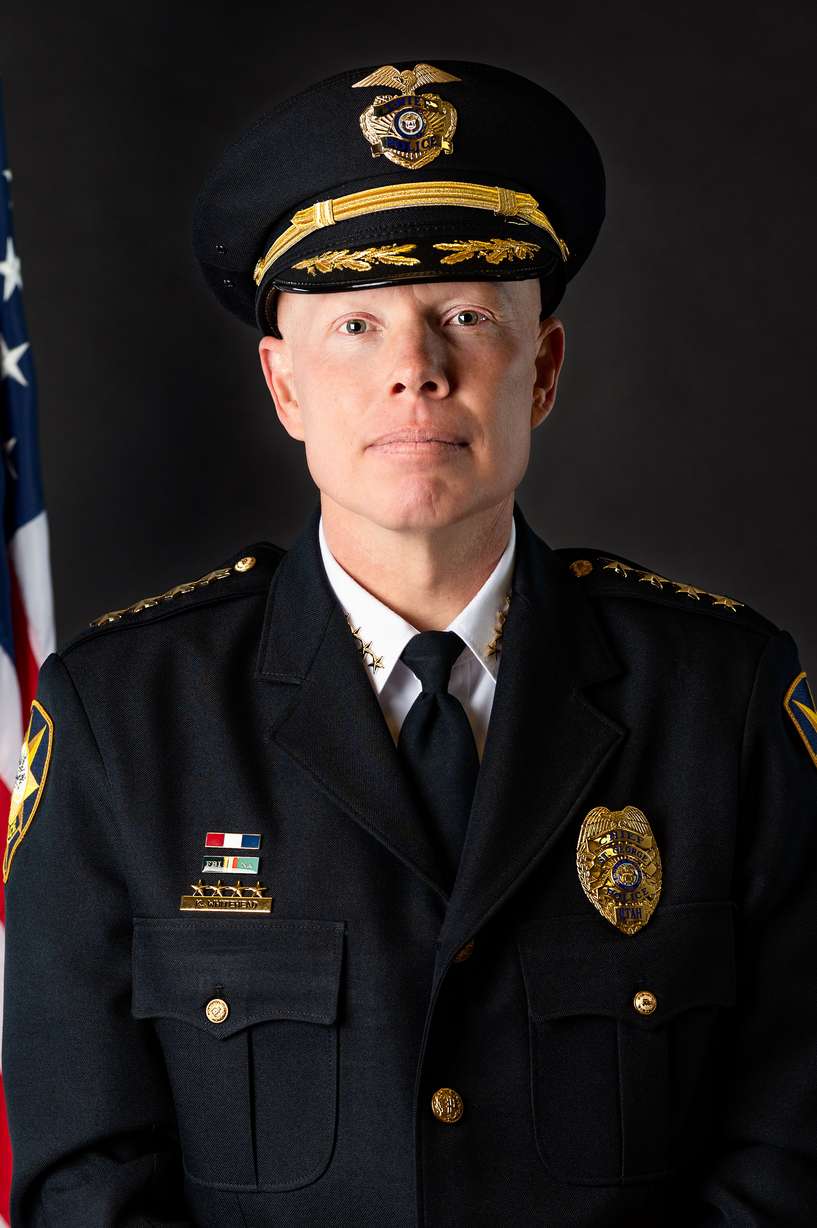
ST. GEORGE — The St. George City Council voted last week to remove the interim tag from Police Chief Kyle Whitehead and make him the full-time leader of one of Utah's largest police departments.
A St. George native, Whitehead started with the city police force in 1999. "This is the only agency I've worked for full-time," he said.
Whitehead worked his way up the patrol division throughout his career and has also had stints in investigations and as deputy chief. He served on the city's SWAT team and trained other officers in defensive tactics, and helped with the 2002 Winter Olympic Games in Salt Lake City.
"The main reason I got into policing was the ability to interact and help people," he said. "The interaction is something I really find fascinating, and it really kind of drives me."
Whitehead said he originally aspired to join a federal law enforcement agency, but after his Olympics experience he realized he was more interested in being part of a local community.
"That's probably what kept me at the time, the desire to continue to help and do my best to be out in the neighborhoods helping people."
Whitehead took the interim police chief role in March just in time for months of coronavirus-related sicknesses and social unrest. He spoke to KSL.com this week about policing in 2020, proactive solutions, community outreach and the legacy he hopes to leave with the St. George force.
This interview has been lightly edited for length and clarity.
Q: How is your community recovering from the flooding over the weekend?
A: Things are going well, as far as the city goes. We've had some damage. There's been some property damage, especially some private property damage, which is unfortunate. I hear most people, when it comes to insurance, aren't insured for flood, and so that becomes unfortunate. I know we had quite a few with some sewer backups and just general flooding in homes. Kind of a bad thing.
The city, though, most of our (damage) was superficial. We had a few retaining walls, a few culverts, have some issues and open up some holes in the ground. But by and large, I think we weathered it better than we anticipated we would.
Q: What do you like about working in St. George and what are the challenges of policing there?
A: The one thing that I hear consistently from people is that they're amazed at, for the size of our city, how clean it is. Clean being there aren't graffiti problems, crime seems relatively low. And that, to me, makes me think that we're doing a good job as a police department. We're keeping on top of the issues.
Because really, I think people like St. George, that it's got a larger city feel, but it's still kind of that "Small Town USA" at the same time. You kind of get the best of both worlds with that. That's one thing, I think, that really makes us unique.
As far as challenges, right now it seems there's a real narrative out there — there's a portion of the population that doesn't have confidence in the police. We really don't experience that here. Generally speaking, I think our citizens are very appreciative of us. We have just had overwhelming support over the last few months — people brining in goodies and thank-you notes and letters. We're really supported here.
And so we aren't seeing a lot of the challenges that other departments may be in some communities throughout the country. Here, we experience the challenges that come with growth. The increase in traffic. Our traffic is not like Salt Lake traffic, obviously, but it gets busy, and sometimes drivers get a little bit careless, or forget, or a little selfish, even. So we see a lot of crashes, a lot of red light violations, a lot of cellphone violations. We just continually feel like we have to remind people, "Look, when you get behind the wheel, remember: Focus on driving and don't get distracted by other things." But I think that's a problem anywhere. It's something we see here quite a bit.
Property crime seems to be, you know, it ebbs and flows. We'll have a rash of burglaries and theft and things, and then we'll kind of go without for a while. Not to say we don't have ones and twos here and there, but property crime seems to creep up, especially, with the construction sites, a lot of building. It's a target-rich environment, some of these, especially south of the city where we have a lot of homes being built. Sometimes those areas don't get the attention they need from us because of calls or other things, so people come in and take things and cause problems there. So theft is a big one.
Just like anywhere, we see our share of domestic violence and other violent crimes. Obviously, our homicide rate is probably a little bit lower than the average, but we still see homicides, assaults, things like that. So those are probably the things that we see the most problems with: traffic, and then probably our property crimes, and some of our domestic disputes, violence, things of that nature.
I will add one other thing, is mental health. That's a whole other area that I think many agencies, many communities, are finding is really challenging, because there just aren't services there to help those people that have that struggle, have that challenge. We're always trying to look for ways to better help those people that don't necessarily involve handcuffs and a trip to the jail. That's another thing that we see — it seems like continually, we're dealing with these mental health issues and people in crisis. It's unfortunate, it really is.
Q: 2020 has been a difficult year for many reasons. What was it like for you to start this job this year?
A: You know, I've had a lot of people ask me that question, and having never been a chief before — even being the deputy chief, I realized there were a lot of things I didn't understand well. I didn't realize things that happened within the city government, things that the chief was involved in. So coming into this in the middle of a pandemic, and some of this civil unrest, I really didn't know any different. So for me it was just, "Well, here are these challenges just like we've done in the past throughout the years. We'll face them head-on and try to do the best we can."
The protests, for example, we saw protests here in St. George unlike protests we've ever seen here before. We were a little bit worried. We were a little bit concerned that there might be more issues, especially seeing what was happening in Salt Lake and other large cities around the country. We tried some things a little bit different.
The first night, we had a big protest here on our main road through town, St. George Boulevard. We made some mistakes, but overall I think we had some positive interactions and that kind of set the tone. The rest of the time we had the protests here, each night we learned and tweaked things a little bit, and pretty soon these things were really functioning well. We didn't have a lot of violence.
We had a few little incidents, but nothing on the scale of what we'd seen around the country. We had a few vehicles that were damaged by some protesters in an intersection the first night, but after we kind of figured that out, we didn't have any more of that problem, either.
So like I said, as these challenges come up, we've got a great department here. I really can't take credit for it. We have such outstanding people that are well-trained and that just do such a great job. We've really been fortunate.
Q: Is your department considering any proactive changes in light of the national conversation about police tactics?
A: Yes. We have, in fact. Sometimes it's unfortunate that it takes these kinds of events to remind us of what's important, but that's something we've always tried to do as a department, is to look toward the future and see where we, potentially, need to do better. As a chief, that's one of the things that I've committed to our community, to our elected officials, that I want to continuously evaluate how we police. And just because something worked a few weeks ago or a month ago, doesn't mean it's the right way to do it next week. So we've got to continuously be evaluating those things.
I've talked to some of the people in the minority community around here that have shared some experiences with me that I realized, I've never experienced. But I'm of a different race, so maybe that — maybe there are things out there, perceptions and things that I just don't see. I want to try to close those gaps and have those discussions. It's been helpful to me. Up until six months ago when I started having these discussions, I never imagined some of these things that were happening. And now, since I've been having these discussions with individuals, it's helped me stop and think a little bit about, "OK, what do we need to do to help with some of these issues?"
We continuously evaluate our policies and make sure that our officers are treating everybody with dignity and with the respect they deserve. At the end of the day, a lot of it just comes down to good communication and being able to listen and have these discussions. When people bring up perspectives, and sometimes opinions, that feel a little bit confrontational, that we don't bristle — that we listen, and approach things with an attitude of understanding.
We've had meetings recently, and hopefully will continue to have meetings with our local ACLU representatives, and we also have a local Black Lives Matter representative. We want to continue to engage those community leaders, and listen to the concerns that they have, and encourage them, "Look, as you interact with the community, and people share things with you that maybe they don't dare bring to us, bring them to us. At least bring them to us on behalf of the people so we can look into them."
Because we want to make sure we're doing the right things. And heaven forbid, we want to completely avoid having any catastrophe like we've seen in some of these other jurisdictions around the country. But I think if we continually focus on doing the best job we can, we'll hopefully avoid that.
Q: Is is harder to change policy in a community that already supports the police? Does the union present challenges? Or do you feel that they're supportive of efforts to work toward reform?
A: I think people are supportive of that, and I would hope that there are, because really it just benefits everybody. It doesn't just benefit one group or one demographic of people, but it benefits the entire community. You take a use-of-force policy, for example. If we can improve in these areas, it benefits the entire community, not just certain groups.
I will say this. There has been — for example, around the country, I've heard some people that are in favor of eliminating school resource officers. In some states, and even here in Utah, I've heard that discussed. Personally, and from my experience as a police officer, I think that would be a horrible mistake. We look at the benefits, and you talk to many of our community members here, that if you were to do away with that program I think we would see all kinds of problems result from that.
And so obviously, if someone were to come along and propose that idea, and we were to do it, then yeah, I think we would face some community frustration over that. But some of the things I hear, in some areas, the school resource officers, they're kind of blurring the lines and getting into the administrative side of things in the schools, which here we take a very hard and fast stance that, look, our officers are not school administrators. If they see a dress code violation, for example, they would refer that to school administration, and that's the end of it. We're not arresting kids for not wearing their face masks, we're not taking them to detention for dress code violations. And in some areas, I've heard that maybe that is going on. And maybe that's some of the frustration and what's causing this push to take police out of the schools.
What I find interesting is, every community is unique. And there's kind of this nationwide push for police reform. But my suggestion is, why don't we reform the areas and the locations, the communities, where reform is needed? Because what may need to be reformed in St. George may not need to be reformed somewhere else and vice versa. So I don't think there is — communities have different expectations of what they feel is appropriate and what's not.
Communities are different, and I think we have to be careful. Now, when it comes to civil rights and some of those things, absolutely, across the board, we all have to be on the same page when it comes to policing. But some of the more intimate details in the communities, we've got to leave up to the community and the elected officials and the school boards and those people.
Please join us in welcoming our new Chief of Police Kyle Whitehead, appointed today by our City Council. Chief Whitehead is here with his command staff, including new Deputy Chief of Police, Thad Feltner.
— City of St. George (@Cityofstgeorge) August 21, 2020
We salute you all. Our deepest thanks for helping keep us safe! pic.twitter.com/uliZxXf1M0
Q: How do you want your tenure to change and grow the department? How do you want to be remembered?
A: That's a good question. Probably the best way I could describe it is, I just hope I don't mess it up.
But in all seriousness, I don't want to be remembered as the person who, "Man, I'm glad this guy's finally gone." That's my first fear.
My second fear is, I don't want to create a vacuum so that when I do go, everybody's scratching their head going, "Now what are we going to do?" I look at my success as a police chief here is if I can, when that time comes, I can end my position, head off into my next adventure, and things just transition seamlessly and there isn't any drama. I've mentioned to the city manager here and also the mayor that my goal is, I hope to have two or three people within the department trained up so they would be very good candidates to take over the direction of the department and move the department forward.
I want to see us continue to be a very progressive police department. I want us to continue to focus on community relations, communication, doing things internally, attracting other officers to want to come and work here. That's another area I'm very concerned about, is our ability, with some of this negative rhetoric, are we going to be able to recruit police officers? And what caliber and quality of recruits are we going to see? After the Ferguson (shooting) back in (2014), we noticed a difference in the types of recruits we started seeing. Fortunately, we still saw good people, but it wasn't in the mass quantity that we did previously. I worry now, we've had another year of some pretty negative publicity, and what that does.
I hope to be able to make us very competitive — attract neighboring agencies, or officers from the Wasatch Front that are tired of the snow and the cold and whatever else, and would like to come down here. I hope we can continue to be an agency that people look to as an example and say, "We want to be like them."
Q: Is there anything you want to add?
A: I could not do my job without the support of the police department. We have such outstanding individuals here: officers, our support staff. I'm very appreciative of the council and the mayor and the city manager for their trust in allowing me to take on this position. I'm very excited, but at the same time I'm a little bit nervous and quite humbled for the opportunity.
I also want to just thank our community. We have such an outstanding community. Really, if the community doesn't trust the police department, you're facing an uphill battle and I don't feel that here. We have a very supportive community and we rely on them in a lot of situations to be our eyes and ears. We can't be everywhere at once. I really appreciate our community and hope we can continue to have a good relationship and support one another.






