'%3e%3cpath%20d='M34.1406%205.85938C30.3906%202.10547%2025.3047%200%2020%200C14.6953%200%209.60938%202.10547%205.85938%205.85938C2.10938%209.61328%200%2014.6953%200%2020C0%2025.3047%202.10547%2030.3906%205.85938%2034.1406C9.61328%2037.8906%2014.6953%2040%2020%2040C25.3047%2040%2030.3906%2037.8945%2034.1406%2034.1406C37.8906%2030.3906%2040%2025.3047%2040%2020C40%2014.6953%2037.8945%209.60938%2034.1406%205.85938ZM37.0117%2023.543H31.1602V13.5391H27.6328V19.9414C28.1211%2020.6914%2028.3711%2021.582%2028.3711%2022.5625V22.625C28.3711%2023.668%2028.1172%2024.6055%2027.6328%2025.4297V26.6094H36.082C33.4883%2032.9375%2027.2891%2037.3789%2020.0039%2037.3789C10.3711%2037.3789%202.62109%2029.6289%202.62109%2020C2.62109%2010.3711%2010.3711%202.62109%2020%202.62109C29.6289%202.62109%2037.3789%2010.3711%2037.3789%2020C37.3789%2021.1484%2037.2617%2022.2656%2037.0508%2023.3477C37.0391%2023.4141%2037.0234%2023.4766%2037.0117%2023.543Z'%20fill='white'/%3e%3cpath%20d='M22.3086%2018.5352C20.4336%2018.125%2019.9531%2017.8398%2019.9766%2017.1836V17.1406C19.9766%2016.6992%2020.3477%2016.2148%2021.4023%2016.2148C22.582%2016.2148%2023.8867%2016.6797%2025.0781%2017.4766L26.8516%2015.0195C25.4453%2013.8906%2023.707%2013.3398%2021.5547%2013.3398C18.5195%2013.3398%2016.4375%2015%2016.4063%2017.4766V17.5352C16.3633%2020.2617%2018.5859%2020.9805%2021.293%2021.6016C23.0391%2021.9766%2023.5703%2022.3164%2023.5703%2022.9609L23.5469%2022.9766C23.5469%2023.3906%2023.2578%2023.7031%2022.7852%2023.8359C22.5742%2023.9062%2022.1289%2023.9727%2021.5156%2023.9727C20.7617%2023.9727%2019.7539%2023.8633%2018.6328%2023.4844C18.0898%2023.2891%2017.4727%2023.0039%2016.8047%2022.6133L20.1406%2026.625C20.2813%2026.6602%2021.0977%2026.8516%2021.7734%2026.8516C25.0039%2026.8516%2027.0859%2025.2461%2027.1094%2022.6328V22.5703C27.1602%2020.1133%2025.2148%2019.1719%2022.3086%2018.5352Z'%20fill='white'/%3e%3cpath%20d='M5.24219%2013.5664V26.6133H8.75391V23.7578L10.2969%2021.9531L14.2031%2026.6133H18.3867L12.3555%2019.5195L17.4023%2013.5664H13.4531L8.75391%2019.0586V13.5664H5.24219Z'%20fill='white'/%3e%3c/g%3e%3cdefs%3e%3cclipPath%20id='clip0_97_2430'%3e%3crect%20width='40'%20height='40'%20fill='white'/%3e%3c/clipPath%3e%3c/defs%3e%3c/svg%3e)






Estimated read time: 5-6 minutes
This archived news story is available only for your personal, non-commercial use. Information in the story may be outdated or superseded by additional information. Reading or replaying the story in its archived form does not constitute a republication of the story.
TUCSON, Ariz. — For the BYU football team, Saturday’s 28-23 upset win at Arizona provided a glimmer of something different than last year’s dismal 4-9 campaign.
Sure, it provided an offensive line that knew how to handle its business, a steady running back who carried the load and a defensive game plan that flummoxed one of college football’s offseason darlings in Wildcats star quarterback Khalil Tate.
But for the players, the coaches — and especially the fans — who sat through the previous season, it provided something even more important.
Saturday provided hope.
College football is about hope, and in no place does hope shine brighter than in the offseason, when every team is undefeated, every fan has CFB Playoff aspirations and every coach dreams of big bowl bids and heftier contracts.
And for one more week, that hope still exists for BYU.
“Any time you can get a win, and doing it on the road against a Pac-12 team is really good for us,” BYU coach Kalani Sitake said. “I loved the momentum, and I loved the sideline, the way our guys believed. This team believes in each other, in the coaches, and they believe that they can do some great things.”
It’s entirely possible that Arizona entered the 2018 season with over-aggrandized expectations that will dwarf the Wildcats’ first regular season under their 32nd head coach, Kevin Sumlin.

It’s completely within the realm of possibility that Tate’s Heisman status will fizzle by early October, that his immaculate running ability and average passer rating will be eclipsed by his team’s defensive acumen and lack of depth at several positions — notably along the offensive line.
But it’s also perhaps equally possible that BYU … got better in the offseason.
Tanner Mangum certainly did. After missing the final three games with a torn Achilles tendon — and struggling prior to it — of his junior campaign in 2017, Mangum returned from an offseason of recovery and competition with freshman Zach Wilson to post his best game since throwing for 283 yards and three touchdowns in a 41-20 win over San Jose State last October.
“I was just enjoying it,” said Mangum, who completed 18-of-28 passes for 209 yards and a score. “I loved the atmosphere and loved being out there with these guys. Being healthy is something I don’t want to take for granted again.”
After the bevy of losses in the 2017 season, Sitake cleaned house. Gone was Ty Detmer, the former offensive coordinator and Heisman Trophy-winning quarterback whose legend in Provo still shines above the city like the Y. on the mountain lit up during graduation week.
With Detmer came the ouster of his offensive assistants: offensive line coach Mike Empey, receivers coach Ben Cahoon and running backs coach Reno Mahe, along with a host of support and personnel staff members.
In their place came Jeff Grimes, the former BYU offensive line coach who ascended to his first coordinator job fresh off an apprenticeship with MAC-inspired offensive coach Matt Canada. Among Grimes’ first duties was hiring his own coaching staff, and he brought in OL protegé Ryan Pugh, quarterbacks coach and former Utah offensive coordinator Aaron Roderick, and receivers coach and former Weber State coordinator Fesi Sitake.
Add the trio to retained tight ends coach Steve Clark, and the group had three position coaches with play-calling experience. BYU’s offense was bound to get better.
And at least for one night, it did.
Squally Canada nearly topped the century mark on the ground, piling in three touchdowns from a total of 4 yards out to pace the track. Canada looked like the heir apparent to his good friend and former teammate Jamaal Williams, BYU’s all-time leading rusher who is currently projected to be the starter with the Green Bay Packers.
“It felt good to start the season off with a win,” Canada said. “We just have to carry it over into next week and keep the momentum rolling.”
But the former Washington State running back brought his own flair to BYU — that of a seasoned veteran readying for the first game of a senior campaign in which he has plenty to prove.
“I don’t know what Jamaal is going to say,” he said cheekily when asked about what Williams might think of his game. “I don’t even think he watched the game. I don’t know what Jamaal is doing.”
But offense is only half the game.
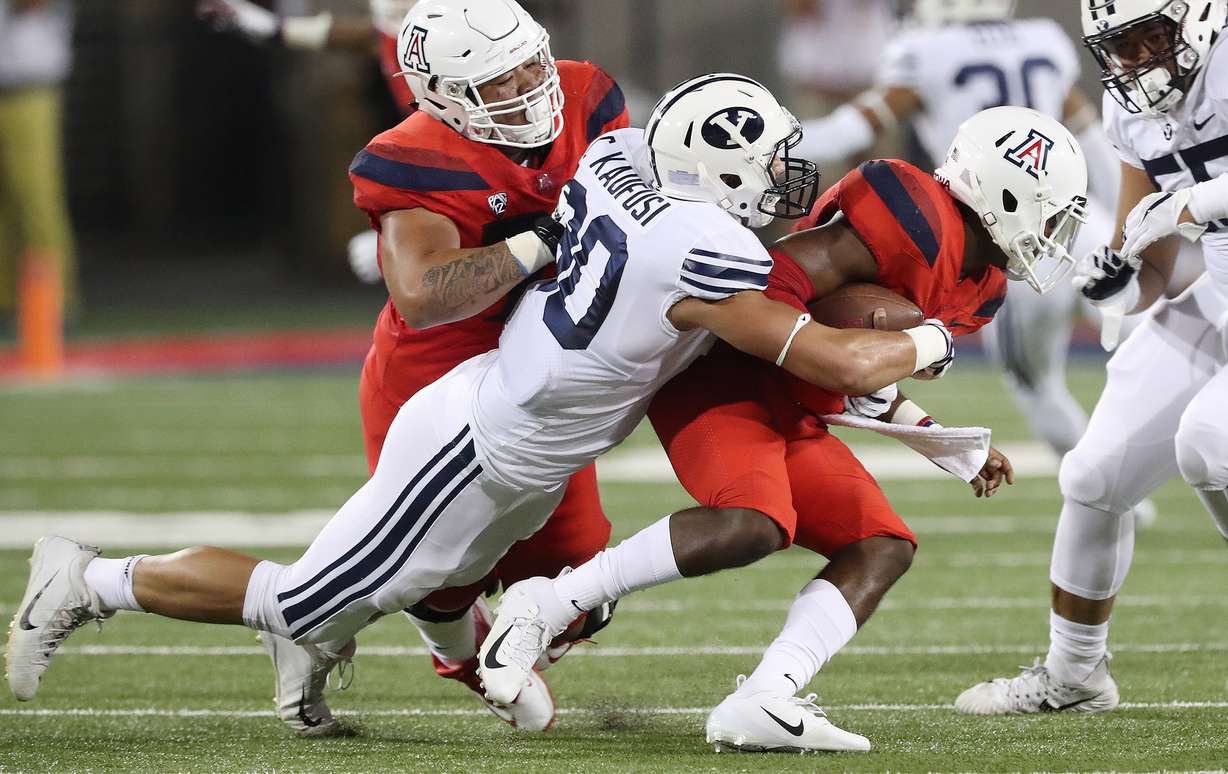
Defensive coordinator Ilaisa Tuiaki leaned on his own staff, drawing up a game plan that held Tate in check. The crew — led by the stout defensive line emboldened by Corbin Kaufusi and Khyris Tonga, among others — held Tate to just 14 yards rushing with one touchdown, daring the former breakout star to lead the Wildcats to a win with his arm.
Tate led a valiant comeback, but couldn’t make up the difference of BYU’s 21-0 third-quarter run that proved to be the fatal flaw. He only took one sack, by senior captain Corbin Kaufusi, but was rendered virtually mooted in his ability to make additional plays using his legs.
“We got good pressure by the defensive line all game,” linebacker Zayne Anderson said. “That really helped to flush it out, to contain the back.”
The lack of sacks and turnovers were one of the rare criticisms from Sitake, a former BYU fullback who made his name as a defensive coach before taking the head job at his alma mater in 2015.
But taken in the context of Arizona, the tradeoffs worked as well as can be expected.
“We wanted to create more turnovers on defense, so I’m frustrated,” Sitake said. “But I think this is just a different type of game where we really had to play it smart, and try to keep everything in front. I’ve seen teams be really aggressive on him, and then they miss him and give up a big touchdown.
“We picked our spots, and he just created more space in time.”