Estimated read time: 5-6 minutes
This archived news story is available only for your personal, non-commercial use. Information in the story may be outdated or superseded by additional information. Reading or replaying the story in its archived form does not constitute a republication of the story.
SALT LAKE CITY — Gary Andersen looks relaxed on the sidelines as he watches players battle it out in the first week of fall camp at the University of Utah.
The former head coach seems to be enjoying himself in what almost seems a spectator role following a departure from Oregon State, where he left approximately $12 million on the table when he resigned midseason last year. Now, he’s back at Utah as its associate head coach and enjoying every moment at his alma mater.
“It's great to be back home in Salt Lake City,” Andersen says with a smile. “I'm just happy every day to be here.”
For the past nine years, Andersen made his way through the head coaching ranks, stopping at Utah State, Wisconsin and finally at Oregon State. His defensive knack rubbed off on each program as he saw individual successes from each place he temporarily called home and grew to love — he even got a tattoo while at Utah State.
But home remains in Salt Lake and at the University of Utah specifically, where the 54-year-old coach once played from 1985-86 and coached from 1997-2008 (with one stop to Southern Utah in 2003). Salt Lake is where his three boys — Keegan, Chasen and Hagen — reside and where he recently found out he’s going to be a grandfather for the first time.
It’s also home to long-time friend Kyle Whittingham, who instantly jumped at the chance to hire back Andersen once the NCAA allowed for a 10th coach on staff. Andersen re-joined Utah on Jan. 2 and Whittingham has been grateful ever since.
“He's a great resource for me,” Whittingham said. “First and foremost, he's a great football coach — he's an outstanding coach. He can recruit, he has no weakness, he can do it all.”
But sharing an understanding of what it takes to be a head coach in a rigorous and high-pressured league, particularly in the shared understanding within the Pac-12, has been one of the most valuable aspects of the hiring for Whittingham.
“I think every head coach should have a former head coach on the staff because they're the only ones that can really relate to the chair you're in and what you're going through,” Whittingham added. Dennis Erickson, a former head coach at Miami and Arizona State, previously served in that role for Whittingham from 2013-16.
The benefit, Andersen says, is that “I know what he (Whittingham) stands for and it's exactly what I stand for, which makes things really good for me.
“It's been awesome to be in this position,” he added. “We've had a lot of success when we've been together, and hopefully we can continue to have that success.”
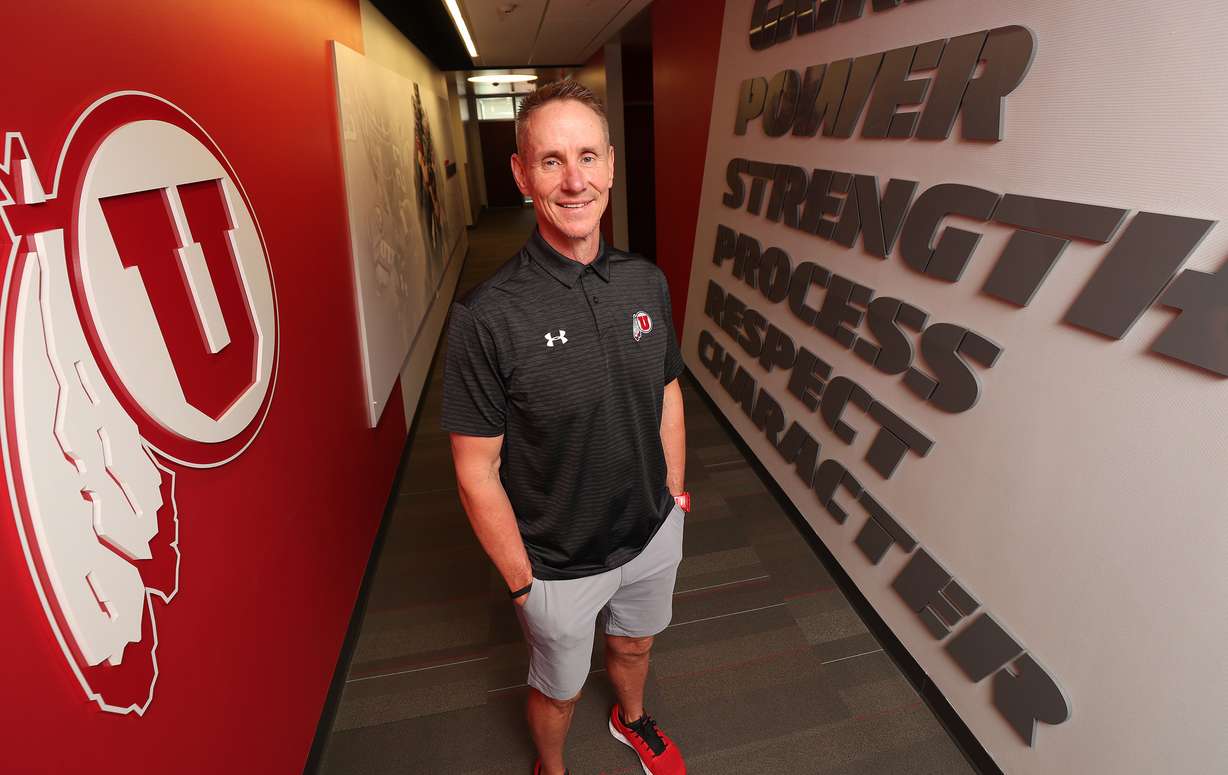
And although Andersen has been a head coach at two Power Five programs, he said he has “no agenda” coming into Utah. As a former defensive coordinator at Utah, he’s there to backup and enhance a defensive unit led by defensive coordinator Morgan Scalley, a former player of Andersen’s from 2001-04.
“My biggest agenda for them, personally, is to help them be as good as they can be,” Andersen said. “That's important for me.
“It's not as important as coaching the kids in the program, but it is definitely second to that,” he added. “I ain't got all the answers — in any way, shape or form, do I have all the answers. But it's about the kids in this program, like it always is, the way it should be, and it's awesome that I can see those guys on the field.”
Scalley said Andersen’s “experience” on the defensive side of the ball has been the greatest asset to having him back at Utah, particularly his knowledge of the defensive line, which he’s been charged to oversee alongside with Lewis Powell, who is also a former player of Andersen’s from 2001-03.
“I've never coached the defensive line,” Scalley said, having played and coached as a safety prior to his role as defensive coordinator. “So that's a tough deal. Coach Powell has been doing a heck of a job, but to add another set of eyes, have one d-line coach with your tackles and one with the defensive ends, just in terms of practice and what you're able to focus on in practice, is a big plus.”
At Utah, the defensive line has always been considered the bread and butter of a hard-nosed defense that preys on opponents; a unit that has sent numerous athletes to the NFL over the years. It's that prestigious history that Andersen hopes to preserve under his leadership at Utah.
“That carries a heavy tag with it, when you walk in that room, you're representing a lot of very, very talented players and the expectations is that you're a really good player if you're in that room and you get on the field,” he said. “They handle that, they understand those expectations.”
Andersen’s newfound role back with the defense even has Whittingham a little jealous, who said “that’s why you coach, to work with your own group or your own unit and be able to have your guys.” Whittingham, though, added that he’s grateful to keep his “little group of guys” on special teams.
But Andersen’s addition to the coaching staff can be summed up in his own words: “It’s been awesome.”