'%3e%3cpath%20d='M34.1406%205.85938C30.3906%202.10547%2025.3047%200%2020%200C14.6953%200%209.60938%202.10547%205.85938%205.85938C2.10938%209.61328%200%2014.6953%200%2020C0%2025.3047%202.10547%2030.3906%205.85938%2034.1406C9.61328%2037.8906%2014.6953%2040%2020%2040C25.3047%2040%2030.3906%2037.8945%2034.1406%2034.1406C37.8906%2030.3906%2040%2025.3047%2040%2020C40%2014.6953%2037.8945%209.60938%2034.1406%205.85938ZM37.0117%2023.543H31.1602V13.5391H27.6328V19.9414C28.1211%2020.6914%2028.3711%2021.582%2028.3711%2022.5625V22.625C28.3711%2023.668%2028.1172%2024.6055%2027.6328%2025.4297V26.6094H36.082C33.4883%2032.9375%2027.2891%2037.3789%2020.0039%2037.3789C10.3711%2037.3789%202.62109%2029.6289%202.62109%2020C2.62109%2010.3711%2010.3711%202.62109%2020%202.62109C29.6289%202.62109%2037.3789%2010.3711%2037.3789%2020C37.3789%2021.1484%2037.2617%2022.2656%2037.0508%2023.3477C37.0391%2023.4141%2037.0234%2023.4766%2037.0117%2023.543Z'%20fill='white'/%3e%3cpath%20d='M22.3086%2018.5352C20.4336%2018.125%2019.9531%2017.8398%2019.9766%2017.1836V17.1406C19.9766%2016.6992%2020.3477%2016.2148%2021.4023%2016.2148C22.582%2016.2148%2023.8867%2016.6797%2025.0781%2017.4766L26.8516%2015.0195C25.4453%2013.8906%2023.707%2013.3398%2021.5547%2013.3398C18.5195%2013.3398%2016.4375%2015%2016.4063%2017.4766V17.5352C16.3633%2020.2617%2018.5859%2020.9805%2021.293%2021.6016C23.0391%2021.9766%2023.5703%2022.3164%2023.5703%2022.9609L23.5469%2022.9766C23.5469%2023.3906%2023.2578%2023.7031%2022.7852%2023.8359C22.5742%2023.9062%2022.1289%2023.9727%2021.5156%2023.9727C20.7617%2023.9727%2019.7539%2023.8633%2018.6328%2023.4844C18.0898%2023.2891%2017.4727%2023.0039%2016.8047%2022.6133L20.1406%2026.625C20.2813%2026.6602%2021.0977%2026.8516%2021.7734%2026.8516C25.0039%2026.8516%2027.0859%2025.2461%2027.1094%2022.6328V22.5703C27.1602%2020.1133%2025.2148%2019.1719%2022.3086%2018.5352Z'%20fill='white'/%3e%3cpath%20d='M5.24219%2013.5664V26.6133H8.75391V23.7578L10.2969%2021.9531L14.2031%2026.6133H18.3867L12.3555%2019.5195L17.4023%2013.5664H13.4531L8.75391%2019.0586V13.5664H5.24219Z'%20fill='white'/%3e%3c/g%3e%3cdefs%3e%3cclipPath%20id='clip0_97_2430'%3e%3crect%20width='40'%20height='40'%20fill='white'/%3e%3c/clipPath%3e%3c/defs%3e%3c/svg%3e)


Estimated read time: 3-4 minutes
This archived news story is available only for your personal, non-commercial use. Information in the story may be outdated or superseded by additional information. Reading or replaying the story in its archived form does not constitute a republication of the story.
PROVO — For years, as the flag-bearer of two conferences, BYU played the role of a loyal family member and never flexed its muscles to make selfish demands.
Looking back, it's crazy to think the likes of Wyoming got the same financial benefits and exposure as BYU. The Cougars were the big dogs of the WAC and Mountain West and should have been treated as such.
In regard to the football team's most heated rival, the athletic administration needs to worry about No. 1 and forget everything else. Specifically, athletic director Tom Holmoe should forget about trying to fit Utah into BYU's football schedule.
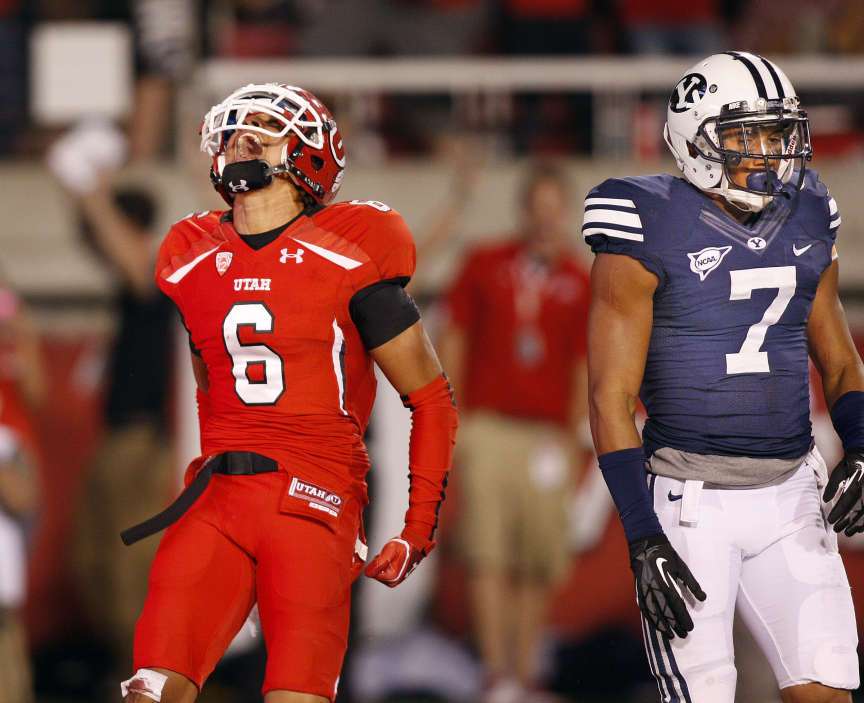
Speaking at an informal gathering with media members this month, Holmoe said it's hard to set up a series with the Utes. If that's the case, then bag it.
Athletic director Chris Hill fired the first hit at the rivalry last summer, announcing Utah had scheduled Michigan and therefore needed to put BYU on hold for the 2014 and 2015 seasons. One of the country's great rivalries has nothing scheduled beyond games this September and in 2016.
Maybe the time has come for one of Utah's great traditions to die a painful death for all eternity.
As a member of the Pac-12, Utah doesn't need to schedule BYU anymore. As far-fetched as it seems now, Utah's primary goals are to win the conference's South Division and play for a shot at the Rose Bowl. It serves no purpose for the Utes to waste all that energy and emotion to beat the Cougars early in the season only to get worked the next week in a conference game.
In turn, BYU doesn't need Utah anymore in order to further its goals. As a football independent with an ESPN contract, BYU can get big games with relative ease during the first month of the season.
#poll
"Our thoughts are that we would go a series at a time--home-and-home at a time," said Holmoe at the meeting with reporters. "It is hard to do series with them now."
If it's so hard, then quit wasting any more time on it. Holmoe's conversation with Hill ought to be simple, something along the lines of "Do you want to play the third week of September or not?"
Holmoe should give Hill and deadline of five minutes. If he needs more time, Holmoe then needs to hang up the telephone and move on.
"They're in a conference that has [scheduling] rules, and we're independent and we're scheduling [other games]," Holmoe said. "As I schedule out in the future and I have a chance to play Nebraska, I'm not going to go, ‘Wait a second, let me see [about Utah],' I'm going to get Nebraska. It makes it harder for us and them."
Without saying as much, Holmoe pointed the blame at Utah for taking the initial two-year break. Any big-name opponent BYU can get is going to demand a return game. And in some cases, BYU gets only one home game in exchange for two road games.

"If we hadn't have taken the two years off it would have been easier to slide them through," Holmoe said. "In that two-year hiatus, I started scheduling other games; you go home-and-home [with an opponent], and you've got to jump into that [following] year."
Nevertheless, Holmoe said, the series with Utah will continue to some degree. Neither athletic director wants it to end on his watch.
The problem is there might be an occasional season the game isn't played. And that's not good enough.
A rivalry the caliber of this doesn't need to be reduced to another series. Either schedule it every season - preferably the first week of the season - or send it the way of Texas/Texas A&M and Oklahoma/Nebraska, two great rivalry games that were killed by the outbreak of conference expansion.
If it goes away, maybe we'll all realize what we missed.