Estimated read time: 4-5 minutes
This archived news story is available only for your personal, non-commercial use. Information in the story may be outdated or superseded by additional information. Reading or replaying the story in its archived form does not constitute a republication of the story.
SALT LAKE CITY — As college athletic programs continue to hopscotch around the country searching for the most cash, the one distinction that differentiates the amateurs from the professionals has taken a huge hit.
Rivalries are generally fluid at the professional level, dependent upon the competitive state of each participant. Players naturally come and go, sometimes even before fans can save up enough money to buy their jerseys.
But college sports was thought to be different, a pure form that transcended any individuals.
Shep Talk:
Time to retire the rivalry
The only real reason to continue playing the game is because it has always been played. That isn't good enough anymore. Both BYU and Utah are in different circumstances now. The game no longer means anything other than state bragging rights.Not anymore.
Expansion and realignment has ruined some storied rivalries, under the guise of what's best for each school. And now it's hitting close to home.
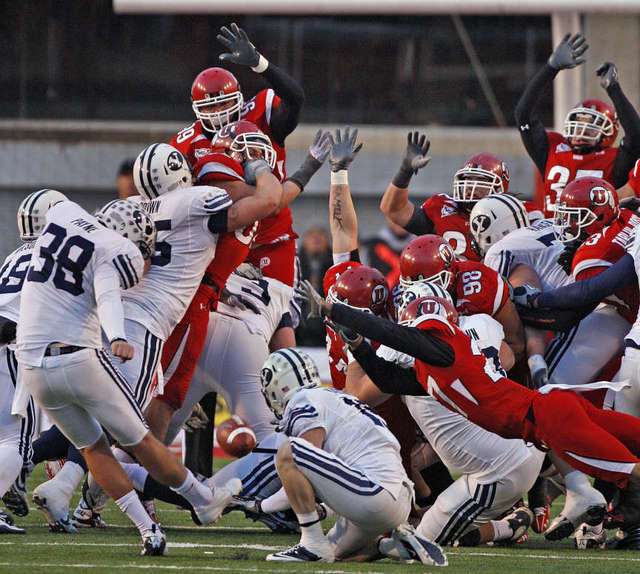
The state of Utah's best rivalry, the Utes vs. the Cougars, appears to be on the verge of extinction, at least as we know it.
Ain't that a shame?
Speaking to Yahoo! Sports two weeks ago, Utah football coach Kyle Whittingham sounded as if this season's game in September could be the last for a while. Based on his remarks, the grudge match could range from being played each year to periodically to not at all.
Anything less than annually isn't good enough.
"Bottom line is we've got to do what's best for our program," Whittingham told Yahoo's Graham Watson. "That supersedes anything to do with the rivalry. If taking a year or two off periodically is best for our program, best for our scheduling, then that's what we've got to do.
"Our program is bigger than the rivalry. That's got to take a backseat to us doing what's best for our program."
Our program is bigger than the rivalry. That's got to take a backseat to us doing what's best for our program.
–Kyle Whittingham
Ouch.
For all the beatdowns the Utes have administered to the Cougars in recent years, Whittingham's statement that Utah's program is bigger than the rivalry stings far worse for BYU than last season's 54-10 embarrassment at LaVell Edwards Stadium. Its one thing to be beat, but entirely another to be dismissed.
Upon reflection, Whittingham toned down the rhetoric during an interview with DJ and PK on 1280-AM. The former BYU linebacker insisted he's not anti-rivalry, saying he recognizes the excitement the game creates within the state.
"Saying our program is bigger than the rivalry was probably a poor choice of words," he said. "It's not the first time I've had a poor choice of words. I'm sure it won't be the last."
However, in the same interview, Whittingham made it a point to say he was not backing off the other statements. From their standpoint, the Utes aren't sure the schedule will permit an annual game with BYU.
Whittingham was also quick to point out any scheduling decisions don't rest entirely with him. He deflected authority to long-time athletic director Chris Hill and the university administration.
"I guess the thing I was trying to convey is the well- being of our program is more important than the uninterrupted continuation of the rivalry," Whittingham said. "That's pretty much the bottom line. We've got to do what's best for us."
To a borrow one of Whittingham's go-to phrases, the bottom line is Utah wants six home games each season. Ideally, the Utes would run out of the Rice-Eccles Stadium locker room seven times every year. In effect, Utah's desire to maximize the number of home games may freeze out BYU.
With the Pac-12 playing nine conference games, each team will alternate five home games one year and then four the following season. The conference also announced that it will phase in a Pac-12 vs. Big 10 series, with all teams playing a home-and-home series on a rotating basis.
In summary, Utah won't play BYU if it means not having enough home games in a particular season.
"The dynamics surrounding the game have changed dramatically," Whittingham said. "It's not the same animal as far as all the circumstances that both programs are under."
For 20 years, Utah was nothing more than afterthought for BYU, a break in the schedule that allowed the coaches to get a good look at the reserves. Now it appears one telephone call from Commissioner Larry Scott has put BYU at Utah's mercy.
BYU needs Utah on the schedule. But the Utes may not want - or even need - the Cougars anymore.
As long as we're talking, I'm confident. If it wasn't going to go, we wouldn't be talking.
–Tom Holmoe, BYU A.D.
"As long as we're talking, I'm confident," said BYU athletic director Tom Holmoe. "If it wasn't going to go, we wouldn't be talking."
The problem is he made those statements during a media session in April. Given what his old college teammate said in May, Holmoe may sing a different tune during the BYU football media day in three weeks.
Let's hope sanity prevails and both sides find a way continue playing the game each year. Utah's decision to join the Pac-12 was a no-brainer, as was BYU's move to independence in football, but dumping the rivalry is wrong.
If USC can figure out a way to play Notre Dame home-and- home each season, then BYU and Utah should do the same.