'%3e%3cpath%20d='M34.1406%205.85938C30.3906%202.10547%2025.3047%200%2020%200C14.6953%200%209.60938%202.10547%205.85938%205.85938C2.10938%209.61328%200%2014.6953%200%2020C0%2025.3047%202.10547%2030.3906%205.85938%2034.1406C9.61328%2037.8906%2014.6953%2040%2020%2040C25.3047%2040%2030.3906%2037.8945%2034.1406%2034.1406C37.8906%2030.3906%2040%2025.3047%2040%2020C40%2014.6953%2037.8945%209.60938%2034.1406%205.85938ZM37.0117%2023.543H31.1602V13.5391H27.6328V19.9414C28.1211%2020.6914%2028.3711%2021.582%2028.3711%2022.5625V22.625C28.3711%2023.668%2028.1172%2024.6055%2027.6328%2025.4297V26.6094H36.082C33.4883%2032.9375%2027.2891%2037.3789%2020.0039%2037.3789C10.3711%2037.3789%202.62109%2029.6289%202.62109%2020C2.62109%2010.3711%2010.3711%202.62109%2020%202.62109C29.6289%202.62109%2037.3789%2010.3711%2037.3789%2020C37.3789%2021.1484%2037.2617%2022.2656%2037.0508%2023.3477C37.0391%2023.4141%2037.0234%2023.4766%2037.0117%2023.543Z'%20fill='white'/%3e%3cpath%20d='M22.3086%2018.5352C20.4336%2018.125%2019.9531%2017.8398%2019.9766%2017.1836V17.1406C19.9766%2016.6992%2020.3477%2016.2148%2021.4023%2016.2148C22.582%2016.2148%2023.8867%2016.6797%2025.0781%2017.4766L26.8516%2015.0195C25.4453%2013.8906%2023.707%2013.3398%2021.5547%2013.3398C18.5195%2013.3398%2016.4375%2015%2016.4063%2017.4766V17.5352C16.3633%2020.2617%2018.5859%2020.9805%2021.293%2021.6016C23.0391%2021.9766%2023.5703%2022.3164%2023.5703%2022.9609L23.5469%2022.9766C23.5469%2023.3906%2023.2578%2023.7031%2022.7852%2023.8359C22.5742%2023.9062%2022.1289%2023.9727%2021.5156%2023.9727C20.7617%2023.9727%2019.7539%2023.8633%2018.6328%2023.4844C18.0898%2023.2891%2017.4727%2023.0039%2016.8047%2022.6133L20.1406%2026.625C20.2813%2026.6602%2021.0977%2026.8516%2021.7734%2026.8516C25.0039%2026.8516%2027.0859%2025.2461%2027.1094%2022.6328V22.5703C27.1602%2020.1133%2025.2148%2019.1719%2022.3086%2018.5352Z'%20fill='white'/%3e%3cpath%20d='M5.24219%2013.5664V26.6133H8.75391V23.7578L10.2969%2021.9531L14.2031%2026.6133H18.3867L12.3555%2019.5195L17.4023%2013.5664H13.4531L8.75391%2019.0586V13.5664H5.24219Z'%20fill='white'/%3e%3c/g%3e%3cdefs%3e%3cclipPath%20id='clip0_97_2430'%3e%3crect%20width='40'%20height='40'%20fill='white'/%3e%3c/clipPath%3e%3c/defs%3e%3c/svg%3e)




Estimated read time: 5-6 minutes
- John Green's book tour for "Hollywood, Ending" stopped in Salt Lake City.
- Green discussed the commodification of art and celebrity culture with fellow author Brandon Sanderson.
- He emphasized art's importance, encouraging creativity despite its vulnerabilities and challenges.
SALT LAKE CITY — John Green's newest novel is a "love letter to movies," but also highlights his concerns over the commodification of creative projects and the way private experiences of the humans in the spotlight are turned into public discourse.
"Hollywood, Ending" was released in September, and for the last few weeks, Green has traveled the country on a book tour. That tour made a stop in Salt Lake City on Saturday at West High. The event, hosted by The King's English Bookshop, included a special guest, a book reading, a chemistry reading, a visit with media ... and a song.
Green is best known for his young adult novels such as "The Fault in Our Stars," but "Hollywood, Ending" is the author's first adult novel. The book follows Kai Laramie and Juniper Castillo, two rising actors cast in a major biopic about Andy Warhol. The pair find their lives changing in major, exciting and unsettling ways as the movie brings them attention, fame and each other.
At many of his tour stops, Green has had special guests join him on stage. For Salt Lake City, fantasy author Brandon Sanderson joined him.
When introducing Sanderson, Green expressed excitement, adding, "I have many questions. Why did he say yes? Why is he so nice? Doesn't he have writing to do?"
Talking about his own work, Green said a very successful author once told him that "fame is the worst good thing that ever happened to me." He said that he found that idea interesting because he doesn't see fame as a bad thing, but it also isn't "the best of the good things."
He said he wrote "Hollywood, Ending" about celebrity culture and the machine that commodifies human experience even against the will of those experiencing it.
"So the characters in this novel have to navigate this machine that turns human experience, especially trauma, into movie tickets."
Art is essential to the human experience
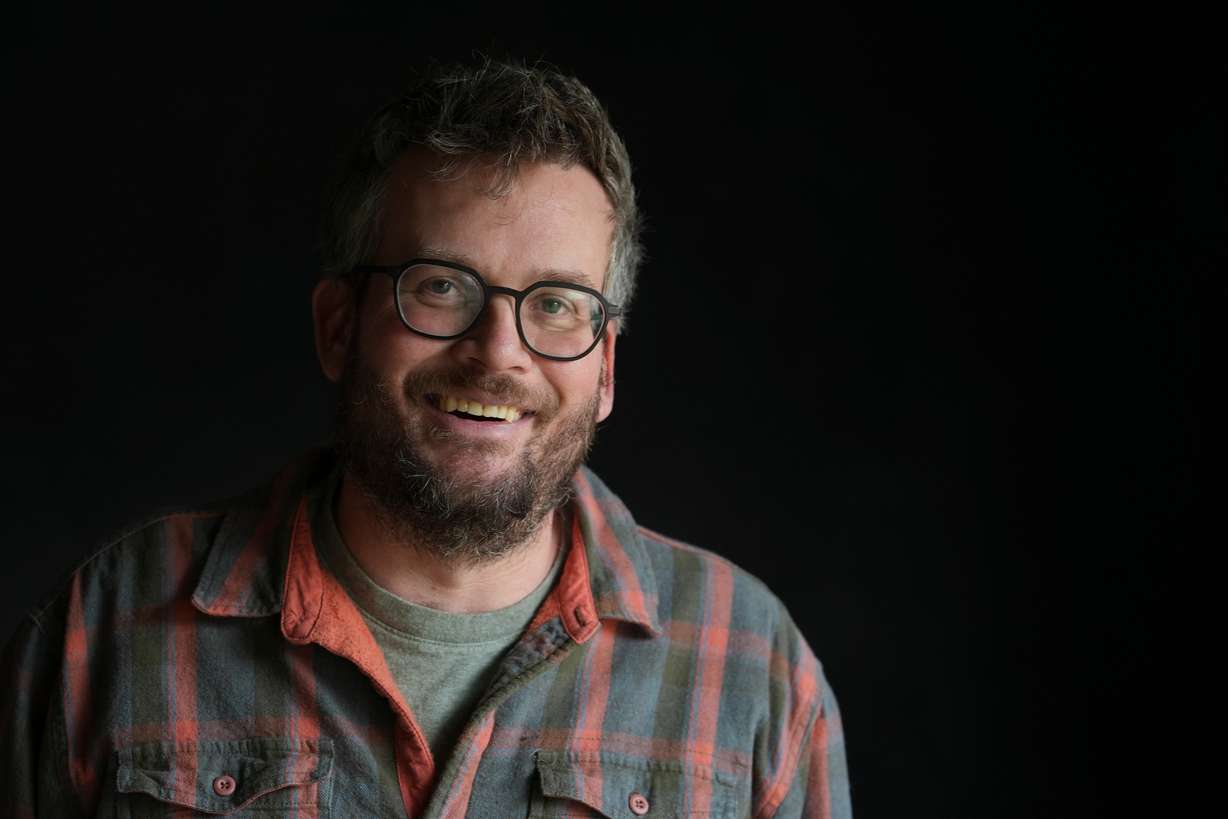
"Art is not optional for humans. We made it before we had a caloric surplus or specialization of labor, and we will make it the entire time we are here, and it will be made by us, by humans," Green said. "Art is essential to the human experience."
Green shared that as he wrote "Hollywood, Ending," he realized he was also writing about how we find loving relationships to sustain us.
"I think we find that love, or at least I've found it, partly through sharing experiences with art," he added.
He encouraged people to go with a friend to a museum, a gallery or even a movie theater, or any other place where you can experience art together.
Green also made a plea asking the audience to make art and encourage others to make it despite the cost, because when we share that art, "maybe just one rare and exceptional someone will receive the gift of your art with generosity and care."
He said that as he writes, he has to trust that the reader will read generously, and because of that, it's worth it to him.
No one should shy away from making and sharing art because every human voice matters and that's why we make art.
"Thank you for making and sharing stuff. I know it makes you vulnerable. I know it can hurt. But I'm grateful to you for doing it anyway."
Working with Hollywood and the machine
"I've been really blessed in Hollywood in a lot of ways. I've really liked a lot of the adaptations of my work, and I'm lucky to have adaptations at all."
He shared that he is concerned with the machine behind the commodification of art and private life. He said this no longer just impacts actors and those in Hollywood, but everyone is now involved in this exchange.
"It really does freak me out that we don't have the line between the personal and the public that we used to have," Green said.
Art is not optional for humans. We made it before we had a caloric surplus or specialization of labor, and we will make it the entire time we are here, and it will be made by us, by humans,
–John Green
Green talked about Andy Warhol, a focus of "Hollywood, Ending," and how, despite being a world-famous artist, he lived a very private life.
"He had a private life, and that is a luxury that is really no longer afforded to most celebrities, including, on some level, even writers," Green said.
Green highlighted how in his book, "Turtles All the Way Down," he touched on a lot of his own personal struggle with obsessive-compulsive disorder and how sharing that part of him with the public was difficult but also rewarding.
"There was a real cost to talking about my OCD. It makes me feel exposed and vulnerable and more than a little scared," he said.
He continued: "There is also a benefit to talking about it, of course. Lots of people have come up to me and said that my talking about my mental illness has helped them feel less alone in theirs, which in turn has helped me feel less alone in my own."
The discussion between Sanderson and Green focused a lot on working with Hollywood, the behind-the-scenes of putting your art out there, and the machine behind the commercialization of art.
While Sanderson is currently working on the first adaptations of his books, Green has had multiple of his books adapted for the screen: "The Fault in Our Stars," "Turtles All the Way Down," "Looking for Alaska" and "Paper Towns."
Sanderson highlighted how Green keeps hopefulness in his books despite covering dark and hard content. He said that it is almost easier to do that in fantasy because you can take the real world away while still making the characters real.
"The real world not being there just makes it more endurable," Sanderson said. "You are able to navigate positive hopefulness with some real darkness."
Green said that he always wants his books to be hopeful.
"I really believe that true stories are hopeful stories," Green said. "And not all hopeful stories are true, but all true stories are hopeful. And I really believe that."
He ended the event by having the audience sing the song "We're Here Because We're Here," which originated as a trench song in World War I.