Estimated read time: 2-3 minutes
This archived news story is available only for your personal, non-commercial use. Information in the story may be outdated or superseded by additional information. Reading or replaying the story in its archived form does not constitute a republication of the story.
Dr. Kim Mulvihill Reporting A severely disabled nine-year-old girl can't walk, talk or eat. So, her parents decided to keep her small, to keep her in the body of a 9-year-old for the rest of her life.
Their choice has sparked an international ethics debate. Her doctors say severe brain damage at birth left the girl in an infant state, unable to sit up, roll over or hold a toy.
The case became public this week when doctors described her treatment in the Archives of Pediatrics & Adolescent Medicine. It involved her parents' decision to remove her uterus and breast tissue as well as giving large doses of hormones to halt her growth.
These photos of Ashley were made public on her family's website this week, when they decided to tell their side of the story. We don't know her last name or who her family is. But we do know that the 9-year-old suffers from what's called static encephalopathy.
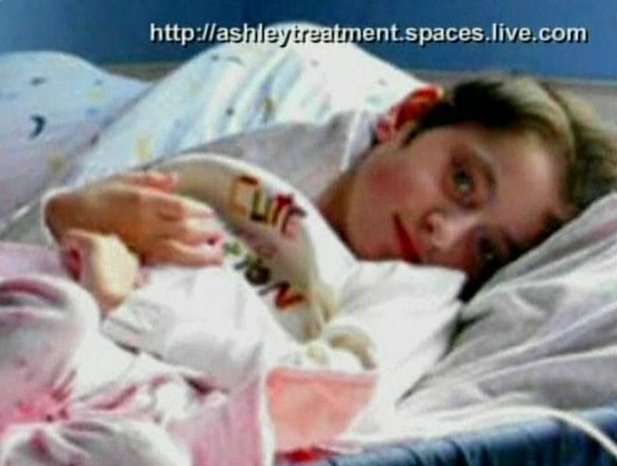
She can't walk or talk or do anything for herself - and never will. So her parents made the unusual decision to stop her growth. And now, biomedical ethicists around the world are weighing in on what appears to be an unprecedented case.
Dr. Benjamin Wilfond, Seattle Children's Hospital: "Initially I was a little startled."
Dr. Michael Kalichman, University of California San Diego: "This is entirely new territory.."
Doctors at Seattle's Children's Hospital gave her high doses of estrogen ensured to keep her at four foot five and about 75 pounds for the rest of her life. And they removed her uterus and breast buds so she'll never menstruate or develop breasts. The surgeries were performed in 2004, but it wasn't revealed to the public until recently.
Dr. Michael Kalichman: "The parents really had two choices in front of them - one was to keep the child at home if she remained small - or to institutionalize the child because they couldn't take care of her anymore."
Some ethicists sympathize with the parents. But some call it a slippery slope that is sure to spark a national debate much like the case of Terry Schiavo.
Dr. Benjamin Wilfond: "I think each case needs to be looked at very specifically and very individually so it's very difficult to say what an individual family might decide depending on the circumstances of the child."
Ashley's parents have declined all interview requests.
Ashley's doctors said without the treatment, she likely would have grown to five feet six inches tall, and weigh 125 pounds.