'%3e%3cpath%20d='M34.1406%205.85938C30.3906%202.10547%2025.3047%200%2020%200C14.6953%200%209.60938%202.10547%205.85938%205.85938C2.10938%209.61328%200%2014.6953%200%2020C0%2025.3047%202.10547%2030.3906%205.85938%2034.1406C9.61328%2037.8906%2014.6953%2040%2020%2040C25.3047%2040%2030.3906%2037.8945%2034.1406%2034.1406C37.8906%2030.3906%2040%2025.3047%2040%2020C40%2014.6953%2037.8945%209.60938%2034.1406%205.85938ZM37.0117%2023.543H31.1602V13.5391H27.6328V19.9414C28.1211%2020.6914%2028.3711%2021.582%2028.3711%2022.5625V22.625C28.3711%2023.668%2028.1172%2024.6055%2027.6328%2025.4297V26.6094H36.082C33.4883%2032.9375%2027.2891%2037.3789%2020.0039%2037.3789C10.3711%2037.3789%202.62109%2029.6289%202.62109%2020C2.62109%2010.3711%2010.3711%202.62109%2020%202.62109C29.6289%202.62109%2037.3789%2010.3711%2037.3789%2020C37.3789%2021.1484%2037.2617%2022.2656%2037.0508%2023.3477C37.0391%2023.4141%2037.0234%2023.4766%2037.0117%2023.543Z'%20fill='white'/%3e%3cpath%20d='M22.3086%2018.5352C20.4336%2018.125%2019.9531%2017.8398%2019.9766%2017.1836V17.1406C19.9766%2016.6992%2020.3477%2016.2148%2021.4023%2016.2148C22.582%2016.2148%2023.8867%2016.6797%2025.0781%2017.4766L26.8516%2015.0195C25.4453%2013.8906%2023.707%2013.3398%2021.5547%2013.3398C18.5195%2013.3398%2016.4375%2015%2016.4063%2017.4766V17.5352C16.3633%2020.2617%2018.5859%2020.9805%2021.293%2021.6016C23.0391%2021.9766%2023.5703%2022.3164%2023.5703%2022.9609L23.5469%2022.9766C23.5469%2023.3906%2023.2578%2023.7031%2022.7852%2023.8359C22.5742%2023.9062%2022.1289%2023.9727%2021.5156%2023.9727C20.7617%2023.9727%2019.7539%2023.8633%2018.6328%2023.4844C18.0898%2023.2891%2017.4727%2023.0039%2016.8047%2022.6133L20.1406%2026.625C20.2813%2026.6602%2021.0977%2026.8516%2021.7734%2026.8516C25.0039%2026.8516%2027.0859%2025.2461%2027.1094%2022.6328V22.5703C27.1602%2020.1133%2025.2148%2019.1719%2022.3086%2018.5352Z'%20fill='white'/%3e%3cpath%20d='M5.24219%2013.5664V26.6133H8.75391V23.7578L10.2969%2021.9531L14.2031%2026.6133H18.3867L12.3555%2019.5195L17.4023%2013.5664H13.4531L8.75391%2019.0586V13.5664H5.24219Z'%20fill='white'/%3e%3c/g%3e%3cdefs%3e%3cclipPath%20id='clip0_97_2430'%3e%3crect%20width='40'%20height='40'%20fill='white'/%3e%3c/clipPath%3e%3c/defs%3e%3c/svg%3e)




- Noah Kahan's Utah tour stop featured local talent, including the impacts of vocal coach Mindy Pack.
- Pack, known for her work with top talent, aims to boost opportunities for local talent.
- Musicians like Candido Abeyta highlight Utah's growing opportunities beyond traditional academic settings.
SANDY — Noah Kahan fans in Utah rattled the state's seismology report and social media algorithms last week, as "The Great Divide Tour" stopped at a sold-out America First Field.
A crowd of 25,000 wore their love for the popular folk-pop artist, and whether they knew it or not, their friends from "Small Lake City" were among the focal talent who brought it together.
Celebrity vocal coach Mindy Pack, who serves Kahan and many others well-known in the music industry, lives just neighborhoods away from last Tuesday's tour stop.
"I have yet to have one artist say that Utah isn't a great crowd," she said of her clientele — a long list that along with Kahan includes the likes of Miley Cyrus, Justin Timberlake and Sabrina Carpenter, among others.
As a girl from Salt Lake City who "gets to do all this," Pack was seemingly not totally immune to the "imposter syndrome" feeling, but carried herself assuredly. One of her missions as a coach, she said, was to bring more of the industry back to her home.
Pack described an instance in which Timberlake's horn section, the Regiment Horns, came to workshop with high schoolers in Utah for a fundraiser she organized. Her love for her community drove her to compile a list of some of the state's best horn players for the horn section in Kahan's show last week.
'Salt Lake City's own'
Candido Abeyta, Kahan's saxophone soloist at the Salt Lake show, was hired first. "We had four days to learn the music and have it memorized," he said. "By the time they had contacted me, it was like, yeah, it was coming down to the wire."
Along with regular gigs and sessions, Abeyta runs the middle-school music program at Hawthorn Academy in West Jordan. He said he'd recently taken over the program and, as a result, class numbers dropped — understandably, as doubtful students missed their old teacher. Ahead of Tuesday's performance, he sprung the news on them with a sly whiteboard note he left in his absence: He'd be gone that day to play a show with Kahan.
One student wrote a message back: "Wait ... really?"
"After this last school year, now, all those kids that left are coming back," he said, adding that others attempted to transfer after Kahan's show. "I'm grateful they're coming back. I tell them, like I had one girl who was like, 'I'm sorry I dropped out last year,' and I said, 'You know what? I'm happy you're here,' I said. 'I'm just happy you're here now.'"
Trumpeter Tom Young and trombonist Marcus Anderson were longtime colleagues of Abeyta's and similarly spend their lives juggling stage work and teaching — Young as a private teacher and adjunct at the University of Utah, and Anderson at Waterford School in Sandy. Both described the opportunity to play with Kahan as a career highlight.
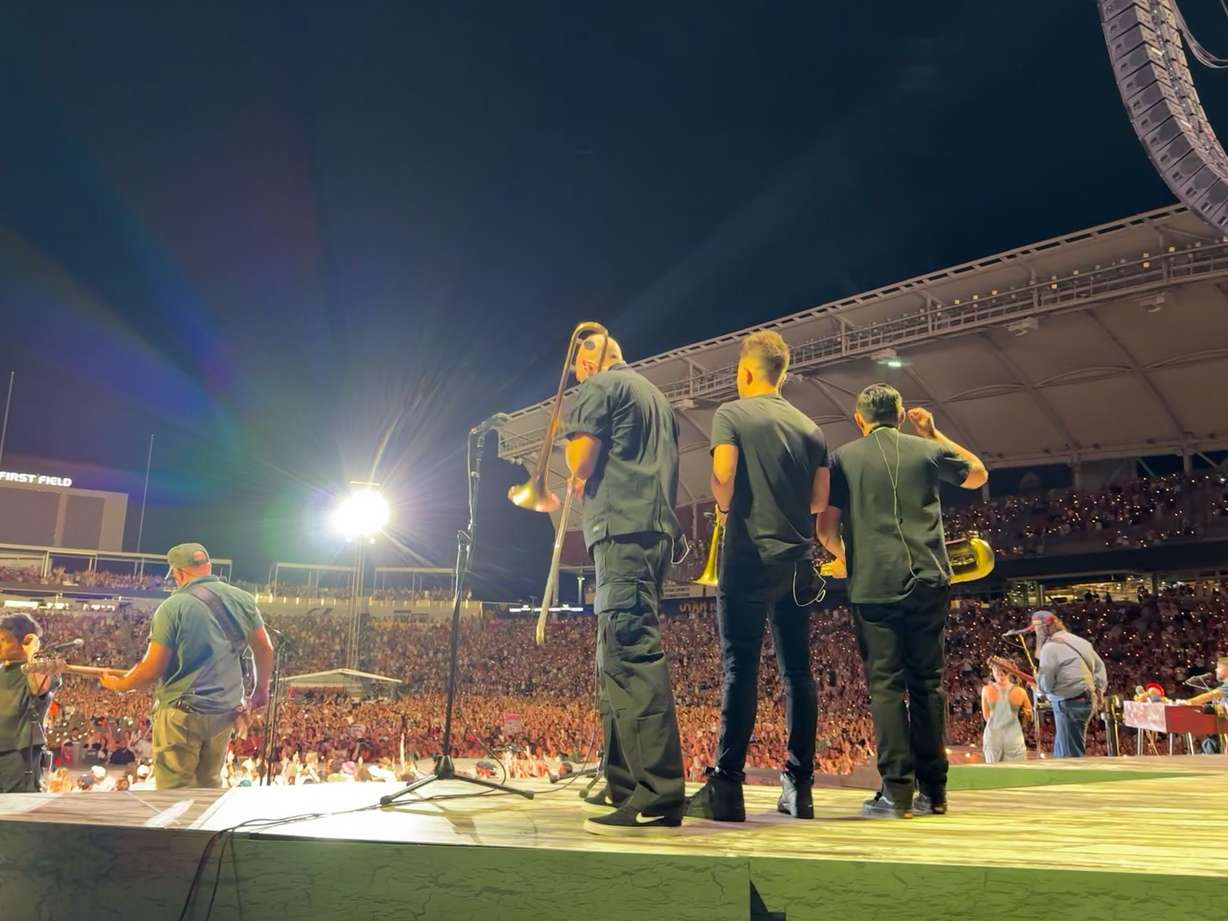
Young said the crowd at America First Field was really reactive — "a testament to Noah's music."
"I think it just really connects with people, and it was an expensive ticket, too. So people were willing to pay that to go feel something," he said. "So being able to like play that music to them, to be a part of it — I think that's why it was kind of so magical."
The magic was also in the crowd for Anderson.
"The biggest part of this was I was able to give my wife a ticket," he said. "She's been a Noah Kahan fan for a while ... and when I got the call, I was more excited to tell her, and my first thought was like, 'Oh, I gotta find a way to get her to the show.'"
Anderson also had other connections in the audience he didn't even know about. One parent left a comment on Instagram: "I was there and took video to show (my son) 'how awesome a trombone player with Noah could be you one day.' Fast forward to seeing this video and find out it's his teacher!! Made it even more awesome, Congratulations you guys killed it!"
The Salt Lake industry standard
Pack agrees that Utah's music industry has not always been the easiest to break into but strongly believes careers for musicians exist beyond teaching and in traditional academic settings. She described her time studying at the University of Utah and noted that opportunities in Salt Lake's music industry have grown since then, but it doesn't mean the industry's current climate is perfect, either. For starters, Pack said she hopes to see more evolution.
"The academic setting is really interesting for somebody who wants to be in the music industry as a vocalist, because (of) the schooling programs here. It's like baroque theory," she said. "It's all the stuff that does not translate in the industry. The classes that translate to our music business market are like PR training, (choreography) dancing."
As an adjunct for two years at Utah Valley University's more contemporary music program, Pack said the effort is on the upswing, but the state needs more.
"There are still some really amazing classes. But still because of the rigidity of like what you have to take for accreditation, which I can totally respect and understand," she said, "but as far as like, industry training? It's hard."
Abeyta echoed Pack's sentiments — he and his colleagues consider themselves "pop musicians," even though all of them hold degrees in jazz.
"I am specifically a pop musician and not a jazz musician or a classical musician," he said. "And I always tell students when I was in college that everybody was either classical or jazz and there was nobody that was in the middle. So that's where I was like, 'This is a good opportunity to try to do the individual stuff.'"
Regardless of the way they got here — a degree that doesn't tell the full story of what they do today, or years spent playing in a ska band — Abeyta said the secret to making a career out of it was all in the mindset.
"If you're open-minded and able to learn? People are going to hire you," he said. "Like, that's really it."