Estimated read time: 4-5 minutes
When Melissa Buehler's teeth were failing, her dentist told her All-on-4 was her only option. While she hated the idea of a permanent denture in her mouth, she believed it was the only choice left. Just a day before her scheduled treatment, she saw an ad for a different kind of procedure.
"It was what I had dreamed of; just replacing my broken teeth without a denture. I called and cancelled my appointment and got my deposit back."
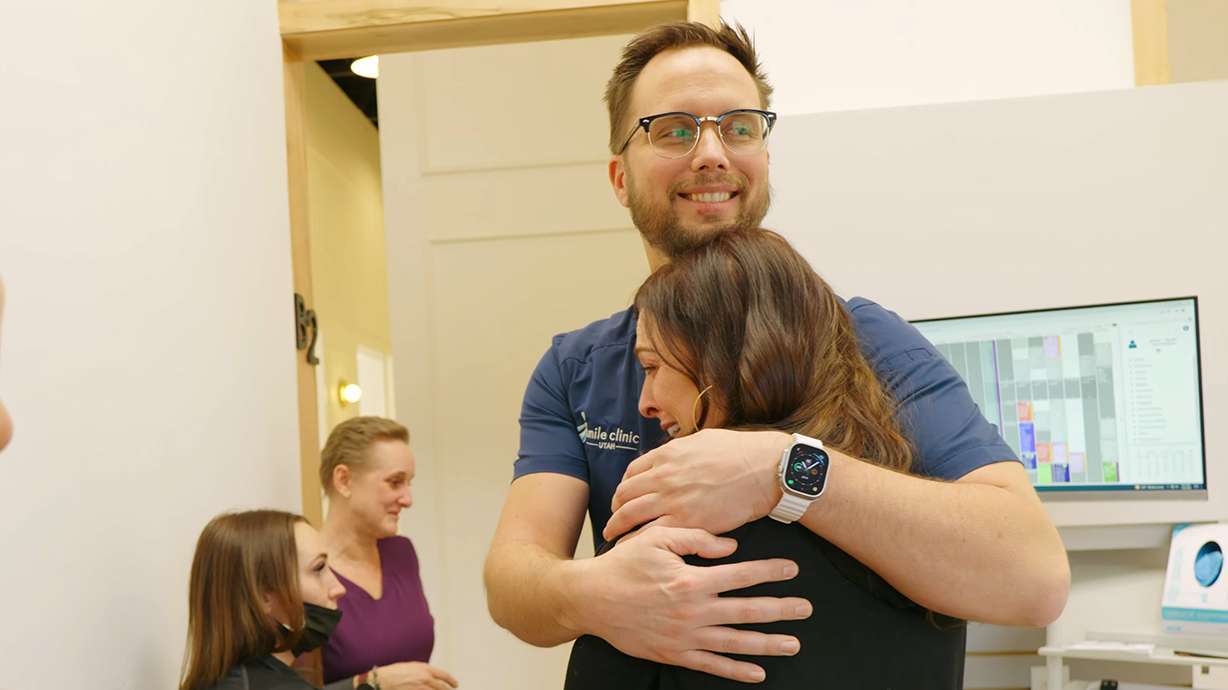
Melissa called the number from the ad and booked a consultation with Dr. Randy Roberts of Smile Clinic in Midvale. He explained to her the 3 on 6 procedure and why it was a far better option for her than the All-on-4. Four years later, she believes it was one of the best decisions she's ever made.
"I love my teeth now," Melissa says. "They look and feel like my real teeth. I am so lucky I discovered the 3 on 6 before they removed all the bone out of my mouth."
For those evaluating options, entering a consultation with specific questions can help clarify the long-term trade-offs of different procedures. According to Melissa, too many patients don't know what the compromises are until after the irreversible treatment has been done.
"You need to ask questions. There are a lot of things they won't tell you if you don't know what to ask," Melissa says.
1. Will you need to shave down my natural jawbone?
In many standard All-on-X procedures, a process called alveoloplasty is required. Because the traditional full-arch prosthetic is a thick appliance that features artificial pink acrylic or zirconia to mimic the gums, the dentist must often shave down perfectly healthy jawbone to create enough vertical space for the prosthetic to sit without looking bulky. This is an uncomfortable topic that dentists often avoid bringing up.

Alternative options, such as the Utah-developed 3 on 6 protocol, take a different approach. The 3 on 6 utilizes six implants to support three separate, segmented bridges that sit directly against the patient's natural gum line. This eliminates the need for bone reduction entirely, replacing only the missing teeth while preserving the existing bone architecture.
2. Will I have fake gums against my real gums?
Even though All-on-X is a permanent, implant-supported solution, its physical footprint inside the mouth is structurally similar to a fixed denture. The presence of the artificial pink flange can feel bulky to the tongue, alter natural speech patterns, and trap food which can breed bacteria and lead to chronic bad breath.
Patients looking for a true "tooth-only" replacement often look toward segmented systems. Because the 3 on 6 system uses separate bridges with no artificial gum material, the palate remains entirely open and the teeth match the natural profile of the jawline, eliminating the bulky "mouthful" sensation.

3. If the prosthetic is damaged, does the entire appliance need to be replaced?
Because dental prosthetics endure thousands of pounds of chewing pressure daily, material wear, chipping, or cracking can occur over time. In a traditional All-on-X configuration, the entire upper or lower smile is a single, continuous piece of zirconia or porcelain.
If a single tooth chips or a fracture occurs in the back of the mouth, the entire multi-thousand-dollar appliance must be removed, sent back to a dental laboratory for repair, or completely remade — leaving the patient without teeth during the process.
By contrast, the 3 on 6 protocol distributes the smile across three independent, segmented bridges. If a section faces accidental damage or wear years down the road, only that specific, localized bridge needs to be removed and repaired. The cost is minor and often covered by the dentist, and a bridge can be replaced in a single appointment. This prevents a minor chip from turning into a costly, full-mouth reconstruction.
4. What does the daily cleaning and annual maintenance look like?
Traditional All-on-4 creates a continuous, solid barrier over the gums, which can result in "food traps" underneath the prosthetic. Maintaining oral hygiene requires specialized threaders and water flossers. In addition, patients should have annual clinic visits where the dentist physically unscrews the entire appliance to clean underneath it. Unfortunately, these cleanings are much more expensive and time intensive than standard cleanings.
Because 3 on 6 bridges maintain natural spacing and pathways, the daily hygiene routine feels highly familiar to patients. Cleaning involves standard brushing and flossing without a complex technical learning curve, which helps minimize the risk of peri-implantitis — an inflammatory condition around implants that can lead to bone loss.
In addition, 3 on 6 bridges never have to be removed for cleaning, making the long-term maintenance much more affordable.

Free second opinions in Utah
While All-on-4 remains a valuable and necessary treatment path for individuals who have already experienced extreme bone degradation, patients with viable jawbone structure are increasingly seeking out conservative alternatives that prioritize bone preservation.
As the pioneer and original developer of the 3 on 6 protocol, Smile Clinic in Midvale serves as an educational resource and training center for providers nationwide. The clinic offers free comprehensive evaluations and second opinions to help patients understand which engineering approach aligns best with their long-term oral health goals.
Individuals interested in exploring full-mouth restoration options or comparing treatment plans can schedule a complimentary consultation by visiting the Smile Clinic website or by calling the Midvale office directly at (385) 406-3488.