'%3e%3cpath%20d='M34.1406%205.85938C30.3906%202.10547%2025.3047%200%2020%200C14.6953%200%209.60938%202.10547%205.85938%205.85938C2.10938%209.61328%200%2014.6953%200%2020C0%2025.3047%202.10547%2030.3906%205.85938%2034.1406C9.61328%2037.8906%2014.6953%2040%2020%2040C25.3047%2040%2030.3906%2037.8945%2034.1406%2034.1406C37.8906%2030.3906%2040%2025.3047%2040%2020C40%2014.6953%2037.8945%209.60938%2034.1406%205.85938ZM37.0117%2023.543H31.1602V13.5391H27.6328V19.9414C28.1211%2020.6914%2028.3711%2021.582%2028.3711%2022.5625V22.625C28.3711%2023.668%2028.1172%2024.6055%2027.6328%2025.4297V26.6094H36.082C33.4883%2032.9375%2027.2891%2037.3789%2020.0039%2037.3789C10.3711%2037.3789%202.62109%2029.6289%202.62109%2020C2.62109%2010.3711%2010.3711%202.62109%2020%202.62109C29.6289%202.62109%2037.3789%2010.3711%2037.3789%2020C37.3789%2021.1484%2037.2617%2022.2656%2037.0508%2023.3477C37.0391%2023.4141%2037.0234%2023.4766%2037.0117%2023.543Z'%20fill='white'/%3e%3cpath%20d='M22.3086%2018.5352C20.4336%2018.125%2019.9531%2017.8398%2019.9766%2017.1836V17.1406C19.9766%2016.6992%2020.3477%2016.2148%2021.4023%2016.2148C22.582%2016.2148%2023.8867%2016.6797%2025.0781%2017.4766L26.8516%2015.0195C25.4453%2013.8906%2023.707%2013.3398%2021.5547%2013.3398C18.5195%2013.3398%2016.4375%2015%2016.4063%2017.4766V17.5352C16.3633%2020.2617%2018.5859%2020.9805%2021.293%2021.6016C23.0391%2021.9766%2023.5703%2022.3164%2023.5703%2022.9609L23.5469%2022.9766C23.5469%2023.3906%2023.2578%2023.7031%2022.7852%2023.8359C22.5742%2023.9062%2022.1289%2023.9727%2021.5156%2023.9727C20.7617%2023.9727%2019.7539%2023.8633%2018.6328%2023.4844C18.0898%2023.2891%2017.4727%2023.0039%2016.8047%2022.6133L20.1406%2026.625C20.2813%2026.6602%2021.0977%2026.8516%2021.7734%2026.8516C25.0039%2026.8516%2027.0859%2025.2461%2027.1094%2022.6328V22.5703C27.1602%2020.1133%2025.2148%2019.1719%2022.3086%2018.5352Z'%20fill='white'/%3e%3cpath%20d='M5.24219%2013.5664V26.6133H8.75391V23.7578L10.2969%2021.9531L14.2031%2026.6133H18.3867L12.3555%2019.5195L17.4023%2013.5664H13.4531L8.75391%2019.0586V13.5664H5.24219Z'%20fill='white'/%3e%3c/g%3e%3cdefs%3e%3cclipPath%20id='clip0_97_2430'%3e%3crect%20width='40'%20height='40'%20fill='white'/%3e%3c/clipPath%3e%3c/defs%3e%3c/svg%3e)


Estimated read time: 5-6 minutes
This archived news story is available only for your personal, non-commercial use. Information in the story may be outdated or superseded by additional information. Reading or replaying the story in its archived form does not constitute a republication of the story.
TOKYO — At least four people have died in Japan's Ishikawa prefecture following a 7.5 magnitude earthquake that struck Japan on Monday, according to local authorities.
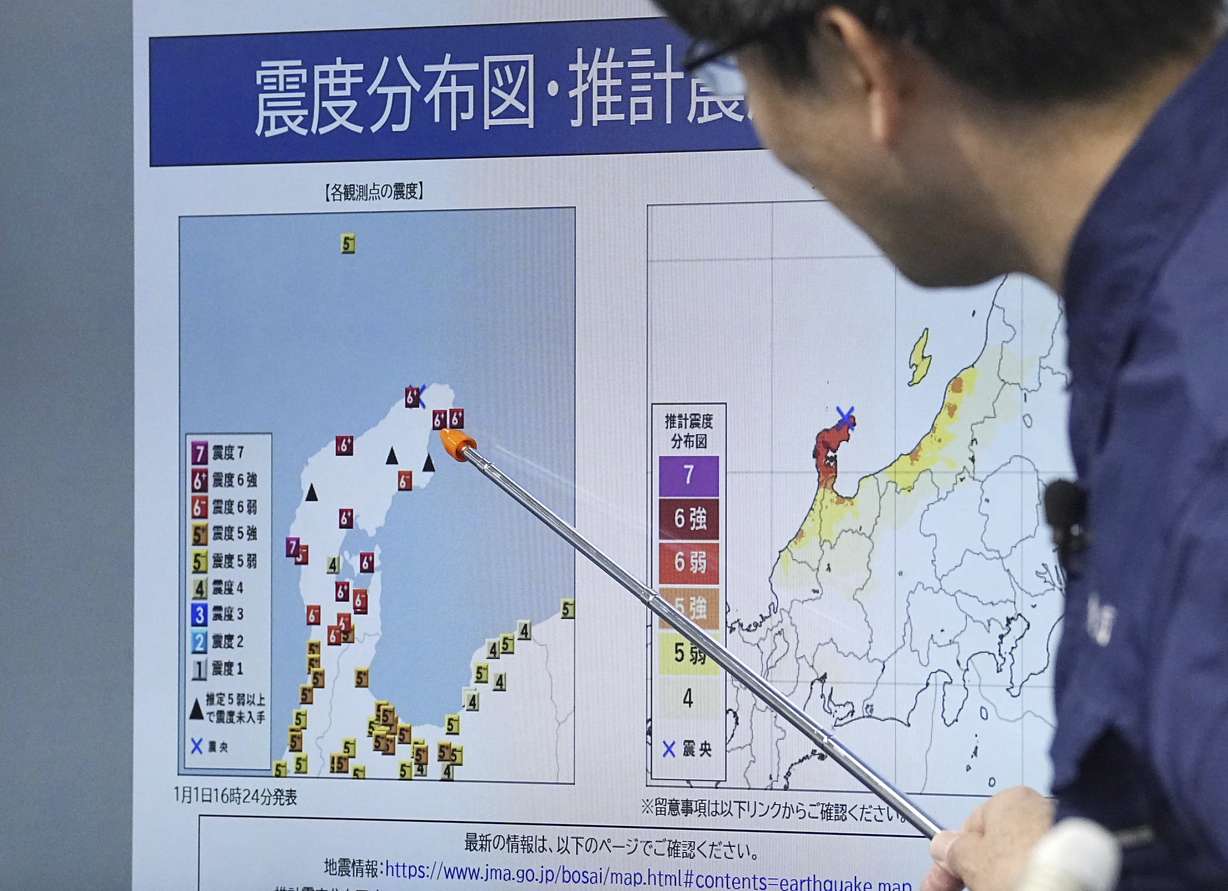
The earthquake struck at 4:10 p.m. local time at a depth of 10 kilometers (6 miles), around 42 kilometers (26 miles) northeast of Anamizu in Ishikawa prefecture, according to the United States Geological Survey.
Two people are also reported to have been seriously injured by the quake, officials said.
The Japan Meteorological Agency immediately issued a tsunami warning along coastal regions of western Japan, and the first waves were reported hitting the coast just over 10 minutes later.
Some of the first reports came from the city of Wajima in Ishikawa prefecture, which saw tsunami waves of around 1.2 meters (3.9 feet) around 4:21 p.m., according to Japanese public broadcaster NHK. No immediate damage was reported.
The tsunami warnings along portions of Japan's western coast were later canceled as the threat of additional large waves diminished.
While the threat of larger waves has now passed, tsunami advisories for waves up to 1 meter (about 3 feet) remain in effect.
Suzu city officials in Ishikawa told CNN that buildings have been damaged and there were reports of injuries. Police in the city said some people were trapped in damaged houses, according to NHK.
A major tsunami warning was in place in the city of Noto in Ishikawa, with waves of around 5 meters (16.4 feet) expected, according to the Japan Meteorological Agency.
It was the first major tsunami warning to be issued since 2011, according to a spokesman from Ishikawa prefecture's disaster management agency.
Under Japan's tsunami warning system, waves expected less than 1 meter (3.2 feet) fall under "tsunami advisory," while those expected above 3 meters (9.8 feet) fall under "tsunami warning" and waves expected above 5 meters fall under "major tsunami warning."
In a televised address earlier, Japan's Chief Cabinet Secretary Yoshimasa Hayashi urged people living in areas under tsunami warnings to evacuate to higher ground.
Footage from NHK showed cameras shaking vigorously as waves slammed into the coastline when the quake hit Ishikawa prefecture.
Houses were also rocked by the earthquake, with images showing collapsed roofs and shaken foundations.
Some services of Japan's Shinkansen bullet trains were suspended.
Four bullet trains that came to a halt between the cities of Toyama and Kanazawa in Japan's Ishikawa prefecture during Monday's powerful earthquake remained at a standstill on Tuesday local time.
Japan's public broadcaster NHK, citing Japan Railways West, reported that nearly 1,400 passengers continued to be stranded inside the immobile high-speed trains more than 10 hours since the powerful tremor shook the region.
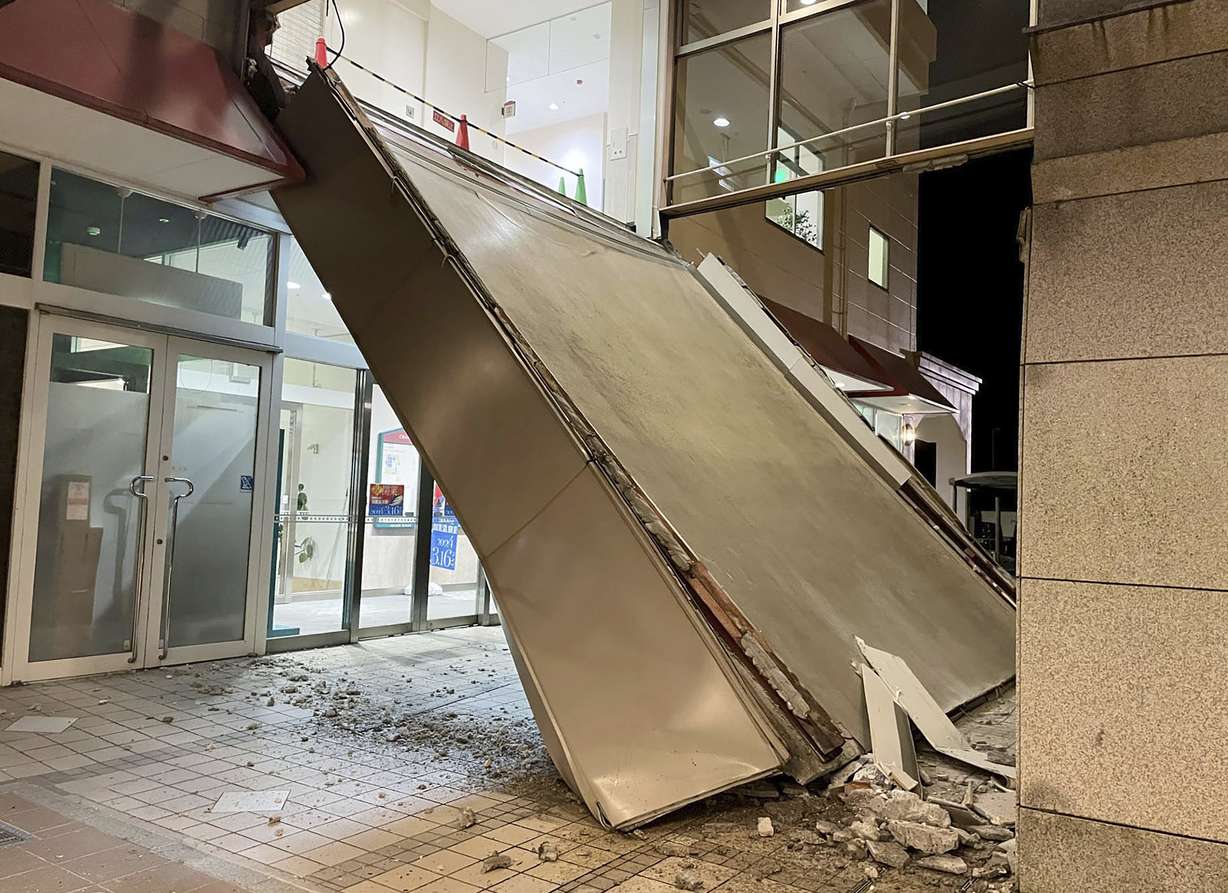
Social media videos showed the aftermath of the quake, with store aisles strewn with goods. One clip filmed from inside a train showed signposts on the platform rocking intensely with the tremor.
More than 32,500 homes in Ishikawa prefecture were left without power following the quake, according to the Hokuriku Electric Power Company.
Japan's Kansai Electric Power Company said in a statement on X, formerly Twitter, that no abnormality had been reported at nuclear plants in the area.
The powerful quake was followed by a series of strong aftershocks, according to the USGS.
A 6.2 magnitude aftershock at a depth of 10 kilometers (6 miles) struck at 4:18 p.m. local time around 4 kilometers (2.4 miles) southwest of Anamizu, according to the USGS.
Some 58 kilometers (about 36 miles) away, tremors of 5.2 magnitude were recorded, and another 5.6 magnitude aftershock was reported closer to the initial quake, according to the USGS.
The country's weather agency warned that powerful aftershocks could continue over the next three days to a week, and cautioned against potential building collapses and landslides.
A seismologist with the U.S. Geological Survey warned that aftershocks caused by the earthquake could last for months.
Susan Hough said people living in that part of the country have felt earthquakes before, but she believes this is "the biggest earthquake by far" — which means most residents likely don't have experience with a seismic event of this scale.
"An earthquake this big is going to continue to have aftershocks. It could easily have aftershocks bigger than magnitude 6, so that is going to be a hazard in its own right," Hough said.
The initial earthquake collapsed buildings, caused fires and triggered tsunami alerts as far away as eastern Russia, prompting orders for residents to evacuate affected coastal areas of Japan.
Japanese Prime Minister Fumio Kishida said authorities were working to assess potential damage in affected areas.
"We have immediately set up the Prime Minister's Office of Response - Disaster Counter Measure HQ. Putting human lives as priority, we are making every effort to assess damages – putting forth all efforts in disaster response," the prime minister wrote on X, formerly Twitter, Monday.
U.S. President Joe Biden is extending support to Japan after a powerful earthquake shook the western area of the country on Monday.
The Biden administration is in touch with Japanese officials, and the United States "stands ready to provide any necessary assistance for the Japanese people," according to a statement.
"As close Allies, the United States and Japan share a deep bond of friendship that unites our people. Our thoughts are with the Japanese people during this difficult time," Biden said in the written statement.
Tsunami waves reported
Waves of less than a meter were reported in a number of other areas along Japan's western coast, including 80-centimeter (2.6-foot) waves in Toyama city, 40-centimeter (1.3-foot) waves in Kashiwazaki and Kanazawa port, and 20-centimeter waves in Tobishima island and Sado island.
The South Korean Meteorological Administration said it was watching for possible sea level changes in the east coast areas of Gangneung, Yang Yang and Goseong of Gangwon Province and Pohang City.
A tsunami threat was also declared in the eastern Russian cities of Vladivostok, Nakhodka, and the island of Sakhalin – as the areas face the Sea of Japan – Russian state media TASS reported. No evacuations have been reported so far.
Contributing: Chie Kobayashi, Eve Brennan, Junko Ogura, Jonny Hallam, Sam Fossum






