Estimated read time: 4-5 minutes
This archived news story is available only for your personal, non-commercial use. Information in the story may be outdated or superseded by additional information. Reading or replaying the story in its archived form does not constitute a republication of the story.
BAYPORT, Minn. — A 35-year-old man who was sent to prison as a teenager for the 2004 killing of a man in a Minneapolis flower shop was set free Monday after a judge ruled the eyewitness evidence on which his conviction rested was unreliable.
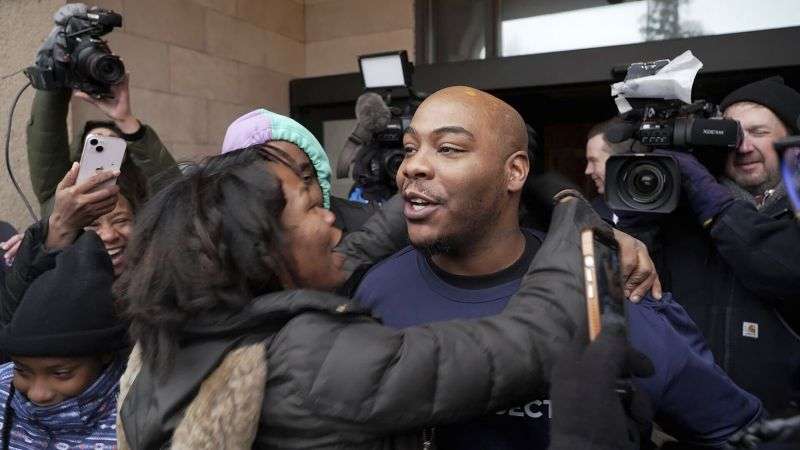
Marvin Haynes, who was 16 at the time of the killing and had spent most of his life behind bars, was released from prison shortly after the judge's ruling.
The Hennepin County Attorney's Office said it agreed with defense attorneys that admitting the shaky evidence violated his constitutional rights during his 2005 trial for the killing of Randy Sherer, 55, who was shot during a robbery.
"I just want to thank everybody that supported me through this whole journey," Haynes told reporters outside the Minnesota Correctional Facility-Stillwater. "And now y'all can recognize that I'm actually innocent."
He said his next step would be to visit his mother, who had not been able to visit him in prison for the last three or four years since suffering a stroke. He said he now hopes to get a job and get his life back in order. And he recalled how get got the news on his birthday last Wednesday that the county attorney had agreed his conviction should be set aside.
"I shed tears," he said. "I haven't cried so much in 19 years. I'm so excited. Overwhelmed with emotion."
Hennepin County Attorney Mary Moriarty told reporters she concluded after reviewing the case records that Haynes was innocent and his prosecution was a "terrible injustice." She said his conviction depended almost entirely on eyewitness identification and there was no forensic evidence, such as fingerprints or DNA, nor video connecting him to the crime.
"We inflicted harm on Mr. Haynes and his family, and also on Randy Sherer, the victim, his family, and the community," Moriarty said. "We cannot undo the trauma experienced by those impacted by this prosecution. But today we have taken a step toward righting this wrong."
This is someone who has every right in the world to be bitter, to be angry. But he's not. And then he carries himself with this remarkable sense of hope and positivity that is so admirable.
–Andrew Markquart, Great North Innocence Project
Moriarty said nearly 28% of cases nationally in which convictions are thrown out involve problems with eyewitness identification.
"'Like many Black boys at the time, our criminal legal system too easily wrote him off, failed to protect his rights and sent him to prison," she said. "He was a 16-year-old boy who had little chance to defend himself against a legal system that determined wrongfully that he was guilty of this murder."
Judge William Koch held that absent the eyewitness evidence, which he said was unconstitutionally admitted, "it is doubtful there would have been sufficient evidence to sustain a conviction." He dismissed all charges with prejudice, meaning they can't be filed again.
Koch said in his order that Haynes' attorneys, from the Innocence Project, showed he did not match the physical description provided by the primary eyewitness. Haynes was "significantly younger" than the description of the killer, about 50 pounds lighter and "significantly shorter," the judge said. Haynes also had "much longer hair" than how the witness described the attacker, and his "manner of speech was not similar."
The judge also found problems with how investigators conducted a photo lineup that did not include Haynes. The person the witness initially identified, saying she was 75-80% sure, was in another state at the time of the killing. Investigators used an old photo in another lineup from when Haynes had close-cropped hair, but he had grown it long since them. The eyewitness did not identify Haynes as the killer until a third lineup and in her trial testimony.
Moriarty noted that one of the lead investigators in the original case, retired Minneapolis Police Lt. Michael Keefe, testified during a recent evidentiary hearing that he objected to the lineup procedures at the time but was overruled.
During the hearing, Haynes maintained his innocence and four of his sisters testified he was asleep at home shortly before the killing.
Attorney Andrew Markquart, of the Great North Innocence Project, thanked Moriarty and her office for taking a serious look at the evidence and agreeing that Haynes' conviction could not stand. He welcomed that Haynes will now get to spend "a very merry Christmas" with his family.
"This is someone who has every right in the world to be bitter, to be angry," Markquart said. "But he's not. And then he carries himself with this remarkable sense of hope and positivity that is so admirable."
It's "well established that subjecting witnesses to multiple viewings of a suspect risks tainting the identification," the Innocence Project noted.
At the time of Haynes' conviction, the county attorney was Amy Klobuchar, who is now Minnesota's senior U.S. senator. Moriarty, who was formerly the county's chief public defender, said she was "deeply sorry" for all the opportunities Haynes missed while he spent more than half his life in prison.