Estimated read time: 4-5 minutes
This archived news story is available only for your personal, non-commercial use. Information in the story may be outdated or superseded by additional information. Reading or replaying the story in its archived form does not constitute a republication of the story.
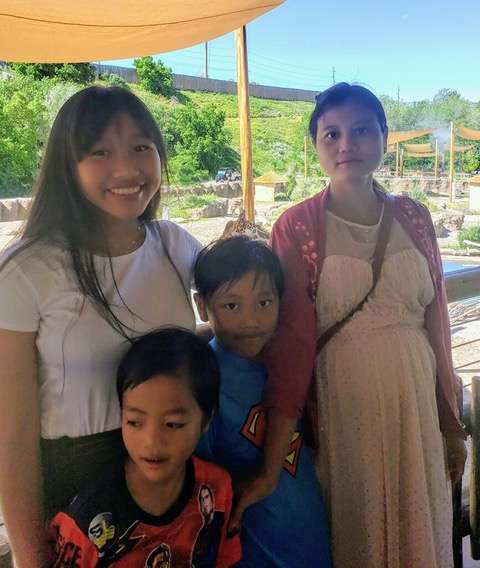
Shamu Nar, 15, was thriving at school in 2019. She loved getting good grades and seeing friends at school.
But when schools shut down amid the COVID-19 pandemic, her experience changed dramatically. "It was easy to get good grades when I was in class," she said, but when in-person classes shut down she couldn't keep up. She dropped all her classes except English and struggled to finish just 10% of the last term's work.
Shamu Nar is a refugee from Burma and now in 10th grade in Salt Lake City School District, where 56.6% of students are considered low-income. Five years ago, her single mother, Naw Lood, brought her four children to Utah after their father died in a refugee camp.
On a recent visit to Shamu Nar's home, the only furnishings in the front room were a rug and fan blowing hot air around their top-level unit. Shamu Nar immediately begged for help and wanted to understand how to submit an assignment to her school's online platform. With four weeks of remote learning behind her, she said classes are hard and she struggles to use the programs. She said, "I try hard and I have Fs." She also said her eyes hurt and she only wants to sleep.
Every day she's trying to help with her mother's new baby, do her own school work and assist her siblings with their work. She said her first-grade brother Ywa Hay Nay needs the most help. Laughing, she said he quickly logs on and then runs outside to play with the other kids.
The Los Angeles Times recently published a story about the difficulties facing districts with high percentages of low-income students planning for remote learning this fall. This online learning "threaten(s) to exacerbate wide and persistent disparities in public education that shortchange students of color and those from low-income families, resulting in potentially lasting harm to a generation of children," the article states.
These fears are playing out in Salt Lake City. Salt Lake District provides laptops, daily meals at 22 schools, and a universal remote learning platform for students, but students like Shamu Nar are still struggling. Shamu Nar has a loaned laptop, but struggles to navigate the learning platform. Shamu Nar's family has never received free meals. Their school is too far to walk in the 30-minute break between Zoom classes and schools are not providing transportation. And while some vulnerable students are being allowed in schools in small groups, Shamu Nar has not been invited.
With schools unable to provide the crucial learning opportunities and social services the most vulnerable families depend on, a handful of Utah nonprofits are trying to fill the gaps.
Salt Lake County-based Circles, an organization working to reduce poverty, has stepped up. Circles is writing grants to provide tech support and to promote their "allies program." This program provides intentional friends and guidance to low-income families. Benjamin Sessions, program director, said mental health has always been an issue for low-income populations. Sessions said the current personal stories now are more crushing and parents don't have breaks. Circles is addressing the mental health side by hosting COVID-19-friendly gatherings and family-to-family support for low-income families. Luckily, Shamu Nar's family has an ally within the Circle's community helping them navigate life's challenges. Many needy families do not.
Young Caring For Our Young, a charitable foundation operated by the Young Automotive Group, got to work after springtime school closures restocking local food banks, holding pantry parades and collecting over 22,700 pounds of food. This fall, Young Caring For Our Young recognized that school district supplies were low and donated 10,000 pantry packs to make sure children have meals on days they are not in school.
While impoverished and refugee families have always relied on organizations like these, they have suddenly become far more important with the doors to public schools closed. For needy families, the local school is a bedrock social institution-- somewhere to find safety, shelter, mentoring, food, supervision, internet access, social support, and the greatest equalizer of all, education. Losing these resources is destabilizing and traumatic.
In the meantime, Shamu Nar remains determined to get her education and help her family survive. She's fortunate that charitable neighbors are helping her on her path. But the school system, set up to protect her constitutional right to free public education, is failing her. Individuals and organizations helping students in similar situations hope the setbacks Shamu Nar has seen this year as her school's doors are locked will not permanently derail her hopes for a better future.
To volunteer/help, visit Circles-Salt Lake or Young Caring For Our Young.