Estimated read time: 5-6 minutes
This archived news story is available only for your personal, non-commercial use. Information in the story may be outdated or superseded by additional information. Reading or replaying the story in its archived form does not constitute a republication of the story.
ADDIS ABABA, Ethiopia (AP) — The Nobel Peace Prize was awarded Friday to a dynamic young African leader whose sweeping reforms and surprising embrace of a bitter rival have been praised as an inspiration to the continent and a hopeful counterpoint to strongman movements far beyond it.
Now the task for Ethiopian Prime Minister Abiy Ahmed is reining in the ethnic violence that followed the loosening of repressive controls, and resisting any urge to crack down. "He deserves it and the new challenge is keeping it," one outspoken African activist, Nigerian Shehu Sani, said of the award.
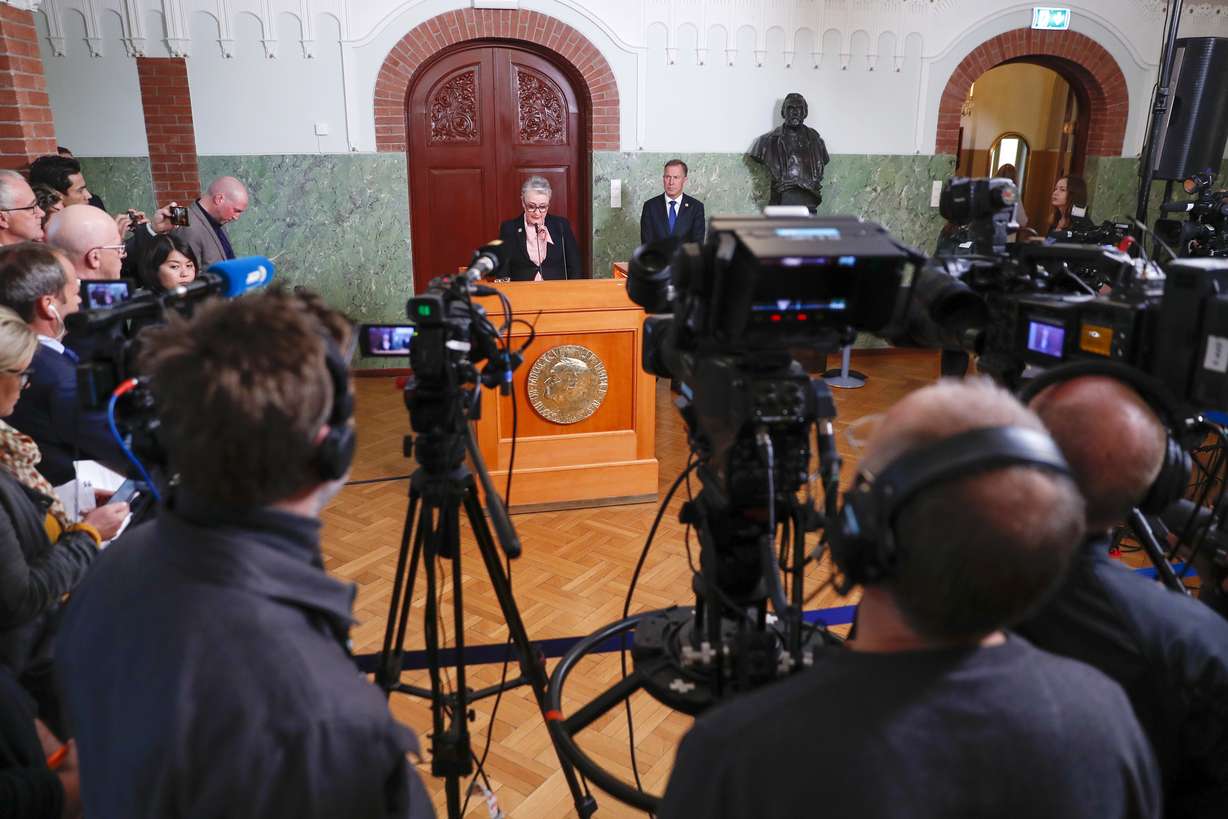
Abiy, a favorite to win despite speculation about young climate activist Greta Thunberg, told the Nobel committee he was humbled and thrilled to receive its 100th peace prize, calling peace "a rare commodity in our region." He hoped the award would encourage other African leaders.
His countrymen, even some critics, celebrated. "'We are proud as a nation!!!" his office said.
The 43-year-old prime minister has embraced the concept of "medemer," a term in Ethiopia's Amharic language that means unity and inclusivity, and has lived it. The son of a Muslim and an Orthodox Christian, and of mixed ethnic heritage, he is a symbol of what he would like to achieve in a country of some 80 ethnicities and some 110 million people. That fractious mix could also bring him down.
"No doubt some people will think this year's prize is being awarded too early," the Nobel committee said. But "it is now that Abiy Ahmed's efforts deserve recognition and need encouragement."
Abiy seemed to come out of nowhere, taking office in early 2018 after widespread protests pressured Ethiopia's longtime ruling coalition and hurt one of the world's fastest growing economies. Within weeks, Africa's youngest leader shocked the long-turbulent Horn of Africa region by fully accepting a peace deal ending a 20-year border war with neighboring Eritrea that saw some 80,000 people killed.

Suddenly, one of the world's longest-running conflicts was ending.
The visibly moved Eritrean president, Isaias Afwerki, soon visited Addis Ababa and diplomatic, communications and transport links were restored. For the first time in two decades, long-divided families made tearful reunions.
The Nobel committee cited that peacemaking in awarding Abiy the prize and acknowledged that "peace does not arise from the actions of one party alone." When Abiy "reached out his hand, President Afwerki grasped it."
The government of Eritrea, still one of the world's most closed-off nations, did not immediately comment, and the country has shown no sign of following Ethiopia's reforms. The Nobel committee said it hoped the award would bring positive change for all in both countries. It also noted Abiy's other efforts toward reconciliation in the region — between Eritrea and Djibouti, between Kenya and Somalia, and in Sudan.
At home, Abiy has offered one surprise after another. He released tens of thousands of prisoners, welcomed home once-banned opposition groups and acknowledged past abuses. People expressed themselves freely on social media, and he announced that Ethiopia would hold free and fair elections in 2020. He named one of the world's few "gender-balanced" Cabinets and a female president, a rarity in Africa.
And for the first time Ethiopia has no journalists in prison, media groups noted last year. The progress has been "incredible," the United States said Friday.
The new prime minister also announced the opening-up of Ethiopia's tightly controlled economy, saying private investment would be welcome in major state-owned sectors — a process that continues slowly.
But while Abiy became a global darling, troubles arose at home.
WORLD EXCLUSIVE:
— The Nobel Prize (@NobelPrize) October 11, 2019
Listen to the call between Ethiopian Prime Minister Abiy Ahmed Ali and Olav Njølstad, Secretary of the Norwegian Nobel Committee, recorded shortly after the announcement of the 2019 Nobel Peace Prize.#NobelPrizehttps://t.co/kZ9rRXBzIw
A grenade was thrown at him during an appearance in the capital last year, and weeks later a large group of soldiers confronted him in his office in what he called an attempt to derail his reforms. In a display of the brio that has won Abiy widespread admiration, the former military officer defused the situation by dropping to the floor and joining the troops in push-ups.
More troubling are Ethiopia's deadly ethnic tensions as people once stifled by repression now act on long-held grievances. Some 1,200 people have been killed and some 1.2 million displaced in the greatest challenge yet to Abiy's rule. Some observers warn that the unrest will grow ahead of next year's election.
Ethiopia's government also has begun reaching for some of the controls it had abandoned. Arbitrary arrests have been reported and internet shutdowns have returned, and the prime minister has defended them in the interest of calming unrest, saying internet service is "neither water nor air."
"We identify this as the most significant contribution to peace in the last year."
— The Nobel Prize (@NobelPrize) October 11, 2019
Berit Reiss-Andersen, Chair of the Norwegian Nobel Committee, speaks to us about the choice of this year's #NobelPeacePrize.https://t.co/i0yvXRFiP6
The Nobel committee acknowledged that "many challenges remain unresolved." And human rights and humanitarian groups moved quickly to urge Abiy to "continue to be brave," as the Norwegian Refugee Council said.
Despite the concerns, global praise poured in. "I have said often that winds of hope are blowing ever stronger across Africa. Prime Minister Abiy Ahmed is one of the main reasons why," United Nations Secretary-General Antonio Guterres said.
At home, some Ethiopians urged their fast-moving young leader to do even more. "This prize is the begging of him to do much better than now," said one resident of the capital, Abebe Arega.
"Peace is a very expensive commodity in my country."
— The Nobel Prize (@NobelPrize) October 11, 2019
We spoke to 2019 #NobelPeacePrize laureate Abiy Ahmed Ali about his work to achieve peace in his region. Listen to the interview:https://t.co/LFC8G6uw28
So far this week, 11 Nobel laureates have been named. The others received their awards for their achievements in medicine, physics, chemistry and literature. The economics award is to be announced on Monday.
With the glory comes a 9-million kronor ($918,000) cash award, a gold medal and a diploma to be awarded at a ceremony in Oslo, Norway, on Dec. 10, the anniversary of Alfred Nobel's death. Even though the peace prize is awarded in Norway, the amount is denominated in Swedish kronor.
___
Read more stories on the 2019 Nobel Prizes by The Associated Press at https://www.apnews.com/NobelPrizes
___
Anna reported from Johannesburg. Associated Press writers Geir Moulson in Berlin, Mark Lewis in Oslo, Norway, and Jan M. Olsen in Copenhagen, Denmark, contributed to this report.
Copyright © The Associated Press. All rights reserved. This material may not be published, broadcast, rewritten or redistributed.