'%3e%3cpath%20d='M34.1406%205.85938C30.3906%202.10547%2025.3047%200%2020%200C14.6953%200%209.60938%202.10547%205.85938%205.85938C2.10938%209.61328%200%2014.6953%200%2020C0%2025.3047%202.10547%2030.3906%205.85938%2034.1406C9.61328%2037.8906%2014.6953%2040%2020%2040C25.3047%2040%2030.3906%2037.8945%2034.1406%2034.1406C37.8906%2030.3906%2040%2025.3047%2040%2020C40%2014.6953%2037.8945%209.60938%2034.1406%205.85938ZM37.0117%2023.543H31.1602V13.5391H27.6328V19.9414C28.1211%2020.6914%2028.3711%2021.582%2028.3711%2022.5625V22.625C28.3711%2023.668%2028.1172%2024.6055%2027.6328%2025.4297V26.6094H36.082C33.4883%2032.9375%2027.2891%2037.3789%2020.0039%2037.3789C10.3711%2037.3789%202.62109%2029.6289%202.62109%2020C2.62109%2010.3711%2010.3711%202.62109%2020%202.62109C29.6289%202.62109%2037.3789%2010.3711%2037.3789%2020C37.3789%2021.1484%2037.2617%2022.2656%2037.0508%2023.3477C37.0391%2023.4141%2037.0234%2023.4766%2037.0117%2023.543Z'%20fill='white'/%3e%3cpath%20d='M22.3086%2018.5352C20.4336%2018.125%2019.9531%2017.8398%2019.9766%2017.1836V17.1406C19.9766%2016.6992%2020.3477%2016.2148%2021.4023%2016.2148C22.582%2016.2148%2023.8867%2016.6797%2025.0781%2017.4766L26.8516%2015.0195C25.4453%2013.8906%2023.707%2013.3398%2021.5547%2013.3398C18.5195%2013.3398%2016.4375%2015%2016.4063%2017.4766V17.5352C16.3633%2020.2617%2018.5859%2020.9805%2021.293%2021.6016C23.0391%2021.9766%2023.5703%2022.3164%2023.5703%2022.9609L23.5469%2022.9766C23.5469%2023.3906%2023.2578%2023.7031%2022.7852%2023.8359C22.5742%2023.9062%2022.1289%2023.9727%2021.5156%2023.9727C20.7617%2023.9727%2019.7539%2023.8633%2018.6328%2023.4844C18.0898%2023.2891%2017.4727%2023.0039%2016.8047%2022.6133L20.1406%2026.625C20.2813%2026.6602%2021.0977%2026.8516%2021.7734%2026.8516C25.0039%2026.8516%2027.0859%2025.2461%2027.1094%2022.6328V22.5703C27.1602%2020.1133%2025.2148%2019.1719%2022.3086%2018.5352Z'%20fill='white'/%3e%3cpath%20d='M5.24219%2013.5664V26.6133H8.75391V23.7578L10.2969%2021.9531L14.2031%2026.6133H18.3867L12.3555%2019.5195L17.4023%2013.5664H13.4531L8.75391%2019.0586V13.5664H5.24219Z'%20fill='white'/%3e%3c/g%3e%3cdefs%3e%3cclipPath%20id='clip0_97_2430'%3e%3crect%20width='40'%20height='40'%20fill='white'/%3e%3c/clipPath%3e%3c/defs%3e%3c/svg%3e)




Estimated read time: 3-4 minutes
- Soldier Hollow Nordic Center is testing snow farming for early ski training.
- Snow stored since March under tarps survived summer heat with 75%-80% intact.
- The experiment aims to prepare for the 2034 Winter Olympics and earlier skiing.
MIDWAY — Some of the country's best cross-country skiers are racing at Soldier Hollow Nordic Center this weekend, preparing for another winter season.
It's part of the annual Schutzenski Festival here, and as in past years, the racing is held on roller skis.
"It's our way of kind of getting ready for winter, giving everybody a competition in the late fall," said Soldier Hollow general manager Luke Bodensteiner, a two-time Olympic cross-country skier.
Bodensteiner says roller skiing is a popular way for athletes to train when there isn't snow on the ground and feels as close to skiing on snow as possible.
"It's actually pretty close. They're similar. It's a great training modality," he said. "Everybody does a lot of it. It doesn't quite meet the sensation of skiing, but it's a pretty good replication.
However, if those athletes really needed snow, they wouldn't have to look very far.
Just a short distance away, there's a giant pile of winter hiding underneath some insulated tarps.

And it's been there since March.
Earlier this year, crews at Soldier Hollow made a pile of snow roughly the size of a football field and about 25 feet deep.
They then covered it with special insulating tarps and mats designed to keep the snow from melting during the warmer months.
The idea, known as snow farming, is something Bodensteiner had been considering for several years.
"We see it happen a lot in Scandinavia, and we said, look, maybe we should stop talking about it and just try it," he said.
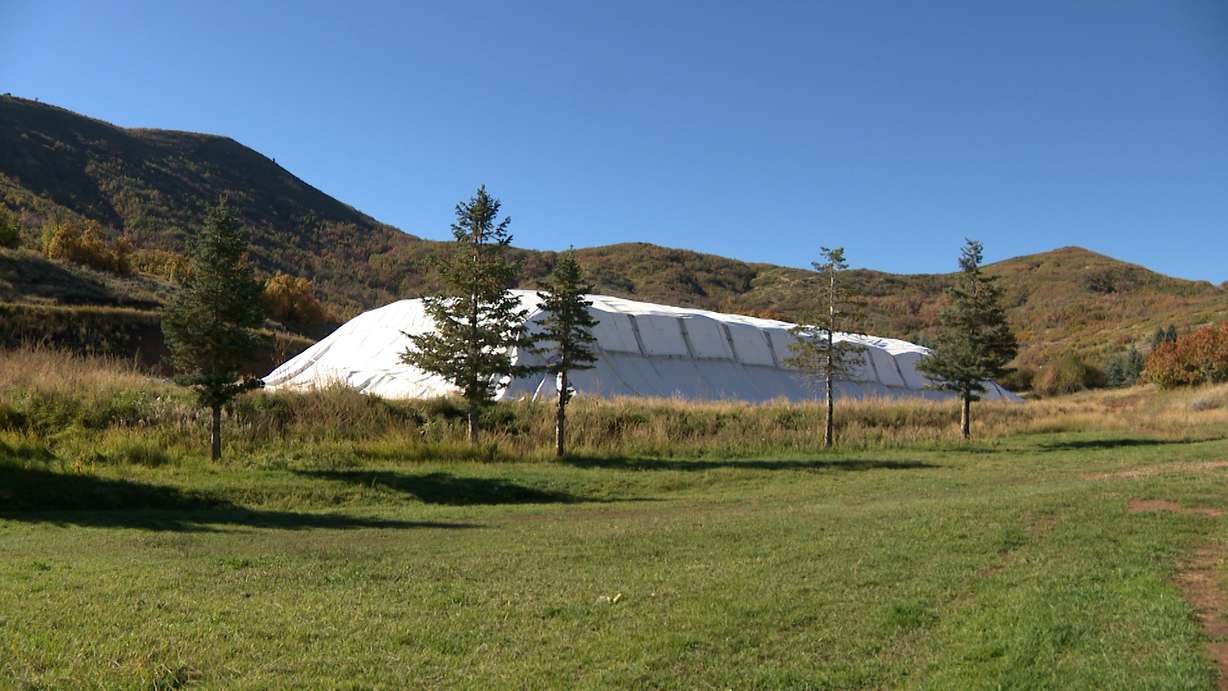
So, they did.
The insulating mats are made of foam boards roughly 2½ inches thick, with a geotextile material underneath.
Bodensteiner said it took crews about a day to cover the snow pile.
Then came the real test.
"We had some hot, hot days, particularly in July, you know, over 100 degrees," said Bodensteiner.

Despite those temperatures, he says the experiment appears to be working.
Based on his observations throughout the summer, Bodensteiner estimates roughly 75%-80% of the snow stored back in March is still there.
"We're actually pretty pleased with how the snow held up," he said.
Crews plan to remove the tarps within the next few weeks to see exactly how much snow survived, then use snowcats to spread the remaining snow onto the cross-country trails.
The hope is to begin skiing by mid-November.
"The idea is to have a training facility and be able to get the ski season started about two weeks earlier than we might normally ski," said Bodensteiner.
However, this experiment isn't just about getting an early start on this year's ski season.
It's also about preparing for the 2034 Winter Olympics and Paralympics.
"This is a little bit of kind of proof of concept for some Olympic snow strategies that we may have," said Bodensteiner.
If the experiment is a success, Soldier Hollow could have several similar snow storage piles around the venue during the summer of 2033, giving crews a headstart on preparing the trails for Olympic competition.
"You know, winter's not getting any easier," he said. "So we have to be thinking in this direction just to guarantee that we've got good racing conditions here in 2034."
Just like with those athletes competing in this weekend's race, the venue itself is already preparing for something much bigger.