
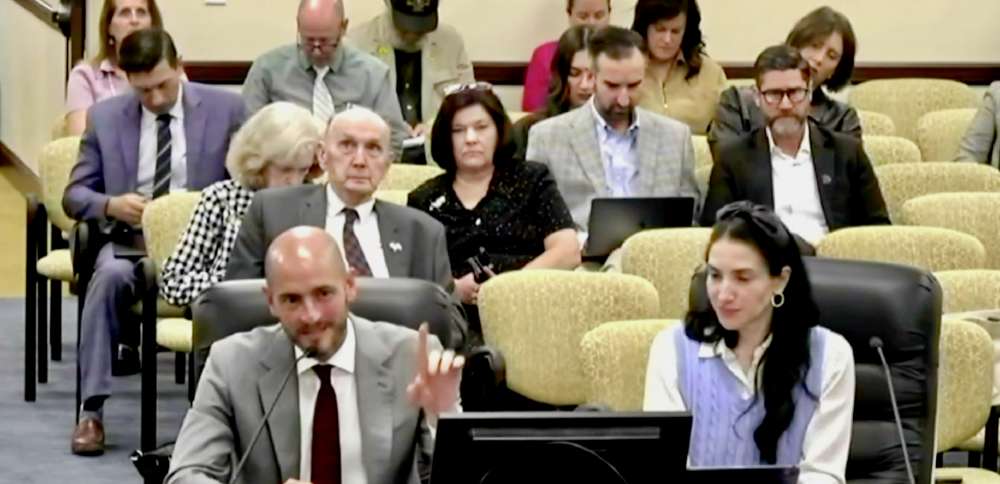
- Utah lawmakers questioned the top official of MIDA, the state entity partnering in development of a controversial data center proposal in Box Elder County.
- One lawmaker said MIDA doesn't do enough to inform the public of its initiatives and another warned of "mission creep" in the projects it pursues.
- MIDA is partnering with O'Leary Digital in the data center proposal.
SALT LAKE CITY — The state entity teaming with the developer of a controversial Box Elder County data center project was the target of pointed questions and concerns at an interim committee meeting of Utah lawmakers on Wednesday.
Rep. James Dunnigan, R-Taylorsville, said the Military Installation Development Authority, or MIDA, doesn't do enough to inform the public of its initiatives. Rep. Doug Fiefia, R-Herriman, expressed concern with "mission creep" in the sorts of projects MIDA takes on in partnership with other entities.
Ever since news of the Stratos Project Area data center proposal in Box Elder County publicly emerged last spring, MIDA, partnering with O'Leary Digital in the initiative, has been focus of questions from some, unfamiliar with the state entity and taken by surprise by the project. The MIDA board, made up of government appointees, worked with O'Leary in hammering out the framework for its data center proposal in a remote area of Box Elder County, and Box Elder County Commissioners subsequently approved two key resolutions allowing the plans to proceed.
In that context, MIDA Executive Director Dan Hemmert appeared at a meeting of the Legislature's Economic Development and Workforce Services Interim Committee. He discussed what the entity does and fielded comments and questions about it.
Dunnigan expressed reservations with the efforts MIDA takes to inform the public of its plans, proposals and operations. Hemmert said MIDA posts information about its public meetings on its own website, midaut.org, as well as the state's public notice website, utah.gov/pmn.
"To me, that's not adequate notice to the public," said Dunnigan, noting that many people probably don't regularly visit the MIDA website. Local government, he went on, "needs to step in and make sure that the local notice is given."
Hemmert stressed that local entities considering partnerships involving MIDA also have to inform the public of the plans. Even so, many Box Elder County residents expressed surprise when the O'Leary Digital data center plans emerged, saying they didn't think the public received enough advance notice or opportunity to sound off.
The O'Leary Digital plans, spearheaded by Canadian businessman Kevin O'Leary, call for a data center operation and up to 9 gigawatts of power-producing capacity to serve it. Proponents have touted the military importance of the project while foes have raised environmental concerns.
In light of the resolutions Box Elder County commissioners approved last May allowing the data center plans to proceed, Dunnigan also raised questions about the sort of pressure local officials face in considering partnerships with MIDA. Many in the public had pressed for the commissioners to rebuff the two measures, but commissioners approved them, in part arguing that collaborating with plan boosters would give local leaders a measure of control in data center development.
In taking action, elected officials "have to own that vote and you cast that vote," Hemmert said. The Box Elder County officials "could have voted no, and the project area would not exist."
Fiefia said many MIDA projects seem to align with the organization's mission to further military initiatives, which he supports. But others don't seem as closely tied to that vision, he continued, noting the data center project.
"As I've been talking to a lot of my constituents during this time, there's a bit of concern, and maybe I share some of it, around this mission creep," he said. MIDA is doing "some great work ... but I think MIDA's success is dependent on public trust, and I think a little of that has been waned because of some of these projects and people saying, 'Well, what does this actually have to do with the military and how was this approved?'"
Hemmert said the data center plans have a military connection
The proposal came in response to a "direct request of the federal military leadership, who asked the state and MIDA to help facilitate independent, redundant off-grid energy and computing capacity to support defense reliance," he said. In the next three to six months, he went on, "there will be some announcements made that help clarify the military connection to that project."