'%3e%3cpath%20d='M34.1406%205.85938C30.3906%202.10547%2025.3047%200%2020%200C14.6953%200%209.60938%202.10547%205.85938%205.85938C2.10938%209.61328%200%2014.6953%200%2020C0%2025.3047%202.10547%2030.3906%205.85938%2034.1406C9.61328%2037.8906%2014.6953%2040%2020%2040C25.3047%2040%2030.3906%2037.8945%2034.1406%2034.1406C37.8906%2030.3906%2040%2025.3047%2040%2020C40%2014.6953%2037.8945%209.60938%2034.1406%205.85938ZM37.0117%2023.543H31.1602V13.5391H27.6328V19.9414C28.1211%2020.6914%2028.3711%2021.582%2028.3711%2022.5625V22.625C28.3711%2023.668%2028.1172%2024.6055%2027.6328%2025.4297V26.6094H36.082C33.4883%2032.9375%2027.2891%2037.3789%2020.0039%2037.3789C10.3711%2037.3789%202.62109%2029.6289%202.62109%2020C2.62109%2010.3711%2010.3711%202.62109%2020%202.62109C29.6289%202.62109%2037.3789%2010.3711%2037.3789%2020C37.3789%2021.1484%2037.2617%2022.2656%2037.0508%2023.3477C37.0391%2023.4141%2037.0234%2023.4766%2037.0117%2023.543Z'%20fill='white'/%3e%3cpath%20d='M22.3086%2018.5352C20.4336%2018.125%2019.9531%2017.8398%2019.9766%2017.1836V17.1406C19.9766%2016.6992%2020.3477%2016.2148%2021.4023%2016.2148C22.582%2016.2148%2023.8867%2016.6797%2025.0781%2017.4766L26.8516%2015.0195C25.4453%2013.8906%2023.707%2013.3398%2021.5547%2013.3398C18.5195%2013.3398%2016.4375%2015%2016.4063%2017.4766V17.5352C16.3633%2020.2617%2018.5859%2020.9805%2021.293%2021.6016C23.0391%2021.9766%2023.5703%2022.3164%2023.5703%2022.9609L23.5469%2022.9766C23.5469%2023.3906%2023.2578%2023.7031%2022.7852%2023.8359C22.5742%2023.9062%2022.1289%2023.9727%2021.5156%2023.9727C20.7617%2023.9727%2019.7539%2023.8633%2018.6328%2023.4844C18.0898%2023.2891%2017.4727%2023.0039%2016.8047%2022.6133L20.1406%2026.625C20.2813%2026.6602%2021.0977%2026.8516%2021.7734%2026.8516C25.0039%2026.8516%2027.0859%2025.2461%2027.1094%2022.6328V22.5703C27.1602%2020.1133%2025.2148%2019.1719%2022.3086%2018.5352Z'%20fill='white'/%3e%3cpath%20d='M5.24219%2013.5664V26.6133H8.75391V23.7578L10.2969%2021.9531L14.2031%2026.6133H18.3867L12.3555%2019.5195L17.4023%2013.5664H13.4531L8.75391%2019.0586V13.5664H5.24219Z'%20fill='white'/%3e%3c/g%3e%3cdefs%3e%3cclipPath%20id='clip0_97_2430'%3e%3crect%20width='40'%20height='40'%20fill='white'/%3e%3c/clipPath%3e%3c/defs%3e%3c/svg%3e)


- Utah's North Capitol building was renamed for former Gov. Mike Leavitt.
- Gov. Spencer Cox praised Leavitt's legacy, including the successful 2002 Winter Olympics.
- Leavitt's parents, aged 97 and 94, watched the ceremony remotely.
SALT LAKE CITY — Utah's newly-opened North Capitol building was renamed Friday for Mike Leavitt, Utah's 14th governor who served the state for a decade from 1993 to 2003.
It's a rare honor for a living former public servant to have his name on a "forever building" that is the capstone of the revamped Capitol Hill complex that has been years in the making, according to Gov. Spencer Cox. Leavitt was on hand with Cox and top lawmakers Friday for the official dedication of what is now the Michael O. Leavitt Building.
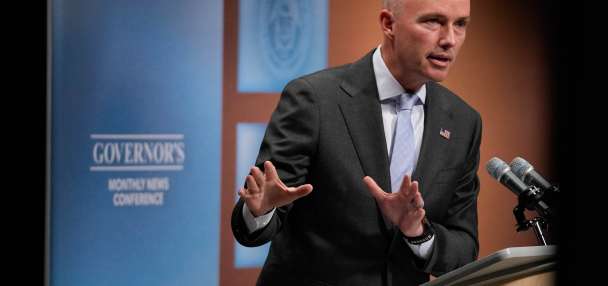
"We don't do this very often ... where we name a building — especially a building of this magnitude — after someone who is not yet dead, who is still very much alive," Cox said. "It's often hard to understand a legacy until someone has passed on."
Rare as it is for a living state official to be honored in such a way, it's even more remarkable given that both of Leavitt's parents are still around to see their son's name added to the $320 million building. His father and mother, aged 97 and 94, respectively, watched the ceremony remotely, Leavitt said.
The building that now bears his name opened earlier this year and houses the Museum of Utah, which opened its exhibits in June. Leavitt said the building "has a feeling of permanence" and joins the rest of the complex as "a monument to the ethos of democracy, which is do your part."
"So I humbly know the significance of having my name permanently associated with this glorious part of the state Capitol Complex," he said, growing emotional. "I have to say that there is no recognition that would be more satisfying or would feel more consequential to me."
Standing in the atrium, several floors below the massive stained glass laylight depicting each of the state's 29 counties, Cox, Senate President Stuart Adams and House Majority Whip Candice Pierucci spoke of the legacy Leavitt leaves behind.
For many Utahns, that legacy will be tied to the successful 2002 Olympic Winter and Paralympic Games in Salt Lake City. Leavitt's tenure encompassed the decade leading up to the games, and concluded less than two years after when he was appointed by then-President George W. Bush to serve as administrator of the Environmental Protection Agency.
Pierucci recalled touching the Olympic torch as it was brought through the state when she was young, calling it a "core memory for me."
"I remember, even at a young age, thinking how incredible it was that our state was hosting the Olympics, and what an incredible job we did with it," she said. "And it brought the world together and showed what our state could accomplish when Utahns are united."
Former U.S. Sen. Mitt Romney, who Leavitt helped select to lead the Salt Lake Organizing Committee and is credited with turning the Games around, sat in the front row of the ceremony Friday.
Adams credited Leavitt with looking to the future, and Cox said the culture Leavitt built has helped fuel Utah's strong economy and growth over the past several decades.
"Culture is so hard to build. It's the hardest thing to build. It's very easy to destroy," Cox said. "I can tell you that every governor since this governor has felt the weight of being able to preserve that culture that made us the state that we are today."
If naming a building after a living person is rare, "this is the rarest of circumstances," he added.
Cox said the strong economy and growth that have defined the 21st century in Utah were not always the norm.
"The modern Utah that so many of us know — and for many young people this has been their entire lives — that wasn't the Utah then, and it's the Utah now because of him," he said.