'%3e%3cpath%20d='M34.1406%205.85938C30.3906%202.10547%2025.3047%200%2020%200C14.6953%200%209.60938%202.10547%205.85938%205.85938C2.10938%209.61328%200%2014.6953%200%2020C0%2025.3047%202.10547%2030.3906%205.85938%2034.1406C9.61328%2037.8906%2014.6953%2040%2020%2040C25.3047%2040%2030.3906%2037.8945%2034.1406%2034.1406C37.8906%2030.3906%2040%2025.3047%2040%2020C40%2014.6953%2037.8945%209.60938%2034.1406%205.85938ZM37.0117%2023.543H31.1602V13.5391H27.6328V19.9414C28.1211%2020.6914%2028.3711%2021.582%2028.3711%2022.5625V22.625C28.3711%2023.668%2028.1172%2024.6055%2027.6328%2025.4297V26.6094H36.082C33.4883%2032.9375%2027.2891%2037.3789%2020.0039%2037.3789C10.3711%2037.3789%202.62109%2029.6289%202.62109%2020C2.62109%2010.3711%2010.3711%202.62109%2020%202.62109C29.6289%202.62109%2037.3789%2010.3711%2037.3789%2020C37.3789%2021.1484%2037.2617%2022.2656%2037.0508%2023.3477C37.0391%2023.4141%2037.0234%2023.4766%2037.0117%2023.543Z'%20fill='white'/%3e%3cpath%20d='M22.3086%2018.5352C20.4336%2018.125%2019.9531%2017.8398%2019.9766%2017.1836V17.1406C19.9766%2016.6992%2020.3477%2016.2148%2021.4023%2016.2148C22.582%2016.2148%2023.8867%2016.6797%2025.0781%2017.4766L26.8516%2015.0195C25.4453%2013.8906%2023.707%2013.3398%2021.5547%2013.3398C18.5195%2013.3398%2016.4375%2015%2016.4063%2017.4766V17.5352C16.3633%2020.2617%2018.5859%2020.9805%2021.293%2021.6016C23.0391%2021.9766%2023.5703%2022.3164%2023.5703%2022.9609L23.5469%2022.9766C23.5469%2023.3906%2023.2578%2023.7031%2022.7852%2023.8359C22.5742%2023.9062%2022.1289%2023.9727%2021.5156%2023.9727C20.7617%2023.9727%2019.7539%2023.8633%2018.6328%2023.4844C18.0898%2023.2891%2017.4727%2023.0039%2016.8047%2022.6133L20.1406%2026.625C20.2813%2026.6602%2021.0977%2026.8516%2021.7734%2026.8516C25.0039%2026.8516%2027.0859%2025.2461%2027.1094%2022.6328V22.5703C27.1602%2020.1133%2025.2148%2019.1719%2022.3086%2018.5352Z'%20fill='white'/%3e%3cpath%20d='M5.24219%2013.5664V26.6133H8.75391V23.7578L10.2969%2021.9531L14.2031%2026.6133H18.3867L12.3555%2019.5195L17.4023%2013.5664H13.4531L8.75391%2019.0586V13.5664H5.24219Z'%20fill='white'/%3e%3c/g%3e%3cdefs%3e%3cclipPath%20id='clip0_97_2430'%3e%3crect%20width='40'%20height='40'%20fill='white'/%3e%3c/clipPath%3e%3c/defs%3e%3c/svg%3e)


Estimated read time: 3-4 minutes
This archived news story is available only for your personal, non-commercial use. Information in the story may be outdated or superseded by additional information. Reading or replaying the story in its archived form does not constitute a republication of the story.
SALT LAKE CITY — The Utah State Capitol turns 100 this year, so let's celebrate the close of the 2016 legislative session with a look back at the construction of this iconic structure.
The history of Utah's Capitol includes a deadly explosion of ammunition, a tax bill on the estate of a New York railroad baron and landscape designs by the same company that created Central Park in Manhattan.
The Capitol Preservation Board is hosting an exhibit this year featuring the 100-year evolution of the Utah statehouse. The exhibit is available to the public all year on the fourth floor gallery.
Drag the slider back and forth on the following pictures to compare today's Capitol with the building while it was under construction.
Before it was known as Capitol Hill, the area near where the Capitol now sits was the site of an armory for the city. On April 5, 1876, the gunpowder and blasting magazines in the arsenal exploded, dropping 40 tons of debris over a two-mile radius across downtown Salt Lake City. The devastating explosions killed four people and broke nearly every window in the area.
In 1888, the area surrounding the old arsenal was donated by the city as a future location for a capitol.
After achieving statehood in 1896, the new government met in the City and County building at 400 South State Street while plans were made for a proper capitol. In 1909, the legislature created a seven-person committee to guide the design and construction of the building, but the state didn't have the $2 million they needed to proceed.
In 1911, the state collected an inheritance tax payment of nearly $800,00 from the estate of E. H. Harriman, the recently deceased president of the Union Pacific Railroad. Harriman was a New York "robber baron" who made a fortune buying bankrupt railroads and turning them for a profit. Harriman incorporated Union Pacific in Utah, which made his earnings taxable under the Utah law. The legislature responded with a $1 million bond to begin work. The final price tag of the project was $2.7 million.
After the money was in, the commission contracted with the famous Olmsted Brothers to create a plan for the site. Costs began to pile up and the Olmsted plans were only partially implemented. When the Capitol and surrounding grounds were updated during a huge $260 million renovation between 2004 to 2008, some of the Olmsted plans for the grounds were finally realized. One unused idea from early Olmsted plans included a tunnel at the entrance of the west side of the building to allow streetcars to enter a proposed subway station.
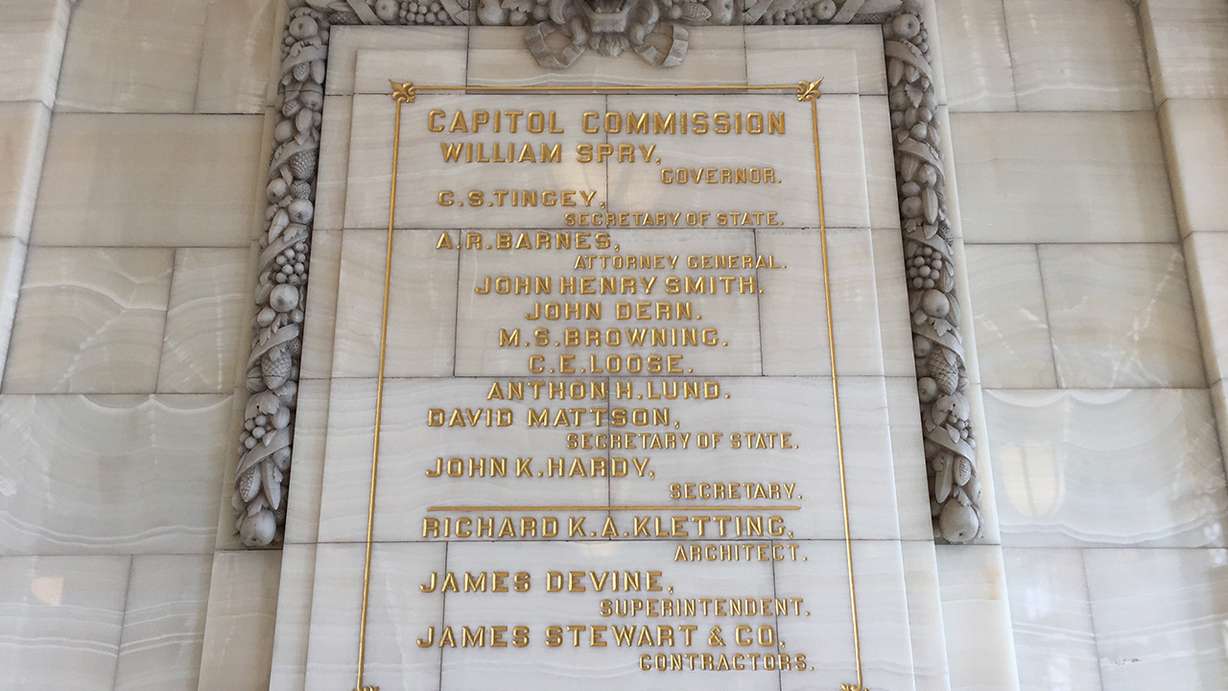
The contract for the building architecture was settled through a design competition. Local architect Richard K. A. Kletting won the bid and turned it into his masterpiece. Kletting created some of Utah's most impressive buildings, including the old Saltair Pavilion, the original Salt Palace, the Oquirrh School, the Enos Wall mansion, and the buildings surrounding the University of Utah Presidents Circle.
The Capitol is open to the public for tours Monday through Friday from 7 a.m. to 8 p.m. and Saturday, Sunday, and holidays from 8 a.m. to 6 p.m. Visit utahstatecapitol.utah.gov for information.