'%3e%3cpath%20d='M34.1406%205.85938C30.3906%202.10547%2025.3047%200%2020%200C14.6953%200%209.60938%202.10547%205.85938%205.85938C2.10938%209.61328%200%2014.6953%200%2020C0%2025.3047%202.10547%2030.3906%205.85938%2034.1406C9.61328%2037.8906%2014.6953%2040%2020%2040C25.3047%2040%2030.3906%2037.8945%2034.1406%2034.1406C37.8906%2030.3906%2040%2025.3047%2040%2020C40%2014.6953%2037.8945%209.60938%2034.1406%205.85938ZM37.0117%2023.543H31.1602V13.5391H27.6328V19.9414C28.1211%2020.6914%2028.3711%2021.582%2028.3711%2022.5625V22.625C28.3711%2023.668%2028.1172%2024.6055%2027.6328%2025.4297V26.6094H36.082C33.4883%2032.9375%2027.2891%2037.3789%2020.0039%2037.3789C10.3711%2037.3789%202.62109%2029.6289%202.62109%2020C2.62109%2010.3711%2010.3711%202.62109%2020%202.62109C29.6289%202.62109%2037.3789%2010.3711%2037.3789%2020C37.3789%2021.1484%2037.2617%2022.2656%2037.0508%2023.3477C37.0391%2023.4141%2037.0234%2023.4766%2037.0117%2023.543Z'%20fill='white'/%3e%3cpath%20d='M22.3086%2018.5352C20.4336%2018.125%2019.9531%2017.8398%2019.9766%2017.1836V17.1406C19.9766%2016.6992%2020.3477%2016.2148%2021.4023%2016.2148C22.582%2016.2148%2023.8867%2016.6797%2025.0781%2017.4766L26.8516%2015.0195C25.4453%2013.8906%2023.707%2013.3398%2021.5547%2013.3398C18.5195%2013.3398%2016.4375%2015%2016.4063%2017.4766V17.5352C16.3633%2020.2617%2018.5859%2020.9805%2021.293%2021.6016C23.0391%2021.9766%2023.5703%2022.3164%2023.5703%2022.9609L23.5469%2022.9766C23.5469%2023.3906%2023.2578%2023.7031%2022.7852%2023.8359C22.5742%2023.9062%2022.1289%2023.9727%2021.5156%2023.9727C20.7617%2023.9727%2019.7539%2023.8633%2018.6328%2023.4844C18.0898%2023.2891%2017.4727%2023.0039%2016.8047%2022.6133L20.1406%2026.625C20.2813%2026.6602%2021.0977%2026.8516%2021.7734%2026.8516C25.0039%2026.8516%2027.0859%2025.2461%2027.1094%2022.6328V22.5703C27.1602%2020.1133%2025.2148%2019.1719%2022.3086%2018.5352Z'%20fill='white'/%3e%3cpath%20d='M5.24219%2013.5664V26.6133H8.75391V23.7578L10.2969%2021.9531L14.2031%2026.6133H18.3867L12.3555%2019.5195L17.4023%2013.5664H13.4531L8.75391%2019.0586V13.5664H5.24219Z'%20fill='white'/%3e%3c/g%3e%3cdefs%3e%3cclipPath%20id='clip0_97_2430'%3e%3crect%20width='40'%20height='40'%20fill='white'/%3e%3c/clipPath%3e%3c/defs%3e%3c/svg%3e)



Estimated read time: 4-5 minutes
This archived news story is available only for your personal, non-commercial use. Information in the story may be outdated or superseded by additional information. Reading or replaying the story in its archived form does not constitute a republication of the story.
SALT LAKE CITY — Gov. Gary Herbert said Thursday he plans to meet with Obama administration officials in Washington, D.C., within the next two weeks to negotiate new limits to his Healthy Utah alternative to Medicaid expansion.
Herbert said after the taping of his monthly news conference on KUED Ch. 7 that he hopes to bring House Speaker Greg Hughes, R-Draper, and Senate President Wayne Niederhauser, R-Sandy, with him to the meeting.
Both the House speaker and the Senate president are receptive to the invitation but are waiting to hear more details about the trip.
The governor also said Thursday he believes climate change is real but whether it's human-caused doesn't really matter, and Republicans will be on the ballot in 2016 despite a court battle over a new candidate nomination process.
His upcoming negotiations will focus on finding ways to cap the costs of his plan for using the Medicaid expansion money available under President Barack Obama's health care law to provide health insurance to low-income Utahns.
"The cost of Medicaid expansion is a concern. That's an issue that I think is legitimate, and we're seeing if we can, in fact, make sure there is no uncertainty about the future," the governor said.
Herbert said he had already spoken to the president, who visited Utah earlier this month, about the need to control the expense to the state, and that Obama had passed along his concerns to U.S. Health and Human Services Secretary Sylvia Burwell.
Over the past year, Herbert has made a number of trips to Washington to negotiate the waivers from Burwell and other administration officials to allow the state to come up with its own plan for Medicaid expansion.
The cost of Medicaid expansion is a concern. That's an issue that I think is legitimate and we're seeing if we can, in fact, make sure there is no uncertainty about the future.
–Gov. Gary Herbert
But Healthy Utah failed to win support during the 2015 Utah Legislature, with strong opposition from Hughes and other House Republicans even though the GOP-dominated Senate approved the governor's plan.
House Republicans offered their own scaled-back plan using more state money, warning that the federal government couldn't sustain the promised Medicaid payments.
The standoff led the governor to announce on the last day of the legislative session that he and legislative leaders would continue working on the issue, with a resolution expected by the end of July.
Herbert has said he will call lawmakers into special session to approve the proposal from the group, which includes Lt. Gov. Spencer Cox, Hughes, Niederhauser and two of the lawmakers who sponsored Medicaid expansion plans.
So far, the group has not had a formal meeting, said Herbert's spokesman, Marty Carpenter. But the governor said he intends to keep their meetings closed to the public, although they could be opened later.
"We're at that stage in the game in the very beginning here where we've got to have the ability to be very frank and open," Herbert said. He said the group is not subject to the state's open meeting laws.
Still, the governor said he recognized the public's interest in their work. "We'll see about going forward and probably having opportunities to have more open meetings and get public input."
Related Story
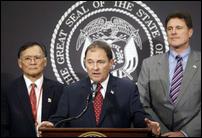
No deal this session on Healthy Utah
There was no deal on Gov. Gary Herbert's Healthy Utah alternative to Medicaid expansion in the 2015 Legislature, but the governor promised Thursday he and legislative leaders will come up with a compromise by July 31.He said any decision to open the meetings would be made with Hughes and Niederhauser.
On the issue of the state's unusually dry weather, Herbert said while he believes in climate change, it's not clear how much impact humans are having. But, he said, what matters is dealing with the changing weather patterns.
"The science is probably a little bit debatable," the governor said. "For me, it doesn't matter from the standpoint that we just need to understand, 'Hey, we're not getting as much snowpack. We'd better prepare for it and do what we can to adjust."
He also dismissed concerns raised by Utah GOP Chairman James Evans that there may not be Republican candidates on the 2016 ballot because the party is fighting changes to the state's caucus and convention system for nominating candidates.
Those changes, made by lawmakers last year to stop the Count My Vote initiative that would have replaced the current system with a direct primary, allow candidates to secure a spot on the primary ballot by gathering signatures.
Last week, the Republican Party lost its bid for a preliminary injunction against the compromise passed by the 2014 Legislature but is expected to continue the court fight against changes required under the law.
Those changes, including opening up primary elections to unaffiliated voters if a party wants to continue using the current system to nominate candidates, must be approved for that party affiliation to appear on the ballot.
Herbert said he was sorry to see the infighting among Republicans, but expressed confidence the issue would be resolved so he and other GOP candidates won't have to run without their party affiliation listed on the ballot.
"I'm confident we'll have Republicans on the ballot in 2016," the governor said, promising he, along with members of the state's all-GOP congressional delegation, will help push for the changes. "I think common sense will prevail."