'%3e%3cpath%20d='M34.1406%205.85938C30.3906%202.10547%2025.3047%200%2020%200C14.6953%200%209.60938%202.10547%205.85938%205.85938C2.10938%209.61328%200%2014.6953%200%2020C0%2025.3047%202.10547%2030.3906%205.85938%2034.1406C9.61328%2037.8906%2014.6953%2040%2020%2040C25.3047%2040%2030.3906%2037.8945%2034.1406%2034.1406C37.8906%2030.3906%2040%2025.3047%2040%2020C40%2014.6953%2037.8945%209.60938%2034.1406%205.85938ZM37.0117%2023.543H31.1602V13.5391H27.6328V19.9414C28.1211%2020.6914%2028.3711%2021.582%2028.3711%2022.5625V22.625C28.3711%2023.668%2028.1172%2024.6055%2027.6328%2025.4297V26.6094H36.082C33.4883%2032.9375%2027.2891%2037.3789%2020.0039%2037.3789C10.3711%2037.3789%202.62109%2029.6289%202.62109%2020C2.62109%2010.3711%2010.3711%202.62109%2020%202.62109C29.6289%202.62109%2037.3789%2010.3711%2037.3789%2020C37.3789%2021.1484%2037.2617%2022.2656%2037.0508%2023.3477C37.0391%2023.4141%2037.0234%2023.4766%2037.0117%2023.543Z'%20fill='white'/%3e%3cpath%20d='M22.3086%2018.5352C20.4336%2018.125%2019.9531%2017.8398%2019.9766%2017.1836V17.1406C19.9766%2016.6992%2020.3477%2016.2148%2021.4023%2016.2148C22.582%2016.2148%2023.8867%2016.6797%2025.0781%2017.4766L26.8516%2015.0195C25.4453%2013.8906%2023.707%2013.3398%2021.5547%2013.3398C18.5195%2013.3398%2016.4375%2015%2016.4063%2017.4766V17.5352C16.3633%2020.2617%2018.5859%2020.9805%2021.293%2021.6016C23.0391%2021.9766%2023.5703%2022.3164%2023.5703%2022.9609L23.5469%2022.9766C23.5469%2023.3906%2023.2578%2023.7031%2022.7852%2023.8359C22.5742%2023.9062%2022.1289%2023.9727%2021.5156%2023.9727C20.7617%2023.9727%2019.7539%2023.8633%2018.6328%2023.4844C18.0898%2023.2891%2017.4727%2023.0039%2016.8047%2022.6133L20.1406%2026.625C20.2813%2026.6602%2021.0977%2026.8516%2021.7734%2026.8516C25.0039%2026.8516%2027.0859%2025.2461%2027.1094%2022.6328V22.5703C27.1602%2020.1133%2025.2148%2019.1719%2022.3086%2018.5352Z'%20fill='white'/%3e%3cpath%20d='M5.24219%2013.5664V26.6133H8.75391V23.7578L10.2969%2021.9531L14.2031%2026.6133H18.3867L12.3555%2019.5195L17.4023%2013.5664H13.4531L8.75391%2019.0586V13.5664H5.24219Z'%20fill='white'/%3e%3c/g%3e%3cdefs%3e%3cclipPath%20id='clip0_97_2430'%3e%3crect%20width='40'%20height='40'%20fill='white'/%3e%3c/clipPath%3e%3c/defs%3e%3c/svg%3e)


- Widemouth 2 Fire in Utah has burned over 68,000 acres, threatening hundreds of structures.
- Black Canyon Fire prompts new evacuations in Emery County due to unfavorable winds.
- Utah wildfires have burned nearly 455,000 acres this year, with smoke affecting air quality.
FILLMORE — This winter's record-low snowpack mixed with other odd weather impacts created extremely dry vegetation in central Utah this summer that, mixed with red-flag conditions this weekend, created fire behavior that was more intense than many could ever recall.
Crews were already battling the lightning-caused Widemouth 2 Fire, which started on July 27, but the weather thwarted many initial firefighting efforts to set up potential containment lines, said Brian Monroe, Fillmore district ranger for Fishlake National Forest.
It's largely why the fire jumped sixfold over the weekend, estimated to have reached 68,354 acres by Monday evening.
"This has been a challenge. … It's like the perfect storm," he said during a community meeting at Millard High School on Monday.
Millard County officials said a recreational vehicle burned and approximately 100 cattle have been lost in the fire. Despite that, Monroe and others said it's surprising that it hasn't been worse.
Some evacuations remain in place in the Millard County communities of Fillmore and Kanosh, but they credited efforts to strategically protect structures that have helped reduce the impacts of the fire in the towns and cities that have been threatened by the blaze.
Crews from all over the state arrived as the fire activity spiked, assisting in these efforts when fire activity peaked. They were able to keep structures from burning and, more importantly, avoid any injuries after a historic run, Monroe said.
"When they told me we had made it through the night and that nobody ... had been killed or burned over, what little bit of light there could be that morning was shown," he said.
Millard County Sheriff Richard Jacobson said he had "never seen such a thing" concerning the run that fire made over the weekend.
A federal incident management team is now taking over command of the fire, which Fillmore Mayor Curt Hare called "miraculous." It was one of two available teams because many others are currently assigned to massive fires burning in the Pacific Northwest.
The fire burned over one of the area's springs, but it didn't appear to create any significant damage, he said.
Over three dozen inmates at the Millard County Jail have been moved to the Utah State Correctional Facility in Salt Lake City as a fast-moving wildfire in central Utah threatens the jail. Approximately 40 incarcerated individuals at the Millard County Jail were relocated Sunday night, while the fire also threatens about 1,000 homes in the Fillmore area, Utah Department of Corrections officials said.
The National Weather Service issued a series of red flag warnings that cover large swaths of central, eastern and southern Utah. Heat, wind and low relative humidity can make it easier for any new fire starts or existing fires to "spread rapidly," the agency warns.
A meteorologist assigned to the fire said Monday was less windy and cooler, but relative humidity has remained at 10% or less, allowing for the fire activity to remain strong. Nearly 400 firefighters were assigned to it on Monday as it remains 0% contained.
Hare urged residents to remain kind to crews and also away from the fire, saying he's been aware of "very disturbing incidents" involving individuals interfering with firefighting operations. He also reminded residents to keep tabs on alerts, noting that larger evacuations can begin at any time.
"I urge citizens to be prepared," he said. "Have a plan, so you can go. Right now, everything looks OK, as far as danger to the town, but, as you know, the winds can change ... and something can change quickly."
Flood mitigation planning is also underway for any potential future impacts there.
Mike Anderson, KSLNew evacuations ordered as Black Canyon Fire grows
Meanwhile, new evacuations were ordered for the Black Canyon Fire, burning by the Sanpete-Emery county line.
The Reeder Subdivision within Emery County, located north of Joes Valley Reservoir, is now under a "Level 3 GO Evacuation Order," meaning that people are urged to evacuate the area, Emery County Sheriff's officials said. It wasn't immediately clear how many people would be evacuated.
The fire started by a lightning strike within the Manti-La Sal National Forest a little more than 15 miles east of Ephraim in Sanpete County on Thursday, but it surged during extreme fire weather conditions over the weekend. It jumped from more than 100 acres Saturday morning to 500 acres by Monday, crossing into Emery County as it grew.
Over 70 firefighters were assigned to the fire on Monday, but extreme fire weather conditions are expected to remain over the next few days.
It remains 0% contained, according to the U.S. Forest Service. Several roads are closed in the area, as is the popular Potters Pond campground.
Utah fires surpass 450,000-acre mark
With the return of extreme fire weather, more than 750 fires have now burned close to 456,000 acres, or over 710 square miles, so far this year, moving this year up in the record books, in terms of acres burned.
This year's total is now either second or third worst on record, depending on what dataset is used. State land managers previously reported that nearly 486,000 acres burned in 2018, but said Monday its current record book lists it as 438,983 acres.
It's unclear what caused the discrepancy. Either way, it's among the worst since fire data was first tracked in recent decades. The record remains 629,212 acres burned, which happened in 2007.
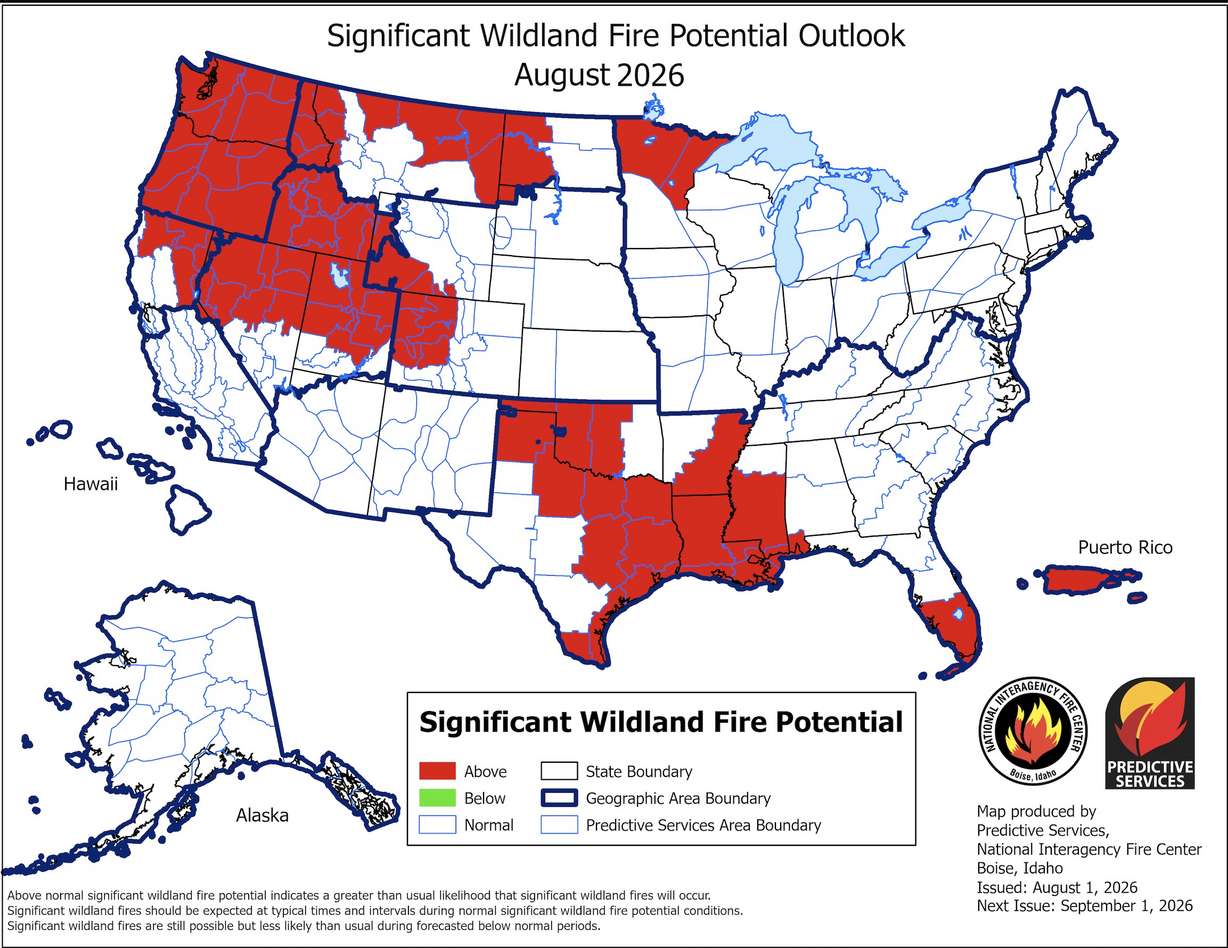
Most of central and northern Utah remains in above-normal fire potential for August, while the risk has dropped to normal in southern Utah, according to the National Interagency Coordination Center. Monsoonal storms have helped reduce some of the state's risks, but not in every region.
"(It) should allow holdovers to start popping up and, certainly, if we see any new fires, there'd be a better potential for growth with the very dry conditions," said Gina Palma, a fire meteorologist with the Great Basin Coordination Center, in a video uploaded on Saturday.
Smoke returns to Utah
A shift in weather patterns is also pushing wildfire smoke from active fires in the Pacific Northwest into Utah this week.
A high-pressure system remains parked over the Four Corners, blocking monsoonal moisture, while a low-pressure system moves north of the state, pushing cooler air but also smoke from fires in Oregon and Washington to Utah, KSL meteorologist Matt Johnson explained.
Several active fires have burned over 2.1 million acres between the two states, per federal data. Air quality index scores across the Wasatch Front and northern Utah ranged from moderate to unhealthy for sensitive groups Monday afternoon.
That's expected to continue across most of the state through at least Wednesday, according to the Utah Division of Air Quality.
"The air quality is going to suffer over the next three days. … It's not going to be as hot, but we deal with smoke," Johnson said, adding that levels are worse near Utah's active fires.
Monsoonal flow could return toward the weekend and into next week, he added.
Contributing: Madi Vollmer and Adam Small
This story will be updated. To be notified about updates, please click Follow This Story below on the KSL app.