'%3e%3cpath%20d='M34.1406%205.85938C30.3906%202.10547%2025.3047%200%2020%200C14.6953%200%209.60938%202.10547%205.85938%205.85938C2.10938%209.61328%200%2014.6953%200%2020C0%2025.3047%202.10547%2030.3906%205.85938%2034.1406C9.61328%2037.8906%2014.6953%2040%2020%2040C25.3047%2040%2030.3906%2037.8945%2034.1406%2034.1406C37.8906%2030.3906%2040%2025.3047%2040%2020C40%2014.6953%2037.8945%209.60938%2034.1406%205.85938ZM37.0117%2023.543H31.1602V13.5391H27.6328V19.9414C28.1211%2020.6914%2028.3711%2021.582%2028.3711%2022.5625V22.625C28.3711%2023.668%2028.1172%2024.6055%2027.6328%2025.4297V26.6094H36.082C33.4883%2032.9375%2027.2891%2037.3789%2020.0039%2037.3789C10.3711%2037.3789%202.62109%2029.6289%202.62109%2020C2.62109%2010.3711%2010.3711%202.62109%2020%202.62109C29.6289%202.62109%2037.3789%2010.3711%2037.3789%2020C37.3789%2021.1484%2037.2617%2022.2656%2037.0508%2023.3477C37.0391%2023.4141%2037.0234%2023.4766%2037.0117%2023.543Z'%20fill='white'/%3e%3cpath%20d='M22.3086%2018.5352C20.4336%2018.125%2019.9531%2017.8398%2019.9766%2017.1836V17.1406C19.9766%2016.6992%2020.3477%2016.2148%2021.4023%2016.2148C22.582%2016.2148%2023.8867%2016.6797%2025.0781%2017.4766L26.8516%2015.0195C25.4453%2013.8906%2023.707%2013.3398%2021.5547%2013.3398C18.5195%2013.3398%2016.4375%2015%2016.4063%2017.4766V17.5352C16.3633%2020.2617%2018.5859%2020.9805%2021.293%2021.6016C23.0391%2021.9766%2023.5703%2022.3164%2023.5703%2022.9609L23.5469%2022.9766C23.5469%2023.3906%2023.2578%2023.7031%2022.7852%2023.8359C22.5742%2023.9062%2022.1289%2023.9727%2021.5156%2023.9727C20.7617%2023.9727%2019.7539%2023.8633%2018.6328%2023.4844C18.0898%2023.2891%2017.4727%2023.0039%2016.8047%2022.6133L20.1406%2026.625C20.2813%2026.6602%2021.0977%2026.8516%2021.7734%2026.8516C25.0039%2026.8516%2027.0859%2025.2461%2027.1094%2022.6328V22.5703C27.1602%2020.1133%2025.2148%2019.1719%2022.3086%2018.5352Z'%20fill='white'/%3e%3cpath%20d='M5.24219%2013.5664V26.6133H8.75391V23.7578L10.2969%2021.9531L14.2031%2026.6133H18.3867L12.3555%2019.5195L17.4023%2013.5664H13.4531L8.75391%2019.0586V13.5664H5.24219Z'%20fill='white'/%3e%3c/g%3e%3cdefs%3e%3cclipPath%20id='clip0_97_2430'%3e%3crect%20width='40'%20height='40'%20fill='white'/%3e%3c/clipPath%3e%3c/defs%3e%3c/svg%3e)


Estimated read time: 2-3 minutes
- Jill Bailey manages severe asthma using an AI app tracking her lung function.
- The app, part of Intermountain Health's study, reduced hospitalizations by 50%.
- Dr. Peter Crossno highlights the app's role in improving patient care efficiency.
MURRAY — For Jill Bailey, managing severe asthma has meant years of doctor visits, medications and hospitalizations.
"I ended up in ICU nine times on life support," she said.
Now, she has a new tool she can use from home — and even from work — an app that uses artificial intelligence to help her and her care team keep track of what's happening with her lungs.
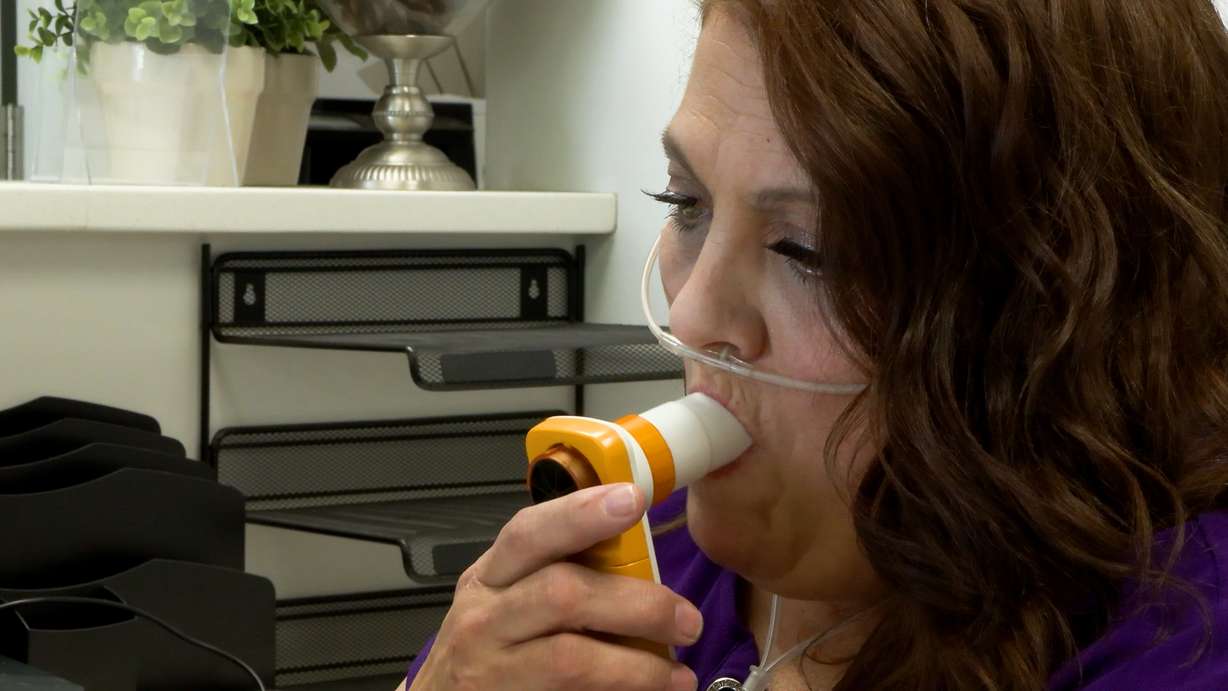
Each day, Bailey breathes into a small device connected to the app. The device measures her lung function and sends the information to the platform.
"I give it three breaths, and then it calculates," she said.
The system can also pull in information from other connected devices, including pulse oximeters and fitness trackers, while Bailey answers questions about her symptoms and medication use.
The AI looks at those data points together, searching for subtle changes that could indicate her condition is worsening. If the system detects a concerning change, a respiratory therapist can step in and contact her.
Dr. Peter Crossno, senior medical director of respiratory care at Intermountain Health and principal investigator of the study, said the goal is to give providers a clearer picture of what's happening between appointments.
"We really wanted to craft both a forward-thinking intervention that uses the technology but also combine it with existing resources to ensure that there still is a human caregiver in the loop," Crossno said.
The technology was tested over two years as part of Intermountain Health and CareCentra's iCARE study, which included about 1,200 patients with asthma, COPD or both.
Across the study, connected devices and patient-reported symptoms generated more than 11.5 million data points — that's an average of about 24 signals per patient per day.
Researchers found hospitalizations dropped by 50%, emergency department visits fell 20%, and total costs of care dropped 57%.
"It's going to make us as clinicians better. It's taking over some of the more mundane parts of taking care of patients to really focus on what's critically important in their care," Crossno said.
For Bailey, the technology has cut down on doctor's visits and ER visits "immensely," and has also helped her better understand her own condition.
"If you don't know your own disease, how can you manage it?" she said.
Bailey said having that information at her fingertips has helped her feel more in control of her health.
"I've had more energy, I've had the ability to do more and help more people and spend more time with my grandkids and kids," she said.
Intermountain Health is now considering ways to expand the technology across its network.