

- French artist Elparo installs his first U.S. sculpture in an Ogden plaza.
- "La Vrille" will be open to the public from Oct. 29 to April 9.
- Elparo's work encourages public interaction and imagination in accessible art spaces.
OGDEN — A massive, spiraling wooden contraption is taking shape in an Ogden plaza, marking a French artist's first U.S.-based installation.
The French artist, known as elparo, has created site-specific, large-scale public art installations in more than 15 countries. His latest edition in his series of artworks titled "La Vrille" is being installed at Dumke Arts Plaza, 445 25th Street, and will be open to the public from Oct. 29 until April 9.
Elparo first got into public art through graffiti, which he did for many years before a local institution asked him to create art for an event.
"This time I was mostly taking all the paints and canvas and trash items, and I decided to create volume with the trash. And people came to this event and said 'Oh this is cool, can you do something for my event?'" he said.
Over the years, he started doing more and more work involving public sculptures. He loves doing public art because it gives people reasons to go outside, meet new people and interact with others and with art in an accessible way.
"Public art you don't have to come to it, it comes to you. You don't have to go to a gallery," he said.
Even though he does also love art in galleries, he understands that for people who don't understand art as much, galleries can be intimidating or sometimes make you feel a little stupid. But with public art, "it's just a gift to people," he said.
The Ogden installation is part of a partnership between the city and Weber State University that started in 2020. The Dumke family endowed the plaza, providing money for it to be used as a gallery and public art space.
Gallery director Andrea Ferber said she finds the artists for the plaza, which showcases two six-month-long installations a year. This year was the first time the plaza did an international call for proposals.
"For this particular project, (elparo) designed a sculpture very specific to the plaza. One of the reasons he was chosen was because he took up all the space of the plaza," Ferber said. "We really are looking for an engagement with the entire space."
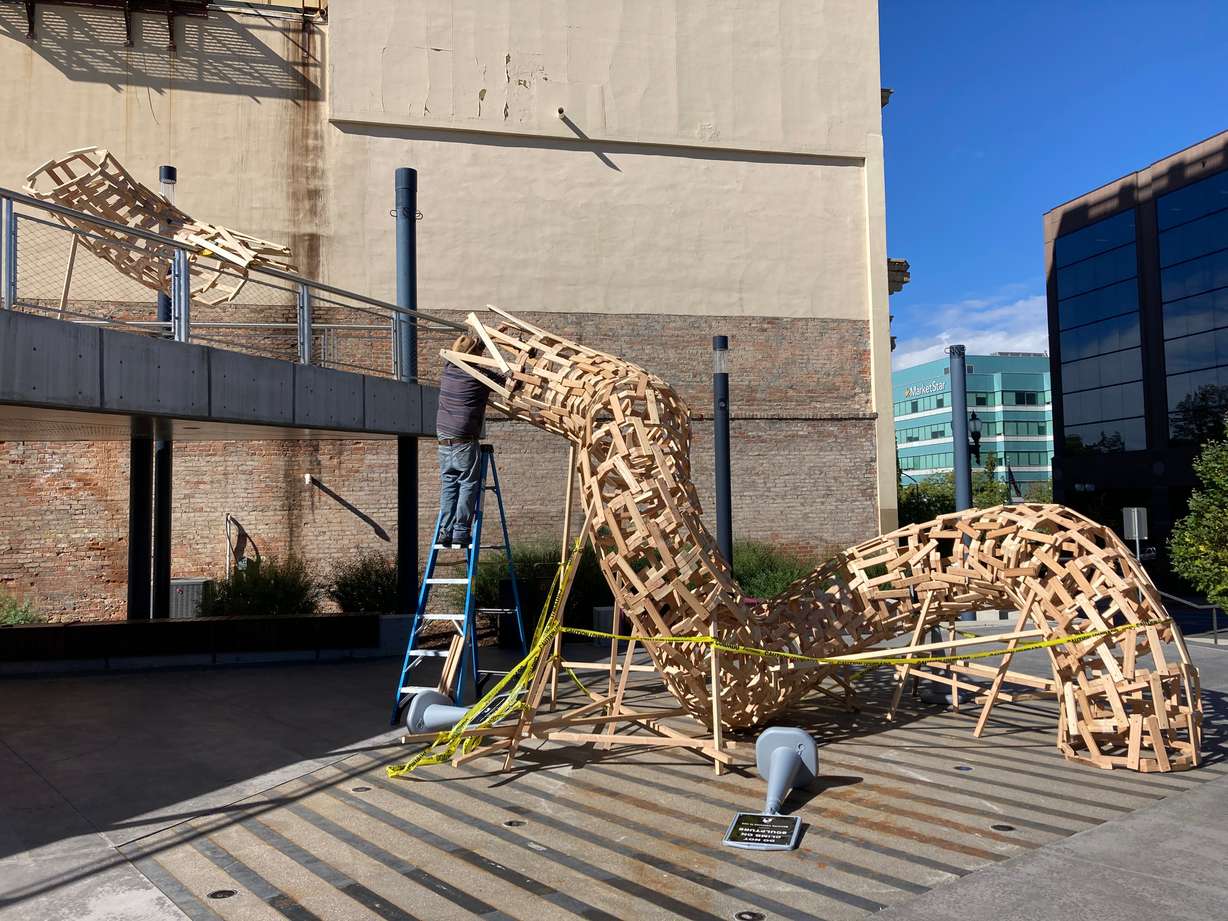
Elparo initially wanted to use reclaimed wood from the trash, as he usually does for his "La Vrille" pieces, but because of travel and time constraints, it "little by little" became brand-new wood, he said. He arrived in Utah mid-October, giving him about two weeks to finish his masterpiece.
Each day, he and Ferber's gallery assistants have worked for hours to saw the lumber and nail hundreds of planks together to bring his design to life.
He goes into each new sculpture project with a plan, but since he does all the construction on site, he often has to be reactive and play along with the constraints of the space.
"I start with pictures of the place and imagine a lot of stuff, like I could do this or that. But when you come inside the space, it's never how you think. So you have to adapt," he said.
As someone with a degree in physics, Elparo uses his knowledge to understand the balance and limits he can push with his art. Each time he creates another "La Vrille" sculpture, the design evolves with the space and location.
He hopes the finished product will give people a place to just sit and imagine.
"The point is to give some abstract volume that everyone can see whatever they want in it and to give some dynamic in the places, which most of the time are quite square," he said. "To give something to people and say to them, 'Imagine whatever you want. You are free there.'"
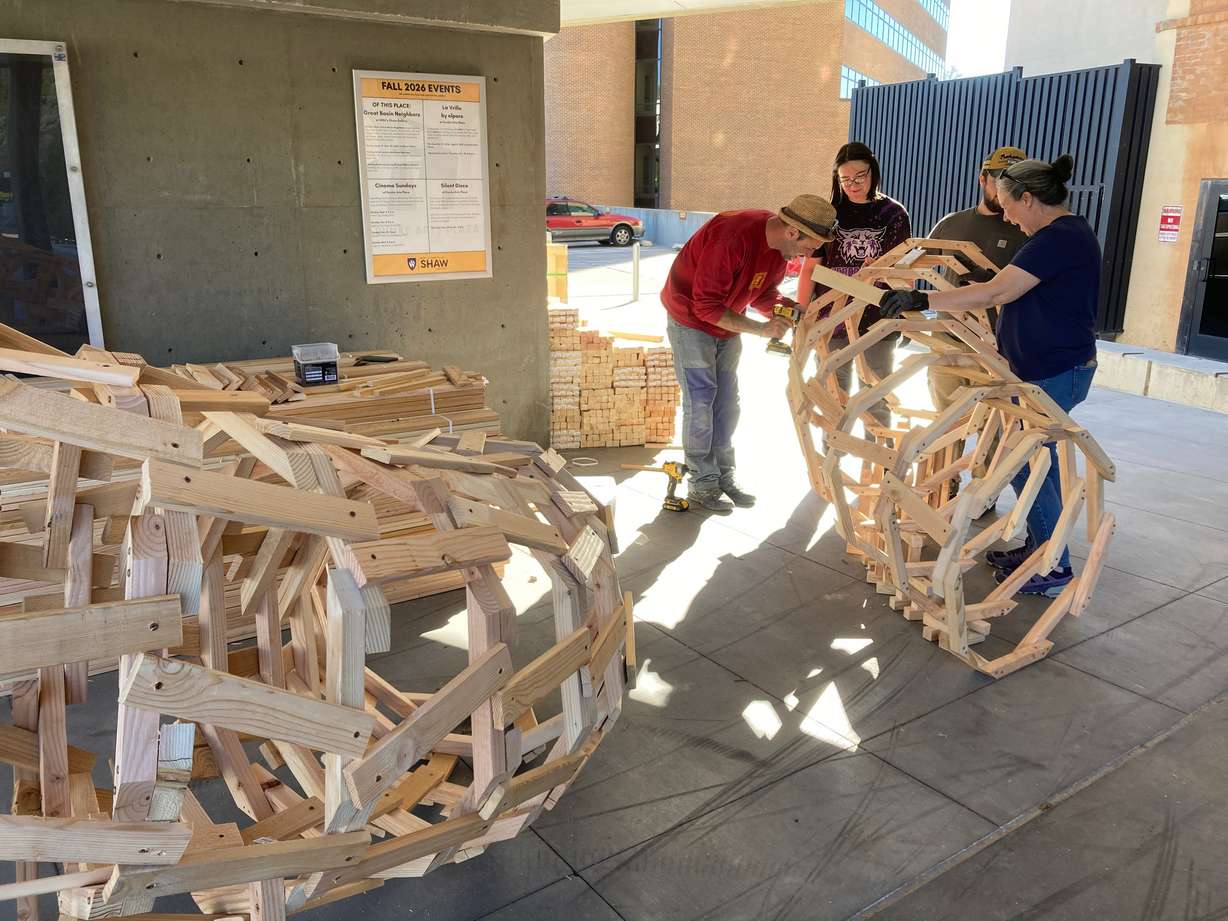
As Elparo has continued making works of art out of recycled materials, he has fallen in love with the process of creating something new and worthwhile out of trash.
"People can say, 'I can do that.' For sure you can do it; it's just screwing planks and grabbing some stuff," he joked. "But the streets are our place. We have to use it and share in it. So this is for the people."
While he isn't quite finished yet with his Ogden iteration of "La Vrille," he is excited about the progress so far and says it will be more than ready for its opening next week.
"Every space is different ... the plaza is two stories and had lots of possibilities to play with the architecture," he said. "Because I travel all around the world to do sculpture, this is a good way to meet people and not be stuck in the same place and I can speak with lots of kinds of people. It's a good exchange, I think."
Even after 10 years of doing sculpture, Elparo says he is still discovering new processes and learning with each one.
"I take every project as a step to the next project. Maybe one day I will have my big sculpture, the final one, you know, but I'm a student and so I just do these sculptures little by little and I'm so happy to have this experiment here," he said.
Ferber said it's an honor that Elparo chose Ogden for his first U.S. work since it's not a major U.S. city.
Public art brings many benefits to a community, she said. Along with beautifying the community, public art makes engaging spaces and experiences, allowing more of the community to come together for events that aren't on a screen. The plaza also hosts other community programming throughout the year to bring people together, she said.
"It's an open public plaza. People come and walk through all the time. Sometimes people bring lunch there or stop there and read or just enjoy it like a public park," Ferber said.