'%3e%3cpath%20d='M34.1406%205.85938C30.3906%202.10547%2025.3047%200%2020%200C14.6953%200%209.60938%202.10547%205.85938%205.85938C2.10938%209.61328%200%2014.6953%200%2020C0%2025.3047%202.10547%2030.3906%205.85938%2034.1406C9.61328%2037.8906%2014.6953%2040%2020%2040C25.3047%2040%2030.3906%2037.8945%2034.1406%2034.1406C37.8906%2030.3906%2040%2025.3047%2040%2020C40%2014.6953%2037.8945%209.60938%2034.1406%205.85938ZM37.0117%2023.543H31.1602V13.5391H27.6328V19.9414C28.1211%2020.6914%2028.3711%2021.582%2028.3711%2022.5625V22.625C28.3711%2023.668%2028.1172%2024.6055%2027.6328%2025.4297V26.6094H36.082C33.4883%2032.9375%2027.2891%2037.3789%2020.0039%2037.3789C10.3711%2037.3789%202.62109%2029.6289%202.62109%2020C2.62109%2010.3711%2010.3711%202.62109%2020%202.62109C29.6289%202.62109%2037.3789%2010.3711%2037.3789%2020C37.3789%2021.1484%2037.2617%2022.2656%2037.0508%2023.3477C37.0391%2023.4141%2037.0234%2023.4766%2037.0117%2023.543Z'%20fill='white'/%3e%3cpath%20d='M22.3086%2018.5352C20.4336%2018.125%2019.9531%2017.8398%2019.9766%2017.1836V17.1406C19.9766%2016.6992%2020.3477%2016.2148%2021.4023%2016.2148C22.582%2016.2148%2023.8867%2016.6797%2025.0781%2017.4766L26.8516%2015.0195C25.4453%2013.8906%2023.707%2013.3398%2021.5547%2013.3398C18.5195%2013.3398%2016.4375%2015%2016.4063%2017.4766V17.5352C16.3633%2020.2617%2018.5859%2020.9805%2021.293%2021.6016C23.0391%2021.9766%2023.5703%2022.3164%2023.5703%2022.9609L23.5469%2022.9766C23.5469%2023.3906%2023.2578%2023.7031%2022.7852%2023.8359C22.5742%2023.9062%2022.1289%2023.9727%2021.5156%2023.9727C20.7617%2023.9727%2019.7539%2023.8633%2018.6328%2023.4844C18.0898%2023.2891%2017.4727%2023.0039%2016.8047%2022.6133L20.1406%2026.625C20.2813%2026.6602%2021.0977%2026.8516%2021.7734%2026.8516C25.0039%2026.8516%2027.0859%2025.2461%2027.1094%2022.6328V22.5703C27.1602%2020.1133%2025.2148%2019.1719%2022.3086%2018.5352Z'%20fill='white'/%3e%3cpath%20d='M5.24219%2013.5664V26.6133H8.75391V23.7578L10.2969%2021.9531L14.2031%2026.6133H18.3867L12.3555%2019.5195L17.4023%2013.5664H13.4531L8.75391%2019.0586V13.5664H5.24219Z'%20fill='white'/%3e%3c/g%3e%3cdefs%3e%3cclipPath%20id='clip0_97_2430'%3e%3crect%20width='40'%20height='40'%20fill='white'/%3e%3c/clipPath%3e%3c/defs%3e%3c/svg%3e)




- Tropical Storm Rachel's remnants brought significant precipitation to Utah, aiding drought relief.
- Some mountain locations received at least 7.5 inches of precipitation; Cottonwood Heights received over 3 inches.
- Utah's mountain soil moisture reached record levels, which can improve spring runoff efficiency.
SALT LAKE CITY — The remnants of what was once Hurricane Rachel ultimately delivered big totals across drought-stricken Utah.
Gauges on Big Mountain and the Mount Timpanogos Divide in the Wasatch Mountains collected at least 7.5 inches of precipitation over a span of a few days, while the Pine Valley Mountains in southwest Utah also collected 7 inches.
Precipitation levels for the first 15 days of the water year are now the highest on record for a few Natural Resources Conservation Service sites across the state, including Little Cottonwood Canyon. It entered Thursday having already received 9.2 inches of precipitation since the water year began on Oct. 1.
The agency's statewide network of 114 sites across all regions gained, on average, 3 inches of precipitation since Rachel's arrival. Most of it fell as rain, but some mountains also collected a healthy first measurable snow of the season.
Snowbird collected 15 inches of snow, but Alta, Brighton and Solitude — also in the Cottonwood Canyons — all collected at least 1 foot of snow. Higher totals were projected at the top of the Uinta Mountains, with peaks that have no sites to collect data from.
Valley communities also received heavy precipitation from Rachel's remnants.
- Cottonwood Heights led the way with 3.2 inches of rain, while Enterprise, Washington County also wound up with over 3 inches across multiple days.
- Brigham City, Monticello, North Salt Lake and Ogden were among the communities that ended up with over 2 inches.
- Logan, Price and Tooele all ended up close to 2 inches.
- Salt Lake City officially received 1.25 inches from the storms, but a University of Utah site collected 2.47 inches and a downtown site collected 1.95 inches.
All of this translated into some flooding, but also multiple benefits heading into winter.
A big boost in soil moisture
Utah's collective statewide mountain soil moisture reached 64.2% on Thursday — 5.1 percentage points above the previous mid-October record over the past 20 years of data collected by the Conservation Service.
It climbed into record territory on Tuesday and is now just 2.7 points below the meteorological fall record.
This may not seem that exciting, but it's a huge deal for Utah's hydrology.
October is particularly important because it's at the beginning of the water year.
"Starting in the fall, we get our soil really wet, hopefully, for the winter. Then we get our snowpack, have our spring runoff, fill up our reservoirs, and then we use it over the summer and to the end of the (water) year," said Laura Haskell, drought coordinator for the Utah Division of Water Resources, summarizing how Utah's water years play out.
Approximately 95% of the state's water supply is tied to mountain snowpack, and experts have learned that soil moisture levels play a key role in how efficiently mountain snow melts into the streams, creeks and rivers that feed into the state's lakes and reservoirs.
When moisture levels are high, more of the water in the snow goes to the reservoirs. As those levels lower, the ground essentially acts like a sponge, absorbing most of the water to recharge the underground system.
Once the snowpack collection begins, Utah is essentially locked into the soil moisture it has in place.
It's still too soon to know what this winter will provide, but everyone from water managers to skiers and snowboarders is hopeful that this year will be fruitful after a record-low snowpack during the 2026 water year.
Chipping away at drought
It's difficult to overcome a record-low snowpack, so Rachel's remnants didn't solve Utah's reservoir depletions. The statewide system remains at 48% capacity, down 8 percentage points from the median average for the start of a new water year, per state data.
It also didn't immediately lift any part of Utah out of drought, either, but it did dent its severity.
Approximately 71% of the state remains in severe or extreme drought, down 5 percentage points from last week and 21 points from last month, the U.S. Drought Monitor reported on Thursday. It's based on observations collected on Tuesday, before the stormy weather officially subsided.
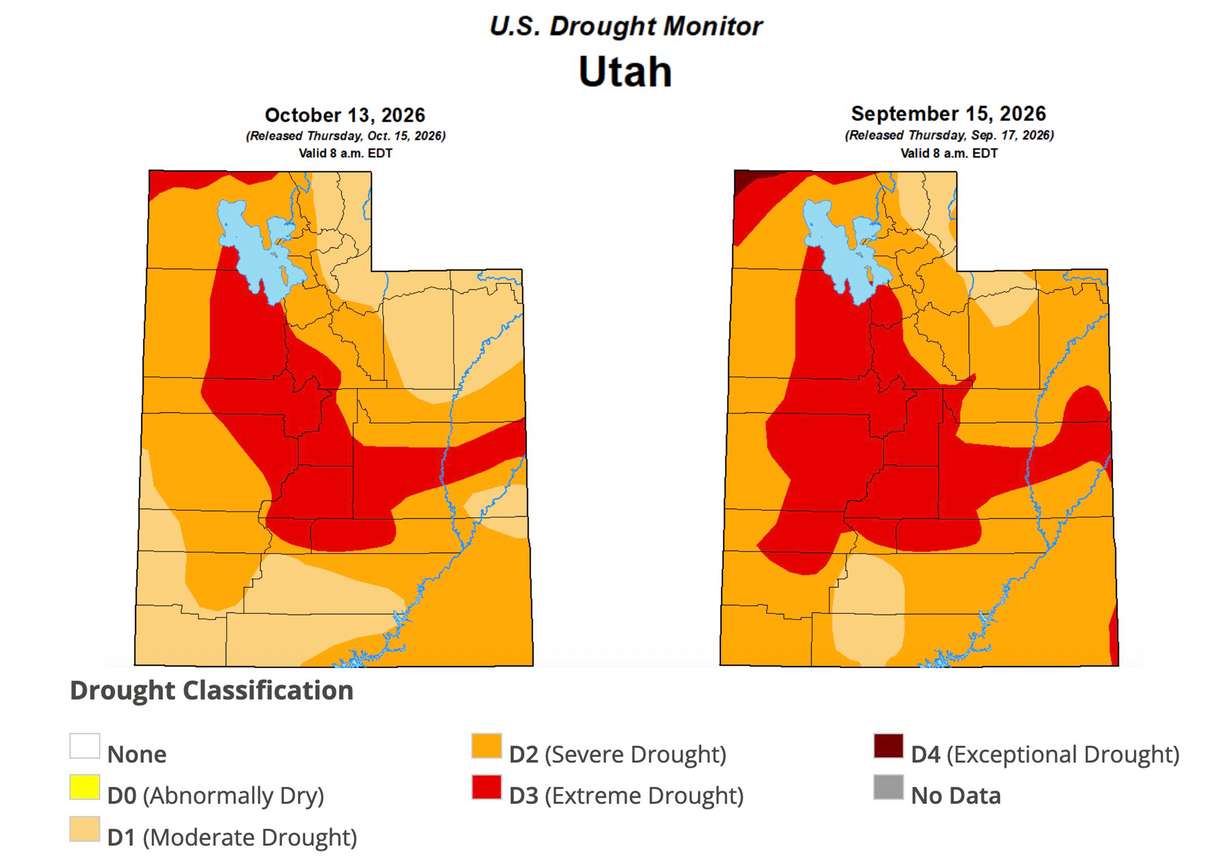
Nationwide drought conditions "changed considerably" because of Rachel and other named storms, according to Lindsay Johnson, a climatologist for the National Drought Mitigation Center.
The Southwest and Intermountain West, including Utah, were among the big winners of the week, Johnson added in an adjoining report, but she cautioned that both regions still have a long way to go to overcome drought conditions impacting both regions.
"Despite these improvements, significant drought persisted across portions of the Great Basin, Southwest and northern Rockies," she added.
Contributing: Debbie Worthen