
- Utah's 2026 water year was the warmest on record, affecting snowpack levels.
- The state experienced its 49th-driest water year, with some areas faring better than others.
- Cache and Rich counties fared best, while Millard County had the lowest precipitation.
SALT LAKE CITY — Utah's 2027 water year is off to a strong start, with record-high soil moisture levels in the mountains after the remnants of Tropical Storm Rachel passed through the state.
It also chipped away at Utah's drought severity, but Utah and many parts of the West are still dealing with "significant drought," Lindsay Johnson, a climatologist for the National Drought Mitigation Center, noted in a U.S. Drought Monitor report on Thursday. The report noted that all parts of Utah remain in at least moderate drought, with over 70% still in severe or extreme drought.
You can blame the 2026 water year for that, which wrapped up on Sept. 30.
All the storms that closed out the year and began the 2027 water year are nice — but it's nothing compared to snowpack, which accounts for approximately 95% of the state's water supply.
Why the 2026 water year was so brutal
Utah, on average, collected 12.47 inches throughout the 2026 water year, which wasn't great, but wasn't terrible, according to federal climate data released earlier this month. It was the 49th-driest out of the past 131 water years tracked by the National Centers for Environmental Information, which blends mountain and valley data.
The past water year shattered every temperature record, though, which helps explain the state's current water situation.
Utah's average temperature of 53.8 degrees between Oct. 1, 2025, and Sept. 30 of this year was 2.1 degrees above the previous record from the 1934 water year. The water year also blew past all previous minimum and maximum temperature records, the center added.
All 29 counties shattered previous records over the past 131 water years, so the numbers were even across the board.
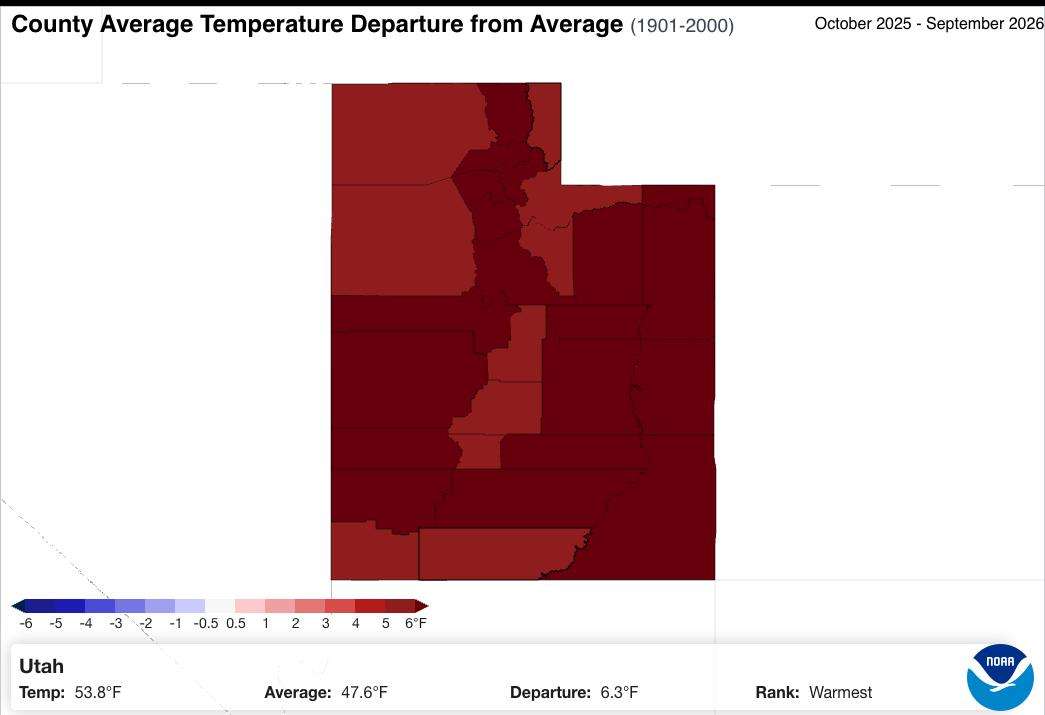
Every season either broke a record or almost did, including the vital snow collection months, which ultimately led to the state's water challenges.
A gallon of rain isn't the same as a gallon of snowmelt, according to Jon Meyer, assistant state climatologist for the Utah Climate Center at Utah State University. He explained earlier this year that this is because rain falls faster than the soil can absorb it and moves downstream before it can be stored, he said, while snowpack offers more concentrated levels that are released at the end of the snow season.
Utah's water system, Meyer pointed out, is "built for delayed release" from snowpack.
So while last year's average mountain precipitation collection was 96% of normal, it was essentially impossible to overcome the record-low snowpack that was barely over 50% of normal, said Jordan Clayton, a hydrologist for the Conservation Service and director of the Utah Snow Survey.
"During the snow season, November through spring and into June even, the conditions were well below normal for precipitation. We definitely got some (precipitation) here and there, but by and large, the whole state was below normal for the time that we needed it, which is during the winter," he told KSL earlier this month.
Utah's reservoir levels peaked at 71% of capacity in May, which was 4 percentage points and a month earlier than normal, per state water data. They're currently 48%, as compared to the normal of 56% and last year's average of 60%.
The state's drought only worsened. It peaked at 95% in severe or worse drought by mid-July, as compared to 43% at the beginning of the calendar year, which had benefited from heavy rain that fell at the start of the water year.
Precipitation by region
In all reality, everyone lost last year because every Utah region suffered from the record-low snowpack, but the new federal data shows some counties fared much better than others in terms of 2026 water year precipitation.
The range on the scale is pretty extreme, too.
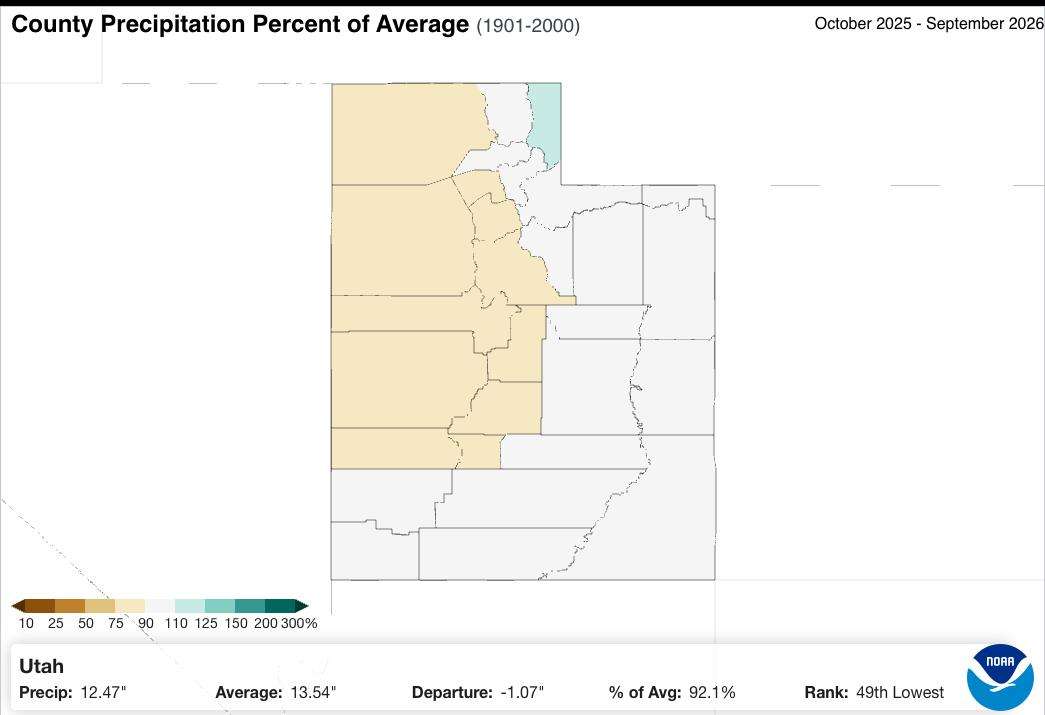
Who got the most
South-central, central and northeast Utah were the biggest precipitation winners, in terms of percentage of normal.
Cache County collected 28.93 inches, leading all counties, but it also typically leads the state in water-year precipitation. Its total was approximately 104% of its 20th-century normal.
Rich County led the way in terms of where it places within its record book. It collected 16.73 inches, 111% of its 20th-century normal and its 33rd wettest water year on record.
Carbon, Duchesne, Emery and Garfield also ended up with 100% of normal precipitation totals, while Iron, Kane, Uintah and Wayne counties ended up with over 95% of the normal.
Most other counties ended up fairly close to the middle of the road when it comes to where the year landed in its record book.
Clayton pointed to the Uinta Mountains, as well as the Virgin and Santa Clara river headwaters in southwestern Utah, as examples of better conditions on a water-year perspective.
Who got the least
Parts of the Wasatch Front, as well as western Utah, fared the worst in terms of what's normal.
Millard County received the least at 7.72 inches, and while it's normally one of the state's driest counties, it was 78% of normal and its 21st-driest water year on record — the closest to record-low of all counties.
Juab, Sanpete, Sevier and Tooele counties, surrounding Millard, all ended up between 78% and 84% of normal. Salt Lake County also experienced abnormally dry conditions. Its 22.11 inches was 86% of normal and its 34th-driest water year since 1895.
Outside of waters around the Wasatch Front, the Upper Sevier and Dirty Devil headwaters and western Utah struggled, Clayton said.
Ongoing drought impacts
Most of this shows up in the latest Drought Monitor map, where the most extreme conditions in Utah are still in west-central Utah, as well as central Utah. Those regions are still reeling from record-low snowpack, too.
Northeast Utah and southwest Utah are in the best condition, but still in moderate drought after the 2026 water year and the start of the new year.
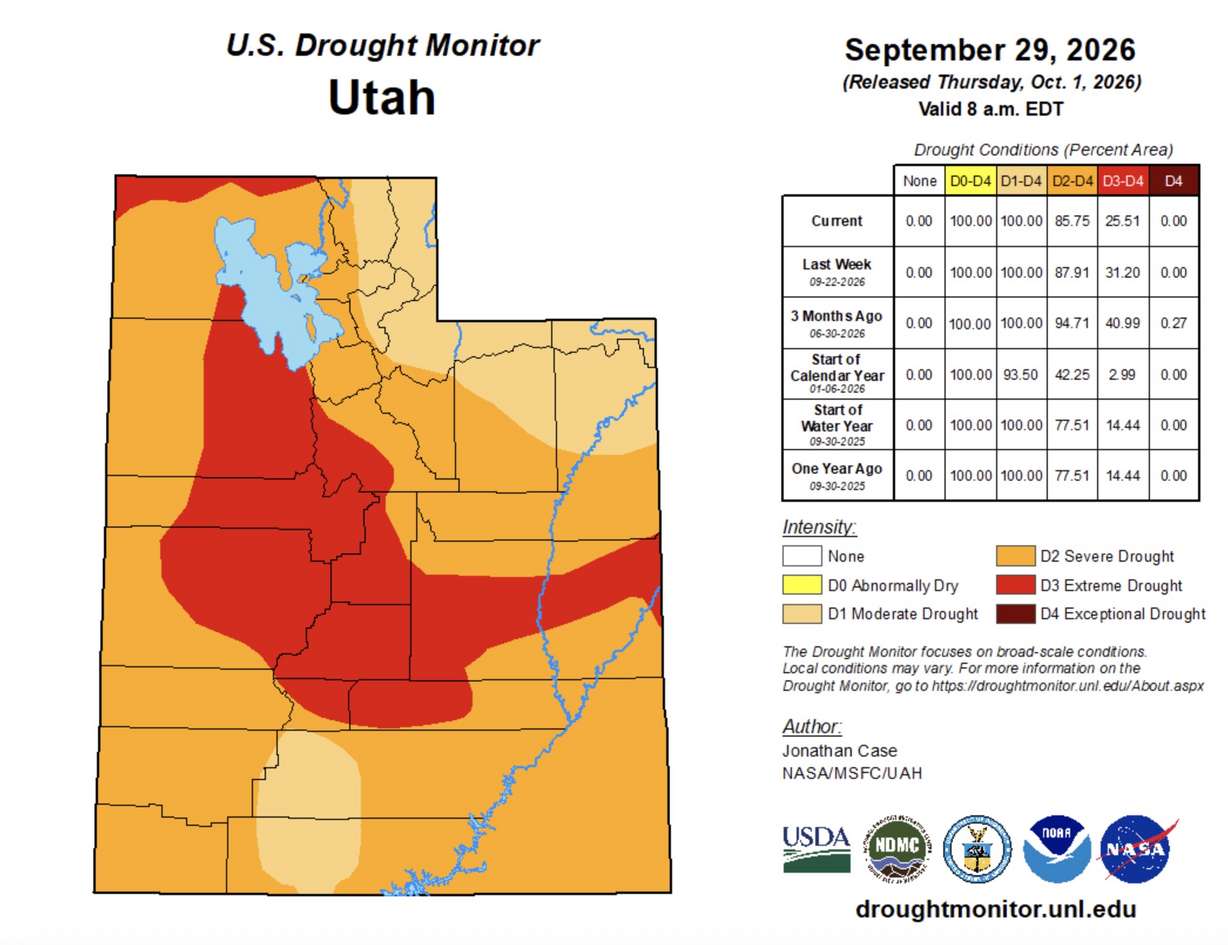
This upcoming winter will likely determine drought trends for the rest of the 2027 water year. While Tropical Storm Rachel offers hope for the water year, experts like Clayton say it's still too early to tell how this winter will go.
That will also determine bodies of water like Lake Powell and the Great Salt Lake, in addition to the state's reservoir system.
"We don't want to hang our hat on having an above-normal winter just yet, but we're certainly hoping for that," he said. "There's nothing we can do other than hope for the best in terms of our snowpack for next runoff season."