'%3e%3cpath%20d='M34.1406%205.85938C30.3906%202.10547%2025.3047%200%2020%200C14.6953%200%209.60938%202.10547%205.85938%205.85938C2.10938%209.61328%200%2014.6953%200%2020C0%2025.3047%202.10547%2030.3906%205.85938%2034.1406C9.61328%2037.8906%2014.6953%2040%2020%2040C25.3047%2040%2030.3906%2037.8945%2034.1406%2034.1406C37.8906%2030.3906%2040%2025.3047%2040%2020C40%2014.6953%2037.8945%209.60938%2034.1406%205.85938ZM37.0117%2023.543H31.1602V13.5391H27.6328V19.9414C28.1211%2020.6914%2028.3711%2021.582%2028.3711%2022.5625V22.625C28.3711%2023.668%2028.1172%2024.6055%2027.6328%2025.4297V26.6094H36.082C33.4883%2032.9375%2027.2891%2037.3789%2020.0039%2037.3789C10.3711%2037.3789%202.62109%2029.6289%202.62109%2020C2.62109%2010.3711%2010.3711%202.62109%2020%202.62109C29.6289%202.62109%2037.3789%2010.3711%2037.3789%2020C37.3789%2021.1484%2037.2617%2022.2656%2037.0508%2023.3477C37.0391%2023.4141%2037.0234%2023.4766%2037.0117%2023.543Z'%20fill='white'/%3e%3cpath%20d='M22.3086%2018.5352C20.4336%2018.125%2019.9531%2017.8398%2019.9766%2017.1836V17.1406C19.9766%2016.6992%2020.3477%2016.2148%2021.4023%2016.2148C22.582%2016.2148%2023.8867%2016.6797%2025.0781%2017.4766L26.8516%2015.0195C25.4453%2013.8906%2023.707%2013.3398%2021.5547%2013.3398C18.5195%2013.3398%2016.4375%2015%2016.4063%2017.4766V17.5352C16.3633%2020.2617%2018.5859%2020.9805%2021.293%2021.6016C23.0391%2021.9766%2023.5703%2022.3164%2023.5703%2022.9609L23.5469%2022.9766C23.5469%2023.3906%2023.2578%2023.7031%2022.7852%2023.8359C22.5742%2023.9062%2022.1289%2023.9727%2021.5156%2023.9727C20.7617%2023.9727%2019.7539%2023.8633%2018.6328%2023.4844C18.0898%2023.2891%2017.4727%2023.0039%2016.8047%2022.6133L20.1406%2026.625C20.2813%2026.6602%2021.0977%2026.8516%2021.7734%2026.8516C25.0039%2026.8516%2027.0859%2025.2461%2027.1094%2022.6328V22.5703C27.1602%2020.1133%2025.2148%2019.1719%2022.3086%2018.5352Z'%20fill='white'/%3e%3cpath%20d='M5.24219%2013.5664V26.6133H8.75391V23.7578L10.2969%2021.9531L14.2031%2026.6133H18.3867L12.3555%2019.5195L17.4023%2013.5664H13.4531L8.75391%2019.0586V13.5664H5.24219Z'%20fill='white'/%3e%3c/g%3e%3cdefs%3e%3cclipPath%20id='clip0_97_2430'%3e%3crect%20width='40'%20height='40'%20fill='white'/%3e%3c/clipPath%3e%3c/defs%3e%3c/svg%3e)


Estimated read time: 3-4 minutes
- BYU researchers are assisting NASA's Dragonfly mission to explore Titan, Saturn's largest moon.
- They study Earth's dunes as analogues for Titan's landscape, aiding NASA's interpretation.
- Students gain valuable experience, contributing to the mission's understanding of potential habitability.
PROVO — NASA's Dragonfly mission, set to launch in 2028, is a first-of-its-kind voyage that will send a robotic spacecraft to Titan, Saturn's largest moon, where scientists hope to uncover clues about the building blocks of life as we know it.
Still two years out, the space-exploration agency has called on a group of Brigham Young University researchers to help develop an understanding of the landscape the Dragonfly rotorcraft will explore, so NASA can better interpret its findings.
But why Titan?
As Saturn's largest moon, Titan is the most Earth-like world known to date, with a dense atmosphere, stable surface liquids and a weather cycle. Additionally, it's covered in complex carbon-based molecules, making it a prime place for scientists to investigate habitability.
"Titan has an atmosphere with the same pressure as Earth's at the surface, and it's actually really enabling because that high-pressure atmosphere helps us to fly very easily," Jani Radebaugh, BYU geology professor and member of the NASA science team, said in a video about the team's work.
Like its atmosphere, Titan's landscapes, Radebaugh said, are also extremely similar to Earth's.
This will allow Dragonfly to explore miles and miles of Titan during its planned 3.3-year mission, with the rotorcraft expected to make one flight every one to two Titan days (about 16 Earth days), according to NASA.
More specifically, Radebaugh and her team are studying dune landscapes on Earth to act as analogs to what the Dragonfly rotorcraft might find on Titan. Their work will help NASA understand where to search for evidence of life, land the drone and collect data.
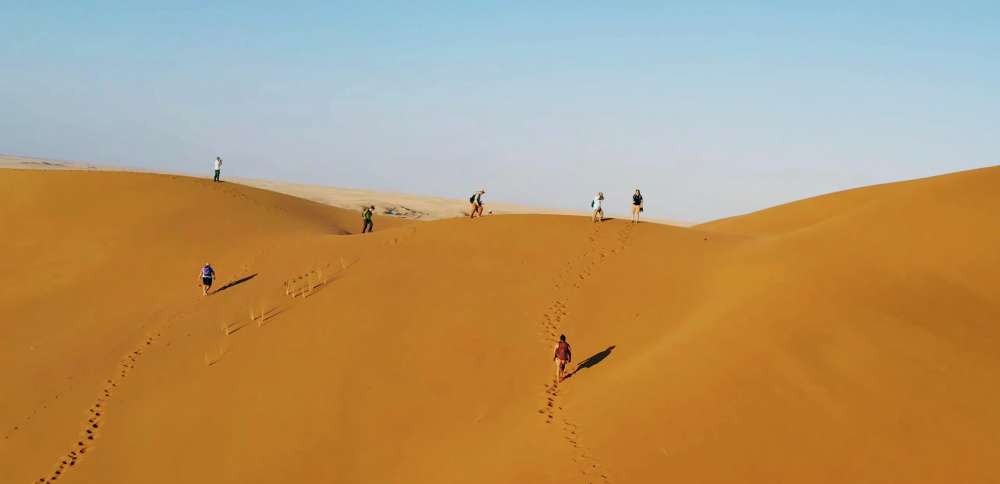
"I had the opportunity to go to the Namib Sand Sea in the southern part of Africa, and we looked at the sand dunes there because they are geometrically the most similar to sand dunes that are found on Saturn's moon, Titan," BYU geology student Logan Peatross said in the video.
As on Titan, the dunes of Namibia are tall, linear ridges that stretch for hundreds of kilometers.
But Radebaugh said that she's particularly interested in the space between the dunes — known as interdunes — where Dragonfly will actually land.
"We went around and scouted out areas that would be potential landing sites. It was really interesting thinking about what it would be like if I could just teleport straight to Titan and see the same structures that I was seeing in Namibia," Peatross said.
The work also took BYU researchers to the Great Kobuk Sand Dunes of Alaska, where BYU master's student Emma Gosselin used ground-penetrating radar to identify deep pockets of water beneath the ice-covered dunes.
"(Our) job was specifically to drill down to look for biology, microbiology, bacteria, and sampling it to kind of assess the astrobiological potential of a cold place in our solar system that also has sand dunes, like Mars or Saturn's moon Titan," Gosselin said in the video.
Essentially, Gosselin and other researchers were looking for areas that could harbor lifeforms, hinting at Titan's potential habitability even in extreme cold.
For Radebaugh, the work is not just valuable to NASA but also to students, giving them a sense of "excitement and hope and exploration."
"I bring my students along on this whole process, so there's always going to be a BYU student involved in Dragonfly. It's such a valuable opportunity to work with NASA, especially for our BYU students. They get to be a part of the forefront of exploration," Radenbaugh said.