'%3e%3cpath%20d='M34.1406%205.85938C30.3906%202.10547%2025.3047%200%2020%200C14.6953%200%209.60938%202.10547%205.85938%205.85938C2.10938%209.61328%200%2014.6953%200%2020C0%2025.3047%202.10547%2030.3906%205.85938%2034.1406C9.61328%2037.8906%2014.6953%2040%2020%2040C25.3047%2040%2030.3906%2037.8945%2034.1406%2034.1406C37.8906%2030.3906%2040%2025.3047%2040%2020C40%2014.6953%2037.8945%209.60938%2034.1406%205.85938ZM37.0117%2023.543H31.1602V13.5391H27.6328V19.9414C28.1211%2020.6914%2028.3711%2021.582%2028.3711%2022.5625V22.625C28.3711%2023.668%2028.1172%2024.6055%2027.6328%2025.4297V26.6094H36.082C33.4883%2032.9375%2027.2891%2037.3789%2020.0039%2037.3789C10.3711%2037.3789%202.62109%2029.6289%202.62109%2020C2.62109%2010.3711%2010.3711%202.62109%2020%202.62109C29.6289%202.62109%2037.3789%2010.3711%2037.3789%2020C37.3789%2021.1484%2037.2617%2022.2656%2037.0508%2023.3477C37.0391%2023.4141%2037.0234%2023.4766%2037.0117%2023.543Z'%20fill='white'/%3e%3cpath%20d='M22.3086%2018.5352C20.4336%2018.125%2019.9531%2017.8398%2019.9766%2017.1836V17.1406C19.9766%2016.6992%2020.3477%2016.2148%2021.4023%2016.2148C22.582%2016.2148%2023.8867%2016.6797%2025.0781%2017.4766L26.8516%2015.0195C25.4453%2013.8906%2023.707%2013.3398%2021.5547%2013.3398C18.5195%2013.3398%2016.4375%2015%2016.4063%2017.4766V17.5352C16.3633%2020.2617%2018.5859%2020.9805%2021.293%2021.6016C23.0391%2021.9766%2023.5703%2022.3164%2023.5703%2022.9609L23.5469%2022.9766C23.5469%2023.3906%2023.2578%2023.7031%2022.7852%2023.8359C22.5742%2023.9062%2022.1289%2023.9727%2021.5156%2023.9727C20.7617%2023.9727%2019.7539%2023.8633%2018.6328%2023.4844C18.0898%2023.2891%2017.4727%2023.0039%2016.8047%2022.6133L20.1406%2026.625C20.2813%2026.6602%2021.0977%2026.8516%2021.7734%2026.8516C25.0039%2026.8516%2027.0859%2025.2461%2027.1094%2022.6328V22.5703C27.1602%2020.1133%2025.2148%2019.1719%2022.3086%2018.5352Z'%20fill='white'/%3e%3cpath%20d='M5.24219%2013.5664V26.6133H8.75391V23.7578L10.2969%2021.9531L14.2031%2026.6133H18.3867L12.3555%2019.5195L17.4023%2013.5664H13.4531L8.75391%2019.0586V13.5664H5.24219Z'%20fill='white'/%3e%3c/g%3e%3cdefs%3e%3cclipPath%20id='clip0_97_2430'%3e%3crect%20width='40'%20height='40'%20fill='white'/%3e%3c/clipPath%3e%3c/defs%3e%3c/svg%3e)




Estimated read time: 3-4 minutes
- Utah officials express concern after screwworm found in Texas for first time in decades.
- No immediate threat to Utah's food supply; vigilance urged for farmers and ranchers.
- Texas establishes quarantine zone; previous infestations caused significant economic losses.
TAYLORSVILLE — Utah agricultural officials say there's no immediate threat to Utah's food supply after the U.S. Department of Agriculture confirmed an infestation of the parasite with flesh-eating larvae in Texas on Wednesday, the first U.S. case in decades.
"We want to be very clear that there is no public health or food safety concern with regard to new world screwworm at this time," said Kelly Pehrson, commissioner of the Utah Department of Agriculture and Food, in a statement on Thursday. "While we are ready to take action and eliminate it, (screwworm) does not currently pose a risk to the food supply."
Screwworms are a fly species that is attracted to the wounds on animals. It will lay eggs next to wounds, which hatch and burrow into the wound, eating the live tissue of the animal. This can lead to severe infections and death, said Amanda Price, Utah's state veterinarian.
It is treatable if caught quickly, she explains, which is why she urges farmers, ranchers and pet owners to remain vigilant.
The species was found in a 3-week-old calf in La Pryor, Texas, about 50 miles from the Mexico border, marking the first Texas case since 1966 and the first in the U.S. since the 1970s, according to the Associated Press. A mix of rapid detection, treatment and sterile flies helped eradicate the species at the time, Price said.
Price told KSL that she and other state agricultural officials had been tracking the species' potential U.S. revival well before Wednesday's announcement. They started watching in 2023, as screwworm cases began to increase in Central America and creep northward into Mexico — and now the U.S.
"We're a little bit concerned that this is just the tip of the iceberg in the U.S.," she said. "If they do come to Utah, it will probably be through the movement of animals into the state from an infested area."
U.S. officials have shut down U.S.-Mexico border ports, hoping to limit screwworms from entering the country on cattle and horses. Yet, that doesn't stop wildlife or the flies themselves from crossing the border. Traps and monitoring programs have been set up to limit the migration.
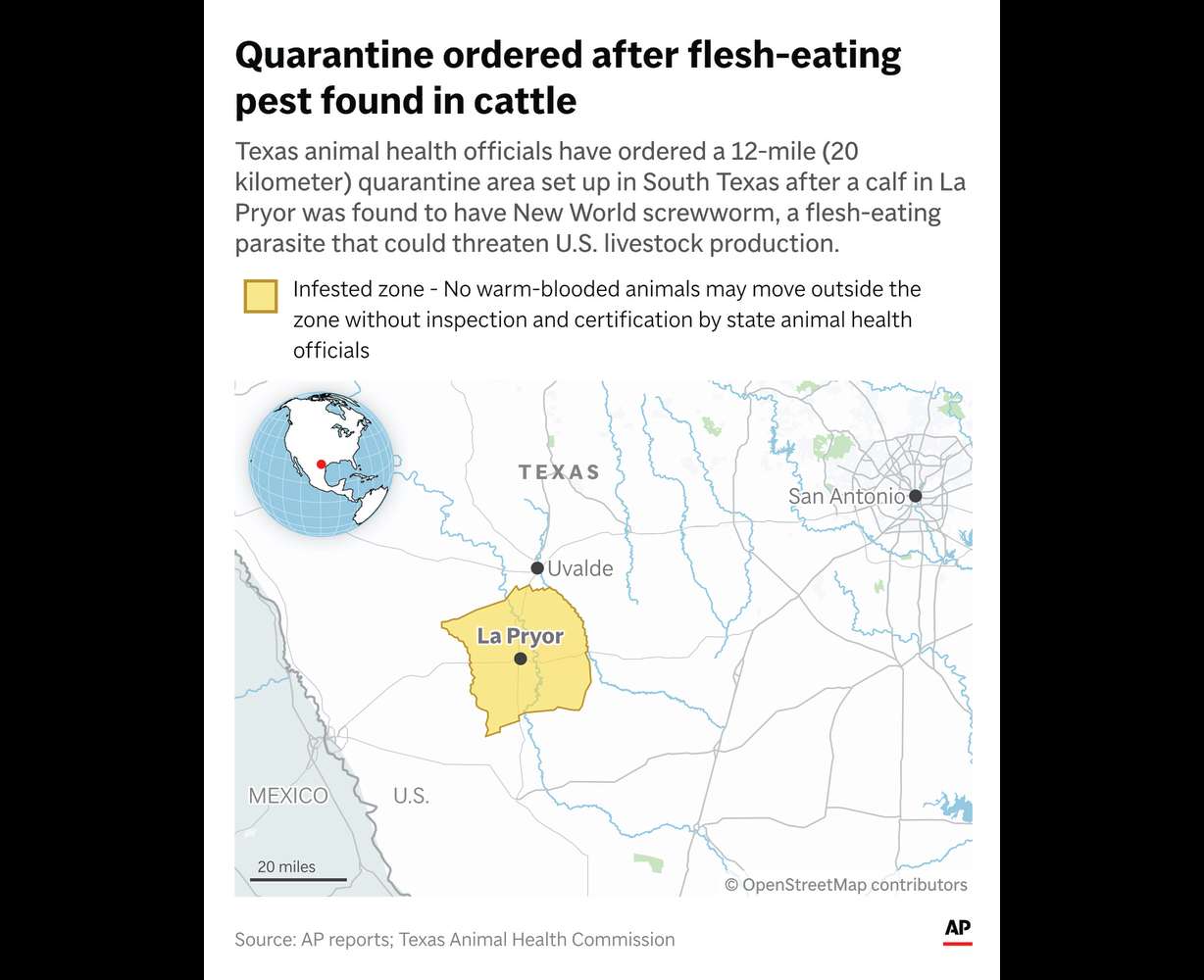
Texas officials established a 12-mile quarantine zone surrounding La Pryor in response to the first confirmed case in the U.S. Previous infestations, the AP reported, caused tens of millions of dollars of losses, or billions in today's dollars.
Price said she doesn't know what the new U.S. case will mean for the country's beef supply, but she believes it may not mean much since she said many Southern states have been preparing for this situation for "a long time." She believes the same mix that helped eradicate the screwworm decades ago will be applied now that it has returned, on top of the improved medications and tools available in the industry.
"It's just a matter of finding it and getting ahead of it," she said.
Avian flu returns to Utah cattle
Screwworms aren't the only problem that Utah agricultural officials are monitoring. Department officials announced on Monday that a dairy sample recently collected in Cache County tested positive for highly pathogenic avian influenza, resulting in new weekly surveillance in the region.
The virus spread through millions of birds since a countrywide outbreak in 2022, leading to higher egg and chicken prices. It was also found in cattle in Utah in 2024 and early 2025. The recent sampling is its first detection since then.
Utah agricultural officials say it's not an "immediate public health concern" at the moment.
"At present, no major impacts to the food supply chain are anticipated," they wrote in a statement. "There have been no confirmed cases of (avian flu) in humans in Utah."
Contributing: Becky Bruce