
Estimated read time: 5-6 minutes
- The book "From Jikji to Gutenberg" challenges Gutenberg's title as the "Father of Printing."
- Randy Silverman co-edited the book, highlighting Korea's 'Jikji' as the first printed text.
- UNESCO recognized "Jikji" and Gutenberg's Bible as international achievements in 2001.
SALT LAKE CITY — Here's a query posed to ChatGPT: "Who is history's most important inventor?"
The AI chatbot considered innovators Nikola Tesla and Thomas Edison before offering its final verdict: "If we're measuring who most changed civilization, I argue Johannes Gutenberg deserves the top spot."
Gutenberg, of course, was long-ago christened the "Father of Printing" after crafting a press using movable type to print a 42-line Bible in the mid-1400s. The A&E Network even dubbed the inventor the "Man of the Millennium."
The German craftsman's contribution to advancing Western civilization remains unimpeachable. But was his 15th century document — printed on a press utilizing movable metal type — actually the first of its kind?
Nope.
In fact, the oldest extant book printed from cast-metal type was produced several decades earlier in Korea, thousands of miles from Gutenberg's Germany.
The book's name? "Jikji Simche Yojeol," or translated, "Essential Passages Pointing Directly to the Mind."
Like Gutenberg's Bible, "Jikji" is a religious text. It was reportedly compiled by the Buddhist monk Master Baegun and shares the stories of revered Buddhist Chan monks.
But that historical fact prompts several contemporary questions.
Given its pioneering role in printing history, why isn't the existence and history of "Jikji" more widely known, at least in the West? And is that unfamiliarity simply a matter of historical unawareness — or a symptom of Eurocentrism?
Those are questions prompted by the publication of "From Jikji to Gutenberg," a hefty new 672-page volume that explores the origins of movable metal type.
Co-edited by University of Utah Marriott Library's head of preservation Randy Silverman, the book includes dozens of essays from scholars from around the world tracing the evolution of moveable-type printing, including the origins of Korea's "Jikji."
And, as Silverman notes in the volume's introduction, "this book is a long-overdue step toward setting the record straight and for Western culture to seriously consider how indebted we are to Asian ingenuity."
A Utahn discovers a history-defining document in Korea
If you're not familiar with "Jikji" and its place in global printing history, give yourself some grace. Silverman himself had been working as a professional preservationist for a quarter-century before he learned of the Korean document's existence.
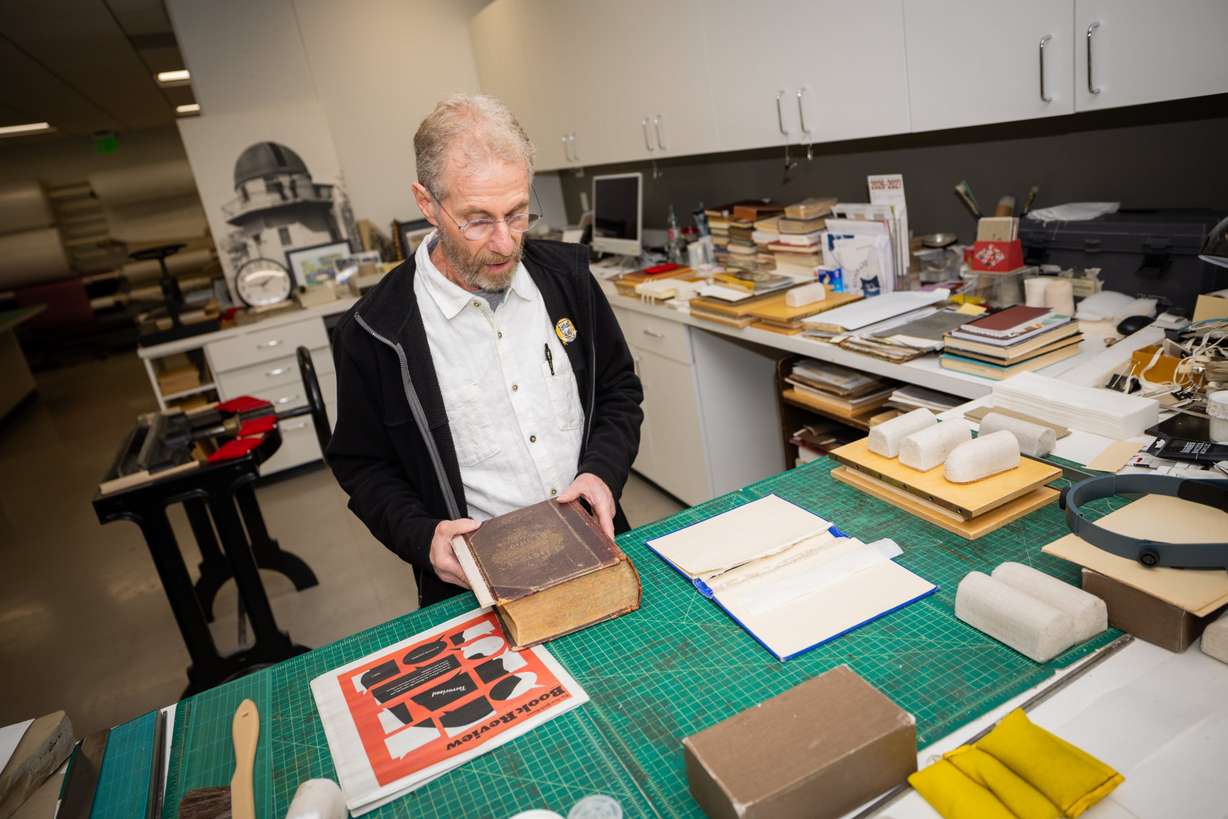
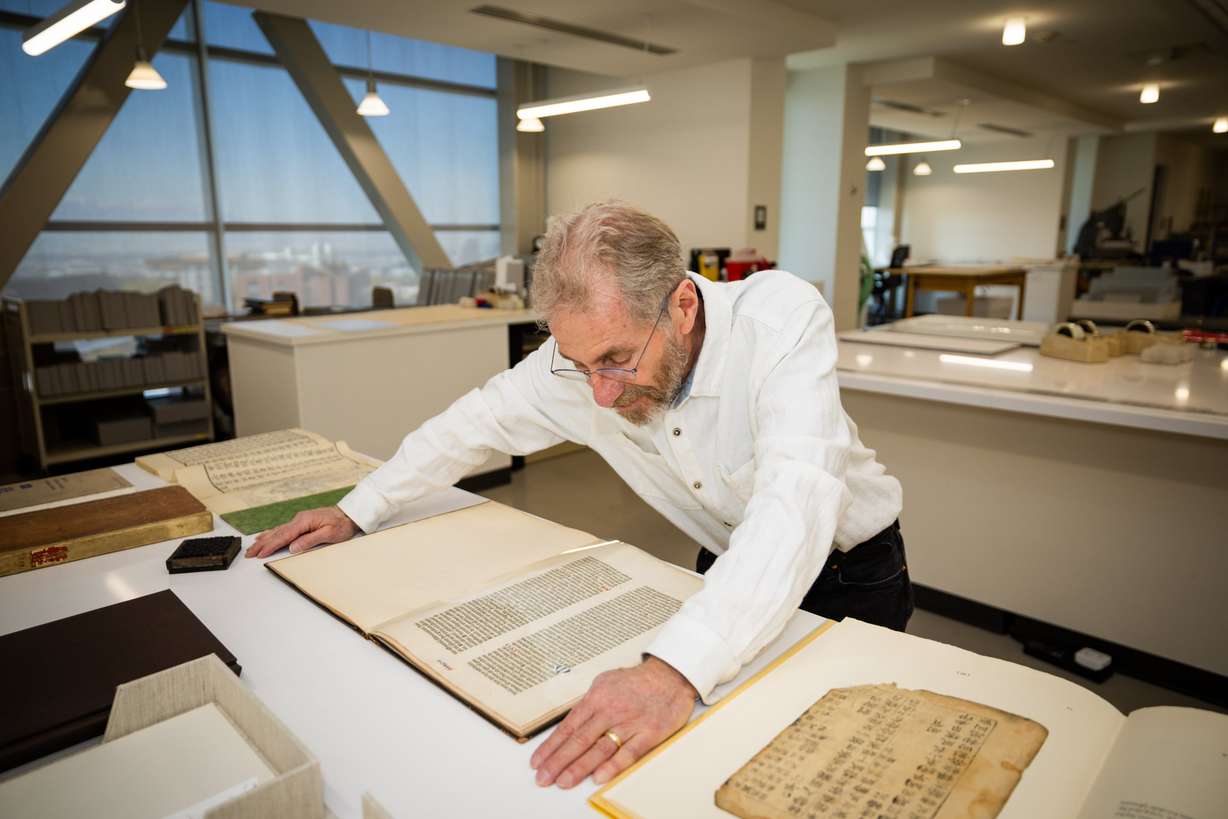
To be sure, Silverman is a Gutenberg fan. When a pair of visitors recently toured the Marriott Library's preservation and conservation lab to discuss "Jikji," he relished the opportunity to show his guests an actual leaf from the Gutenberg Bible now owned by the University of Utah.
And like many Westerners, Silverman had accepted Gutenberg as the civilization-advancing innovator who introduced metal movable type to the world. It's what he had been taught.

Then in the early 2000s, Silverman traveled to Korea at the invitation of the United Nations Educational, Scientific and Cultural Organization.
"UNESCO has asked me to come and give a talk about disasters, which is something I've done a lot of."
Silverman was one of the first conservators to go to Mississippi after Hurricane Katrina to help preserve documents, books, maps, photos and other historical artifacts threatened by the catastrophe. He's also utilized his preservation expertise to protect historical objects in flooded museums in Utah, Hawaii, California and other regions of the country.
While in Korea to deliver his talk, Silverman visited Cheongju, the city where the "Jikji" document was printed. It was there he learned about "Jikji" — and discovered his Western understanding of the origins of moveable metal type printing was incorrect.
"It turns out Cheongju is ground zero for 'Jikji,' that's where it was actually printed," said Silverman. "There's a printing museum in Cheongju and I'm walking around there with my eyes wide open, and I'm asking myself, 'What do I not know here?'"
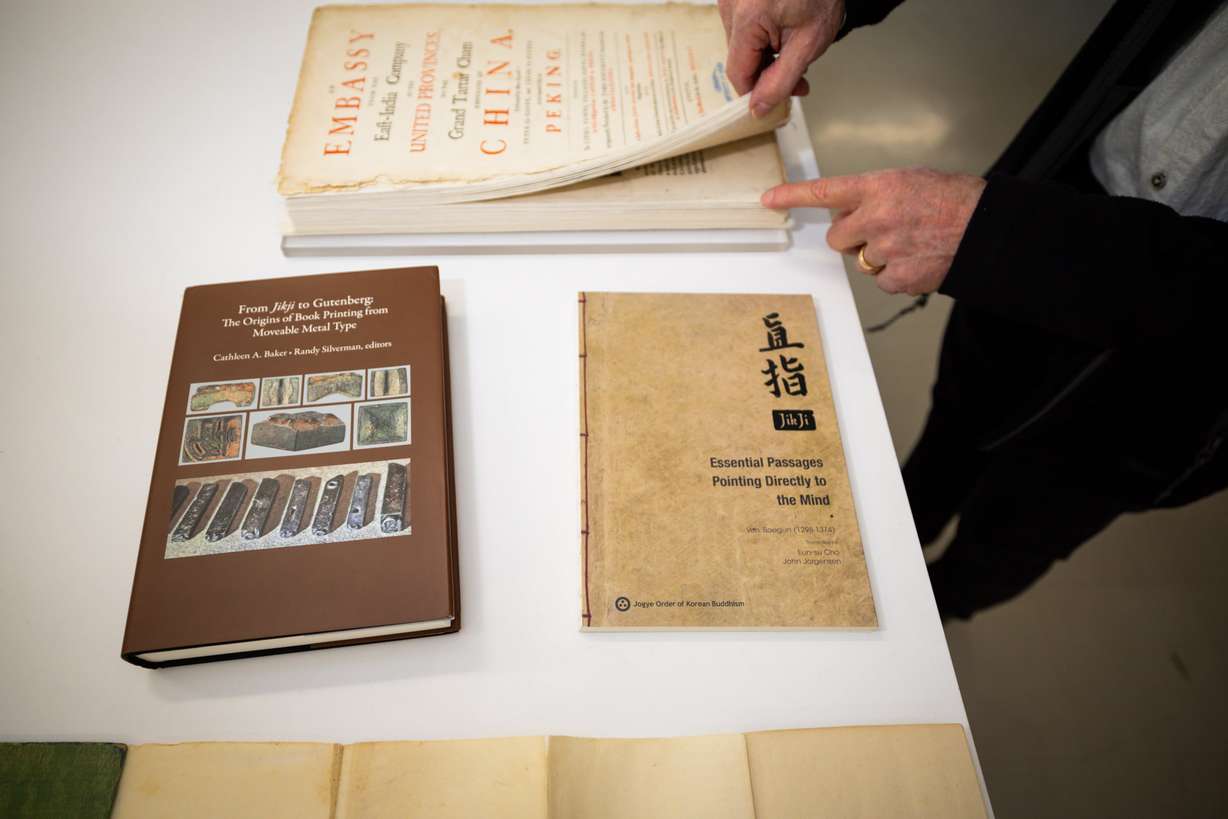
Since personally discovering "Jikji" and its history, Silverman has been driven by an almost evangelical zeal to share what he's learned with others in the academic community and beyond.
"I would like the general population to become aware that we in the West owe a tremendous amount to the brilliance of Eastern thought — and to their development of printing," he said.
In 2001, UNESCO formally recognized "Jikji," along with Gutenberg's Bible, as an "international achievement" with their inclusion in its Memory of the World International Register, according to the recently published book.
But a quarter-century later, most in the West still likely know little of Korea's ground-breaking printing history, including professional librarians and historians.
That reality helped prompt the creation of the From Jikji to Gutenberg project that culminated with the recent publication of "From Jikji to Gutenberg," which was edited by Silverman and his co-editor, Cathleen Baker.
The ongoing project will also include a digital exhibition and an illustrated children's book designed to introduce young audiences to the pioneering printing history of "Jikji."
Sharing the evolving story of 'Jikji' in the West

There are signs that the Western world's understanding and acceptance of "Jikji" and its history are taking hold. Last year, The New York Times published a reader quiz in its article "How Much Do You Know About the History of Books?"
The quiz's second question: "In the mid-1400s, the German craftsman Johannes Gutenberg created a printing press system that moved type and became known for his production of printed Bibles.
"But which country printed what is now the oldest extant book made with movable metal type decades earlier, back in 1377?"
Silverman and his "Jikji" research colleagues are hoping far more Westerners will soon be answering that question correctly.