- The UHSAA board initiated the 2027-2029 realignment on Thursday with a new Competitive Realignment Index.
- Class 6A will expand to 21 schools in general sports, with 22 in 11-man football.
- Schools can apply to move classifications; appeals are based on geography, not performance.
SALT LAKE CITY — The Utah High School Activities Association board of trustees kicked off the 2027-2029 realignment process Thursday, finalizing the formulas for its new Competitive Realignment Index and establishing initial classification sizes across both general sports and football.
Following a blind review — where trustees evaluate index scores with school names removed — the board voted to keep its default 77-13-10 formula for general sports, while making a significant pivot in football to adopt a 65-13-22 ratio that places far greater emphasis on on-field results.
The board also set initial team counts for all classifications, headlined by Class 6A expanding from its current 17-team format to 21 schools in general sports and 22 in 11-man football.
In the general alignment, placements remain anchored by Oct. 1 sophomore and junior enrollment (77%), K-12 socioeconomic data (13%) and three-year athletic performance across all 25 UHSAA-sanctioned sports and activities (10%).
Trustees initially approved a 21-24-24-21-28-28 classification split by an 11-3 vote before passing a motion to reconsider and further debating where the natural breaks fell in the data. Following that discussion, the board adjusted several cut lines by a single school and unanimously approved 21 schools in 6A, 25 in 5A, 25 in 4A, 22 in 3A, 26 in 2A and 27 in 1A.
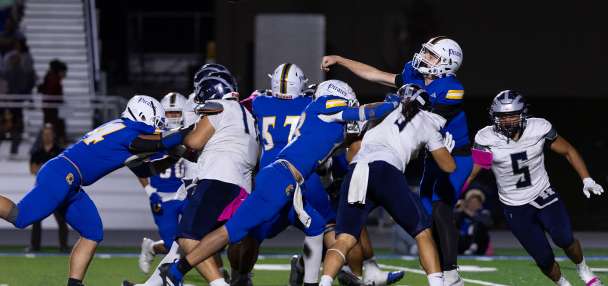
In football, trustees moved sharply away from their provisional 85-8-7 draft, setting the football competitive reallignment index at 65% enrollment, 13% socioeconomic status and 22% football-only performance — more than tripling the weight of three-year gridiron results.
Using natural breaks in the blind football data, the board established an initial 11-man alignment featuring 22 schools in Class 6A, 24 in 5A, 23 in 4A, 16 in 3A, 11 in 2A and 11 in 1A, alongside the eight-player division.
With initial classification sizes now established, member schools have until the board's next meeting to apply to move up into a higher classification — either across their entire athletic program or in individual sports.
Competitive struggles are no longer valid grounds for appealing downward; schools may only petition to drop based on geography and travel burdens, which trustees can address by moving a program down a full class or placing it in a lower region for regular-season play before returning to its assigned classification for state tournaments.
The board of trustees will reconvene Dec. 1 at 9 a.m. to review geographic appeals and play-up requests, give second consideration to classifications and release its first draft of assigned regions.
A public hearing via Zoom follows on Dec. 8 at 6:30 p.m., ahead of second region consideration on Dec. 9 and final approval on Dec. 17. Competition under the new alignment begins in August 2027.