'%3e%3cpath%20d='M34.1406%205.85938C30.3906%202.10547%2025.3047%200%2020%200C14.6953%200%209.60938%202.10547%205.85938%205.85938C2.10938%209.61328%200%2014.6953%200%2020C0%2025.3047%202.10547%2030.3906%205.85938%2034.1406C9.61328%2037.8906%2014.6953%2040%2020%2040C25.3047%2040%2030.3906%2037.8945%2034.1406%2034.1406C37.8906%2030.3906%2040%2025.3047%2040%2020C40%2014.6953%2037.8945%209.60938%2034.1406%205.85938ZM37.0117%2023.543H31.1602V13.5391H27.6328V19.9414C28.1211%2020.6914%2028.3711%2021.582%2028.3711%2022.5625V22.625C28.3711%2023.668%2028.1172%2024.6055%2027.6328%2025.4297V26.6094H36.082C33.4883%2032.9375%2027.2891%2037.3789%2020.0039%2037.3789C10.3711%2037.3789%202.62109%2029.6289%202.62109%2020C2.62109%2010.3711%2010.3711%202.62109%2020%202.62109C29.6289%202.62109%2037.3789%2010.3711%2037.3789%2020C37.3789%2021.1484%2037.2617%2022.2656%2037.0508%2023.3477C37.0391%2023.4141%2037.0234%2023.4766%2037.0117%2023.543Z'%20fill='white'/%3e%3cpath%20d='M22.3086%2018.5352C20.4336%2018.125%2019.9531%2017.8398%2019.9766%2017.1836V17.1406C19.9766%2016.6992%2020.3477%2016.2148%2021.4023%2016.2148C22.582%2016.2148%2023.8867%2016.6797%2025.0781%2017.4766L26.8516%2015.0195C25.4453%2013.8906%2023.707%2013.3398%2021.5547%2013.3398C18.5195%2013.3398%2016.4375%2015%2016.4063%2017.4766V17.5352C16.3633%2020.2617%2018.5859%2020.9805%2021.293%2021.6016C23.0391%2021.9766%2023.5703%2022.3164%2023.5703%2022.9609L23.5469%2022.9766C23.5469%2023.3906%2023.2578%2023.7031%2022.7852%2023.8359C22.5742%2023.9062%2022.1289%2023.9727%2021.5156%2023.9727C20.7617%2023.9727%2019.7539%2023.8633%2018.6328%2023.4844C18.0898%2023.2891%2017.4727%2023.0039%2016.8047%2022.6133L20.1406%2026.625C20.2813%2026.6602%2021.0977%2026.8516%2021.7734%2026.8516C25.0039%2026.8516%2027.0859%2025.2461%2027.1094%2022.6328V22.5703C27.1602%2020.1133%2025.2148%2019.1719%2022.3086%2018.5352Z'%20fill='white'/%3e%3cpath%20d='M5.24219%2013.5664V26.6133H8.75391V23.7578L10.2969%2021.9531L14.2031%2026.6133H18.3867L12.3555%2019.5195L17.4023%2013.5664H13.4531L8.75391%2019.0586V13.5664H5.24219Z'%20fill='white'/%3e%3c/g%3e%3cdefs%3e%3cclipPath%20id='clip0_97_2430'%3e%3crect%20width='40'%20height='40'%20fill='white'/%3e%3c/clipPath%3e%3c/defs%3e%3c/svg%3e)



- The University of Utah launched Redtail, a supercomputer among the world's fastest.
- Utah's AI investments include a $100-million initiative and significant venture capital influx.
- State regulations focus on AI safety, with laws addressing high-risk interactions and deepfakes.
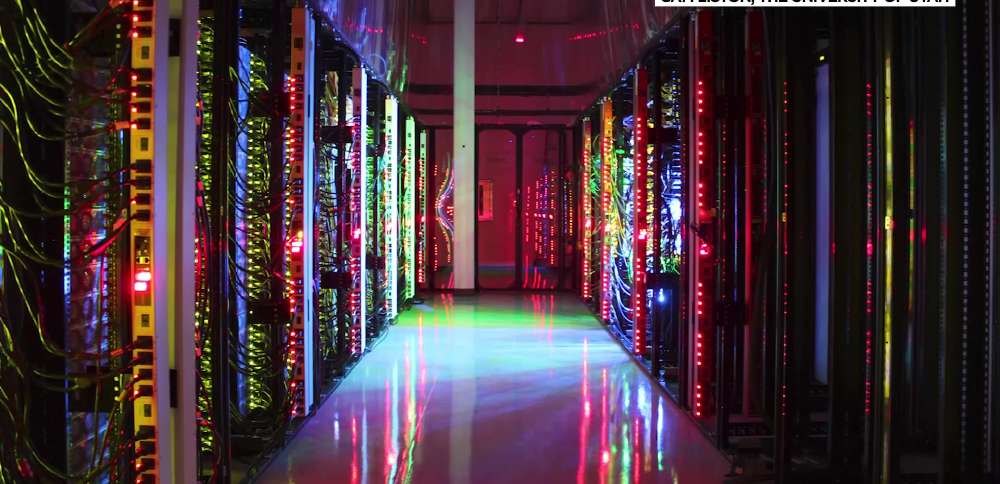
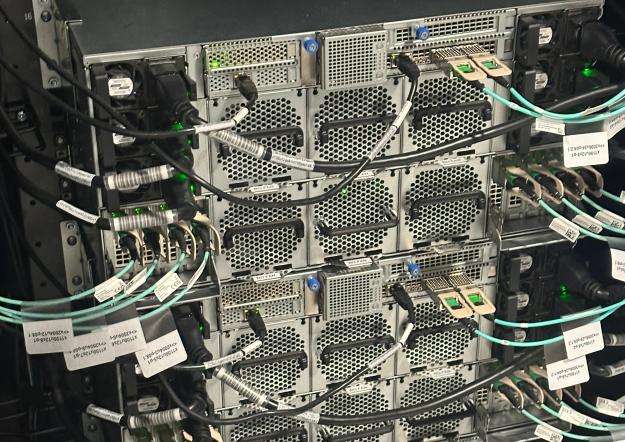
SALT LAKE CITY — The University of Utah just turned on a supercomputer that ranks among the 160 fastest in the world.
Redtail, as it's called, also placed 5th among U.S. public universities on the Top500 list and 76th on the Green500, which tracks the world's most energy-efficient machines. All of this in its first month of operation.
The system cost $50 million, funded through a partnership between the state of Utah, the Huntsman Family Foundation, Hewlett Packard Enterprise and NVIDIA. It's designed to give researchers, students, and eventually businesses across the state access to the kind of computing power that serious AI work requires.
"It demonstrates that the state, the faculty, the students, the researchers, the entrepreneurs have access to state-of-the-art technology that is on par with anybody else in the world," said Manish Parashar, the university's first chief AI officer. "And they can bring that to their work."
The projects already lining up give a sense of the scale. Through a Redtail challenge designed to attract early users, researchers are applying the system to climate modeling, air quality, drug design, aerospace engineering, and something Parashar is particularly excited about: building digital twins of human vascular systems for precision medicine.
"How do you build a digital twin of a human vascular system so that you can do more targeted precision treatments, treatments that are targeted to an individual, that can be more effective?" Parashar said. "These are the types of projects we are seeing emerge."
The same week Redtail earned its rankings, the university was also selected for a National Science Foundation network of AI-driven Cloud Laboratories. Parashar described the Cloud Lab as a way to automate research processes that traditionally require scientists to be physically in the room. The result is that researchers anywhere can participate in work that used to be limited by geography.
"Redtail provides the computational platform that can help build the models and the AI that can drive something like the Cloud Lab," he said.
The bigger picture
The infrastructure investment is significant on its own. But it fits into a pattern that's been building across Utah for the last year.
The state's $100 million Pro-Human AI Initiative, launched at the governor's level, continues to expand. New faculty have been brought in to focus on AI applications in education, air quality, and wildfire monitoring. An $18.6 million Health AI Vault is advancing cancer research and medical AI. And the university was recently evaluated as a national "trailblazer," ranking in the top 5% of academic institutions for its AI response.
The money side tells its own story. Jump, a Utah-based AI company, closed an $80 million growth round earlier this year. Databento, an AI-driven financial data firm, landed a $97 million Series B with more than $300 million in investor demand. Zanskar, an AI-native geothermal company, raised $115 million. Collectively, hundreds of millions in AI venture capital have flowed into Utah in 2026 alone.
Parker Ence, founder of Jump, said the local investing community played a real role in his company's growth.
"Taking investment from Sorenson and Pelion was a key early step for us that set us up for success in later fundraising rounds," Ence told me. "As a minor contributor to the Governor's AI Task Force, I've been impressed with the level of thought going into advancing economic opportunity for Utahns while balancing safety and pro-human outcomes."
He also pushed back on the idea that Utah companies need to recruit from the coasts.
"The idea that you have to go outside of Utah to attract stellar talent isn't true," he said. "Our entire exec team, which I would put up against any vertical-focused AI company, is all Utah-based."
Meanwhile, Silicon Slopes recently launched Start School, a new program for Utah entrepreneurs built around a single thesis: AI tools have lowered the barriers to starting a company to the point that solo founders can build viable businesses without venture capital.
The rules of the road
Utah has also been moving on AI regulation, an area where most states are still debating where to begin.
Margaret Woolley Busse, executive director of the Utah Department of Commerce and architect of the state's Office of AI Policy, told me the biggest surprise has been the level of interest in healthcare AI.
"Innovators doing business in Utah are actively working on transformative AI solutions that have the potential to significantly improve the lives of residents," Busse said. "The state recognizes the risks associated with these advancements and is taking a proactive role in overseeing regulatory sandbox pilots."
Utah already has several AI-specific laws on the books: a requirement that consumers be informed when they're interacting with AI in high-risk situations; protections against non-consensual deepfakes; libel and slander laws expanded to cover AI-generated content; and safeguards around mental health AI applications.
"Without adequate safeguards, public trust in AI technology will not develop, which could hinder its positive applications in various sectors across the state," Busse said.
What businesses are actually experiencing
The state-level numbers are big. But what does all of this actually look like for a Utah business trying to figure out AI?
Kavita Ganesan, founder of Opinosis Analytics, a Salt Lake City-based AI consultancy, works directly with small businesses, mid-sized firms, nonprofits and government agencies. She told me the conversation around AI has changed over the past year, but not in the direction most people assume.
Innovators doing business in Utah are actively working on transformative AI solutions that have the potential to significantly improve the lives of residents.
–Margaret Woolley Busse
"The conversation has shifted from raw enthusiasm to implementing AI the right way," Ganesan said. "As teams become more familiar with the technology, they are seeking true expertise to implement reliable solutions, especially as market hype and low-quality providers create fatigue and disappointment in the field."
I asked her whether Utah's growing AI infrastructure, from Redtail to the Office of AI Policy to the venture funding, is making a practical difference for her clients.
She was direct.
"Most organizations are not held back by a lack of supercomputing power or state policy frameworks," Ganesan said. "They are still working through the foundational phases: trying to vet use cases, identifying real business opportunities, and figuring out how to integrate AI into existing workflows safely and effectively."
It's a reminder that the headline numbers and the day-to-day reality of AI adoption are still in very different places for most companies.
Still early
Parashar acknowledged that Utah's progress, while real, is still early.
"AI is a very fast-evolving technology, and I think we are still in early stages," he said. "We are doing a great job getting to the puck. I think now it's time to think about where the puck is going to be in three years and how do we get there ahead of time, so we're not surprised."
Utah is betting that preparation, not reaction, will separate the states that lead from those that follow. The state is investing in infrastructure, the talent pipeline, policy guardrails and business support before the full wave of demand arrives.
Whether that bet pays off will depend on how quickly the gap closes between the supercomputer in the university basement and the small business owner trying to figure out where AI fits into her Tuesday.
The University of Utah will host its annual One-U Responsible AI Initiative symposium on Oct. 6.
More on KSL

Artificial Intelligence
Read more about artificial intelligence initiatives in Utah and how people are businesses are using it.