'%3e%3cpath%20d='M34.1406%205.85938C30.3906%202.10547%2025.3047%200%2020%200C14.6953%200%209.60938%202.10547%205.85938%205.85938C2.10938%209.61328%200%2014.6953%200%2020C0%2025.3047%202.10547%2030.3906%205.85938%2034.1406C9.61328%2037.8906%2014.6953%2040%2020%2040C25.3047%2040%2030.3906%2037.8945%2034.1406%2034.1406C37.8906%2030.3906%2040%2025.3047%2040%2020C40%2014.6953%2037.8945%209.60938%2034.1406%205.85938ZM37.0117%2023.543H31.1602V13.5391H27.6328V19.9414C28.1211%2020.6914%2028.3711%2021.582%2028.3711%2022.5625V22.625C28.3711%2023.668%2028.1172%2024.6055%2027.6328%2025.4297V26.6094H36.082C33.4883%2032.9375%2027.2891%2037.3789%2020.0039%2037.3789C10.3711%2037.3789%202.62109%2029.6289%202.62109%2020C2.62109%2010.3711%2010.3711%202.62109%2020%202.62109C29.6289%202.62109%2037.3789%2010.3711%2037.3789%2020C37.3789%2021.1484%2037.2617%2022.2656%2037.0508%2023.3477C37.0391%2023.4141%2037.0234%2023.4766%2037.0117%2023.543Z'%20fill='white'/%3e%3cpath%20d='M22.3086%2018.5352C20.4336%2018.125%2019.9531%2017.8398%2019.9766%2017.1836V17.1406C19.9766%2016.6992%2020.3477%2016.2148%2021.4023%2016.2148C22.582%2016.2148%2023.8867%2016.6797%2025.0781%2017.4766L26.8516%2015.0195C25.4453%2013.8906%2023.707%2013.3398%2021.5547%2013.3398C18.5195%2013.3398%2016.4375%2015%2016.4063%2017.4766V17.5352C16.3633%2020.2617%2018.5859%2020.9805%2021.293%2021.6016C23.0391%2021.9766%2023.5703%2022.3164%2023.5703%2022.9609L23.5469%2022.9766C23.5469%2023.3906%2023.2578%2023.7031%2022.7852%2023.8359C22.5742%2023.9062%2022.1289%2023.9727%2021.5156%2023.9727C20.7617%2023.9727%2019.7539%2023.8633%2018.6328%2023.4844C18.0898%2023.2891%2017.4727%2023.0039%2016.8047%2022.6133L20.1406%2026.625C20.2813%2026.6602%2021.0977%2026.8516%2021.7734%2026.8516C25.0039%2026.8516%2027.0859%2025.2461%2027.1094%2022.6328V22.5703C27.1602%2020.1133%2025.2148%2019.1719%2022.3086%2018.5352Z'%20fill='white'/%3e%3cpath%20d='M5.24219%2013.5664V26.6133H8.75391V23.7578L10.2969%2021.9531L14.2031%2026.6133H18.3867L12.3555%2019.5195L17.4023%2013.5664H13.4531L8.75391%2019.0586V13.5664H5.24219Z'%20fill='white'/%3e%3c/g%3e%3cdefs%3e%3cclipPath%20id='clip0_97_2430'%3e%3crect%20width='40'%20height='40'%20fill='white'/%3e%3c/clipPath%3e%3c/defs%3e%3c/svg%3e)




- Rep. Blake Moore and Democrat Peter Crosby debated in Logan for Utah's 2nd District.
- Crosby appealed to working-class voters and pitched himself as a candidate with a new vision.
- Moore leaned into his experience, highlighting legislation and casting himself as a productive legislator.
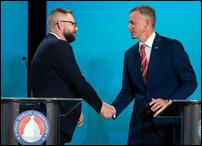
LOGAN — Rep. Blake Moore, R-Utah, and Democrat Peter Crosby met in what was a fairly tame debate Tuesday evening in Logan as they campaign to represent Utah's 2nd Congressional District.
Crosby, a first-time candidate and director for an education research company, tried to pitch himself as bringing a new, hopeful vision for northern Utah, with a focus on affordability for the working class.
"If you are in a situation where you've doubled your net worth in the last five years and you're not really worried about where your kids are going to be able to go to school or if they can afford a house, I'm pretty sure I know who you're going to vote for, and that's fair," he said in his closing remarks. "If, like me, you don't fall into that particular category, there's a vision of our country that's different than the path we're headed down now."
Moore, who is seeking his fourth term in the U.S. House of Representatives, acknowledged that it's a "divisive time" in politics, but he cast himself as a productive lawmaker who can work across the aisle.
"The thing that I focus the most on is maintaining a productive lane," he said in his opening statement. "I've been able to do it under a Democrat and a Republican administration ... and it's something that I'm going to continue to do."
Inflation and gas prices
Concerns about the economy, brought on in part by President Donald Trump's tariffs and the war in Iran, have been a focus of previous congressional debates in Utah this year, and Tuesday's contest was no different.
Crosby criticized the tariffs, saying they have had a direct impact on farmers, ranchers and small business owners in the 2nd Congressional District.
Related:
KSL Truth Test: Fact-checking debate claims in Utah's 2nd Congressional District
The KSL Investigators fact-checked claims from each of the candidates:"If I'm interested in the welfare of everybody in my district, my priority should be to focus on policy that helps everyone as best as I can and does no harm first," he said.
Moore acknowledged that tariffs are "one of the toughest things that we've had to navigate" since Trump took office again last year. While they have made it more difficult for some, he said the tariffs are also allowing some American industries to compete better with international manufacturers.
"There is a lot of pain with this," he said. "Every time that Proctor and Gamble has reached out to our office, we've gone and actually successfully been able to mitigate their issues."
Crosby responded, saying: "Proctor and Gamble, that's great, but none of the small business owners seem to receive the same attention."
Both candidates were asked what they would do to make life easier for young Utahns. Crosby said his daughter, a recent high school graduate, doesn't expect to ever own a home and called for more federal funding to build affordable housing.
"We can close corporate tax loopholes," he added. "There's no reason a corporation should receive a tax break if its workers are dependent on taxpayer subsidies. That, in and of itself, would help improve the wages that our American workers are making."
Moore pointed to a provision in last year's so-called One Big Beautiful Bill Act capping federal student loan borrowing for some graduate programs.
"You can look across the country and you can see cases where they're actually lowering their tuition in direct response to constraints that we put on," he said. "That is a direct impact on various ways to keep it so it's more affordable for you to go and invest in yourself and be able to go and create that American dream."
AI and Flock cameras
Moderator Heidi Hatch also addressed voter concerns about technology, ranging from data centers to artificial intelligence and automated license plate readers, commonly known as Flock cameras. With the president pushing back against state-level regulations of AI, both candidates were asked which level of government they think should be responsible for regulating the new technology.
Moore praised efforts by Utah lawmakers to pass AI regulations — the bill was eventually shelved after pushback from the White House — but said lawmakers should address the application of AI, but didn't provide specifics.
"The application of this generative AI power is key and we need to continue to push in this direction," he said.
Crosby said he believes the technology is "generally neutral," and concerns arise about how people use it. But he pushed back on the Trump administration, saying states should have been allowed to experiment with regulations to see which approach works best.
"My primary concern here is that the states themselves should have been the laboratory for regulation and policy implementation," he said. "It has provided a terrible burden now on the federal government because it does not know yet which regulations will be effective in this space."
"Does the federal government have a role?" he asked. "Absolutely."
On Flock cameras, Moore said he largely trusts law enforcement officials to use the tool appropriately.
"I do have a level of trust with our local law enforcement to be able to do this in a way that respects the Constitution and also ensures public safety," he said. "That's the rub. That's the things that we have to be focused on."
Crosby called for a national right to privacy for all Americans, saying technological advances have "put pressure on that."
"It also means that we have to have a right to data ownership," he said. "New technology has certainly created a vast amount of data, personal data, which is accessible to corporations and the government. And Americans don't own their own data. That's something we could change pretty quickly in Congress if we decided that we wanted to."