'%3e%3cpath%20d='M34.1406%205.85938C30.3906%202.10547%2025.3047%200%2020%200C14.6953%200%209.60938%202.10547%205.85938%205.85938C2.10938%209.61328%200%2014.6953%200%2020C0%2025.3047%202.10547%2030.3906%205.85938%2034.1406C9.61328%2037.8906%2014.6953%2040%2020%2040C25.3047%2040%2030.3906%2037.8945%2034.1406%2034.1406C37.8906%2030.3906%2040%2025.3047%2040%2020C40%2014.6953%2037.8945%209.60938%2034.1406%205.85938ZM37.0117%2023.543H31.1602V13.5391H27.6328V19.9414C28.1211%2020.6914%2028.3711%2021.582%2028.3711%2022.5625V22.625C28.3711%2023.668%2028.1172%2024.6055%2027.6328%2025.4297V26.6094H36.082C33.4883%2032.9375%2027.2891%2037.3789%2020.0039%2037.3789C10.3711%2037.3789%202.62109%2029.6289%202.62109%2020C2.62109%2010.3711%2010.3711%202.62109%2020%202.62109C29.6289%202.62109%2037.3789%2010.3711%2037.3789%2020C37.3789%2021.1484%2037.2617%2022.2656%2037.0508%2023.3477C37.0391%2023.4141%2037.0234%2023.4766%2037.0117%2023.543Z'%20fill='white'/%3e%3cpath%20d='M22.3086%2018.5352C20.4336%2018.125%2019.9531%2017.8398%2019.9766%2017.1836V17.1406C19.9766%2016.6992%2020.3477%2016.2148%2021.4023%2016.2148C22.582%2016.2148%2023.8867%2016.6797%2025.0781%2017.4766L26.8516%2015.0195C25.4453%2013.8906%2023.707%2013.3398%2021.5547%2013.3398C18.5195%2013.3398%2016.4375%2015%2016.4063%2017.4766V17.5352C16.3633%2020.2617%2018.5859%2020.9805%2021.293%2021.6016C23.0391%2021.9766%2023.5703%2022.3164%2023.5703%2022.9609L23.5469%2022.9766C23.5469%2023.3906%2023.2578%2023.7031%2022.7852%2023.8359C22.5742%2023.9062%2022.1289%2023.9727%2021.5156%2023.9727C20.7617%2023.9727%2019.7539%2023.8633%2018.6328%2023.4844C18.0898%2023.2891%2017.4727%2023.0039%2016.8047%2022.6133L20.1406%2026.625C20.2813%2026.6602%2021.0977%2026.8516%2021.7734%2026.8516C25.0039%2026.8516%2027.0859%2025.2461%2027.1094%2022.6328V22.5703C27.1602%2020.1133%2025.2148%2019.1719%2022.3086%2018.5352Z'%20fill='white'/%3e%3cpath%20d='M5.24219%2013.5664V26.6133H8.75391V23.7578L10.2969%2021.9531L14.2031%2026.6133H18.3867L12.3555%2019.5195L17.4023%2013.5664H13.4531L8.75391%2019.0586V13.5664H5.24219Z'%20fill='white'/%3e%3c/g%3e%3cdefs%3e%3cclipPath%20id='clip0_97_2430'%3e%3crect%20width='40'%20height='40'%20fill='white'/%3e%3c/clipPath%3e%3c/defs%3e%3c/svg%3e)




Estimated read time: 2-3 minutes
- Blake Moore and Peter Crosby debated key issues in Utah's 2nd District.
- Moore's and Crosby's claims on tax credits and solar industry impacts were true.
- Crosby's federal budget history claim was rated false by KSL Investigators.
SALT LAKE CITY — Republican Congressman Blake Moore and Democrat challenger Peter Crosby took to the debate stage Tuesday evening at Utah State University ahead of Election Day on Nov. 3.
During the conversation, hosted by the Utah Debate Commission, the candidates discussed several pressing issues impacting Utahns including data center regulation, the federal budget deficit, the impacts of the One Big Beautiful Bill Act and immigration.
But did their claims of fact hold up to the KSL Truth Test? The KSL Investigators fact-checked claims from each of the candidates:
One Big Beautiful Bill Act
The impacts of the One Big Beautiful Bill Act were debated by both candidates.
Moore said without it, passing the Child Tax Credit would have gone back to pre-2017 levels of $1,000.
"And we not only doubled it; we increased it and tied it to inflation and made it permanent," Moore said.
Congress.gov and multiple tax organizations detail the changes that were made to the credit when the bill was passed in July 2025.
The maximum child tax credit was increased permanently from $2,000 to $2,200.
Related:
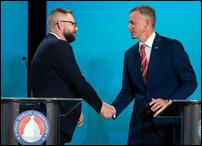
Candidates discuss economy, AI and privacy in debate for Utah's 2nd District
Rep. Blake Moore and Democrat Peter Crosby debated in Logan for Utah's 2nd District.And starting in 2026, that amount will be adjusted annually for inflation. We rate Moore's statement as true.
Crosby said the One Big Beautiful Bill Act also targeted the solar industry.
"Which is going to cost us anywhere from $1.2 to $1.8 billion in lost economic revenue," Crosby claimed.
The One Big Beautiful Bill Act did end the federal residential solar tax credit.
Crosby provided analysis from an energy and climate policy think tank, which has modeling showing Utah's economy could lose $1.2 billion in 2030 and $1.8 billion in 2032.
We rate Crosby's claim true.
The US deficit
In response to a question about federal budget priorities, Moore noted, "In calendar year 2025, the thing that I was most excited about was that we saw that we could actually reduce our deficit by $360 billion. Now, that's not a balanced budget by any stretch, but we saw that we could successfully do it."
According to the Committee for a Responsible Federal Budget, which cited the Congressional Budget Office, the federal budget deficit sat at $1.7 trillion in calendar year 2025, down $369 billion from the $2 trillion deficit the prior calendar year.
We find Moore's claim true.
Federal budget history
When discussing the federal budget, Crosby made this statement:
"My inspiration for this is Dwight Eisenhower, a Republican president, the last president to actually have a budget surplus from World War II until President Clinton."
According to the U.S. Office of Management and Budget's historical table, Eisenhower did record a budget surplus in 1960. And Clinton's budget surpluses started in 1998.
But the U.S. also ran a budget surplus in 1969, during the Lyndon B. Johnson and Richard Nixon transition.
We rate Crosby's claim false.