Estimated read time: 3-4 minutes
This archived news story is available only for your personal, non-commercial use. Information in the story may be outdated or superseded by additional information. Reading or replaying the story in its archived form does not constitute a republication of the story.
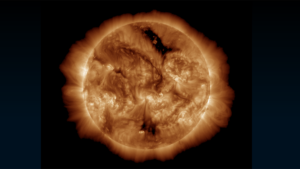
SALT LAKE CITY — Thursday night could offer Utahns another look at the northern lights, thanks to an eruption of plasma and the magnetic field around the sun two days ago. A geomagnetic storm watch for Oct. 10-11 means the sun's corona — the outmost part of its atmosphere made up of plasma — had a coronal mass ejection, often called a CME, that is likely to reach Earth and cause the storm that will possibly visible in northern skies. For Utahns, it means there is a solid chance of aurora borealis viewing Thursday night.
How to see the aurora borealis
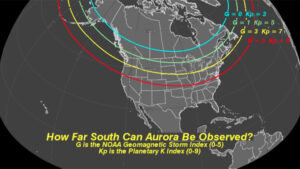
Viewing of the northern lights requires dark skies. NOAA suggests the best viewing is usually within an hour or two of midnight, creating a possible window of 10 p.m. to 2 a.m. The best times of year to view are near the spring and fall equinoxes, making Thursday a stronger possibility. Utah falls in the viewing area for storms ranked G4 or G5 strength, in line for Thursday, so the storm's strength during the dark hours will determine how much light is visible for Utahns. It's also helpful to get to a place with less light polition and giving a person's eyes more time to adjust will help viewing with the naked eye. Cameras with settings that allow longer exposures will be much more likely to capture photos. On the map below G5 storm visibility areas are marked in red while G3 are marked in yellow, leaving the current G4 somewhere in between."Remember that these northern light events can be finicky, ebbing and flowing in intensity," KSL TV meteorologist Matt Johnson said. While sometimes beautiful, geomagnetic storms, including this one, can cause problems with human technology. The storms are measured by the National Oceanic and Atmospheric Administration, a government agency. It has a space weather prediction center for online visitors. There it describes the latest space weather conditions and the last 24-hour observed maximums.For example at press time, there were no radio blackout impacts, but in the last 24 hours there were limited blackout of high frequency radio communication on the sunlit side of the Earth with loss of radio contact for minutes at a time. Storms are measured on a five-point scale, with G5 as the highest rating. At press time the last observed strength was G3 — a level that causes false alarms on protection devices but already measured at G4 for the current storm. The watch remains in effect through Friday. In the last 24 hours, a G4 was recorded and if that happens again Thursday after the sun goes down, auroras can be seen in the northern half of the United States. That's what's predicted for Thursday, with a 75% chance of a minor radio blackout and a 35% chance of a major radio blackout. The storm alert states the following possible technology effects:
Infrastructure operations have been notified to take action to mitigate any possible impacts. Possible increased and more frequent voltage control problem — normally mitigable. Increased possibility of anomalies or effects to satellite operations. More frequent and longer periods of GPS degradation possible.
During relief efforts from hurricanes Helene and Milton, communication from systems that depend on low-Earth orbit satellites or high-frequence communication may experience disruptions. It can also cause a strain on power grids and disrupt GSP services, the kind relied on in disaster relief. FEMA has been notified, according to NOAA. [gallery ids="691708,691740,690737,690774,647095,647000,646990,646399,646234,646037,644495,644014,626123,689414,645499,645462,542994,487280,644410,645934"]