- A watchdog group urges Utah to halt use of license plate readers along state roadways until lawmakers pass legislation better defining how they can be used.
- Members of Utah Civic Compact, who made the call, point to apparent rules UDOT implemented without legislative approval that they say amount to overreach.
- The issue will be a focus in the coming legislative session.
SALT LAKE CITY — A watchdog group that has closely scrutinized deployment of license plate readers in Utah is asking the state to order a halt to the use of the devices along state roadways pending passage of legislation governing their operation.
Representatives from the Utah Civic Compact on Monday alleged that the Utah Department of Transportation improperly implemented rules governing the use of license plate readers. Therefore, use of the cameras — touted by supporters as an important crime-fighting tool but decried by critics as an invasion of privacy — should be stopped pending review of the matter by lawmakers, they say.
"We are asking Gov. Cox to direct the Utah Department of Transportation to pause vendor-owned license plate reader cameras in state highways, right-of-ways, until the Legislature passes regulations governing them," said Clark Dice, the director of communications for Utah Civic Compact. "We believe the Utah Department of Transportation exceeded its authority by creating a separate vendor-licensing system."
The group estimates that at least 1,000 license-plate readers are in operation around Utah, though it's had a hard time getting solid data. They say perhaps half of them are subject to the UDOT rules in question and should be turned off. License plate readers operated on local streets through accords with local law enforcement agencies aren't subject to the UDOT rules in question or the Utah Civil Compact's call for action.
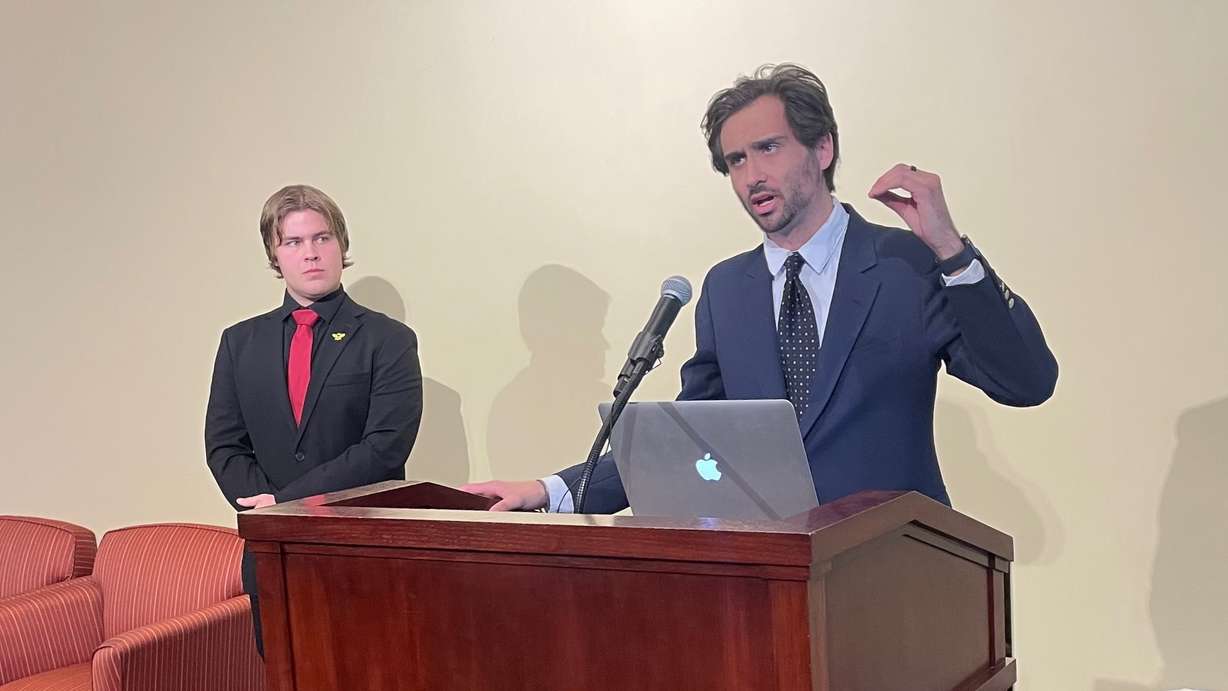
State legislation passed in 2023 requires that law enforcement agencies get permits from UDOT if they want to place license plate readers on state roadways. Jarom Gillins, the Utah Civic Compact's director of policy, doesn't take issue with that requirement. However, he took aim at a rule UDOT subsequently implemented without apparent approval from state lawmakers that seemingly gives Flock Safety broad authority to place license plate readers along state-maintained roadways.
"Under that rule, UDOT gave Flock a license to operate on state highways statewide, and I'm quoting the agreement here, 'regardless of which law enforcement agency has contracted for the company's services.' No statute gives UDOT the power to license the vendor," Gillins said.
UDOT spokesman John Gleason offered a different take on the state agency's role with regard to license plate readers. The devices — which read the license plate numbers of passing cars, allowing law enforcement agencies to track movements of suspect vehicles — are an increasing focus of controversy and a likely topic of debate in the 2027 state legislative session.
"Really, what we adhere to is the state statute that requires us to ... issue these permits as long as they're equipment for official law enforcement use," he said. "Our involvement really begins and ends with the proper installation of the equipment. We want to make sure that it's not presenting a safety concern out there on our roads."
While privacy concerns have been a major point of debate for critics, Gleason said "those are not UDOT questions." As to the number of devices along Utah roadways, he said that remains a question the agency is trying to answer.
"I don't know if anybody knows the number of cameras out there. We're in the process right now of identifying the cameras, making sure that those that are out there in our right-of-way are properly permitted," he said.
Gov. Spencer Cox's office declined comment, deferring to UDOT.
Exercise in leadership
While law enforcement uses license-plate readers to help track criminal suspects, Gillins also noted that they are a means of generating profits for companies like Flock, one of the principal manufacturers of the technology. It's up to state officials to weigh the issues at play.
"Which one is more important for them to do right now for the next two-and-a-half months? Is it give Flock more money, or is it understand how these systems are used so that it can regain the public trust that was lost by installing these systems to begin with?" Gillins said.
Given seemingly strong public sentiment on the topic, Dice said it's incumbent on Utah officials to take action on the issue.
"It is the opinion of the Utah Civic Compact that the people of Utah deserve some sort of signal from their government that they are taking this issue seriously, and ... in pausing these (license plate readers) from the governor's office, that would be an exercise in leadership," he said.