'%3e%3cpath%20d='M34.1406%205.85938C30.3906%202.10547%2025.3047%200%2020%200C14.6953%200%209.60938%202.10547%205.85938%205.85938C2.10938%209.61328%200%2014.6953%200%2020C0%2025.3047%202.10547%2030.3906%205.85938%2034.1406C9.61328%2037.8906%2014.6953%2040%2020%2040C25.3047%2040%2030.3906%2037.8945%2034.1406%2034.1406C37.8906%2030.3906%2040%2025.3047%2040%2020C40%2014.6953%2037.8945%209.60938%2034.1406%205.85938ZM37.0117%2023.543H31.1602V13.5391H27.6328V19.9414C28.1211%2020.6914%2028.3711%2021.582%2028.3711%2022.5625V22.625C28.3711%2023.668%2028.1172%2024.6055%2027.6328%2025.4297V26.6094H36.082C33.4883%2032.9375%2027.2891%2037.3789%2020.0039%2037.3789C10.3711%2037.3789%202.62109%2029.6289%202.62109%2020C2.62109%2010.3711%2010.3711%202.62109%2020%202.62109C29.6289%202.62109%2037.3789%2010.3711%2037.3789%2020C37.3789%2021.1484%2037.2617%2022.2656%2037.0508%2023.3477C37.0391%2023.4141%2037.0234%2023.4766%2037.0117%2023.543Z'%20fill='white'/%3e%3cpath%20d='M22.3086%2018.5352C20.4336%2018.125%2019.9531%2017.8398%2019.9766%2017.1836V17.1406C19.9766%2016.6992%2020.3477%2016.2148%2021.4023%2016.2148C22.582%2016.2148%2023.8867%2016.6797%2025.0781%2017.4766L26.8516%2015.0195C25.4453%2013.8906%2023.707%2013.3398%2021.5547%2013.3398C18.5195%2013.3398%2016.4375%2015%2016.4063%2017.4766V17.5352C16.3633%2020.2617%2018.5859%2020.9805%2021.293%2021.6016C23.0391%2021.9766%2023.5703%2022.3164%2023.5703%2022.9609L23.5469%2022.9766C23.5469%2023.3906%2023.2578%2023.7031%2022.7852%2023.8359C22.5742%2023.9062%2022.1289%2023.9727%2021.5156%2023.9727C20.7617%2023.9727%2019.7539%2023.8633%2018.6328%2023.4844C18.0898%2023.2891%2017.4727%2023.0039%2016.8047%2022.6133L20.1406%2026.625C20.2813%2026.6602%2021.0977%2026.8516%2021.7734%2026.8516C25.0039%2026.8516%2027.0859%2025.2461%2027.1094%2022.6328V22.5703C27.1602%2020.1133%2025.2148%2019.1719%2022.3086%2018.5352Z'%20fill='white'/%3e%3cpath%20d='M5.24219%2013.5664V26.6133H8.75391V23.7578L10.2969%2021.9531L14.2031%2026.6133H18.3867L12.3555%2019.5195L17.4023%2013.5664H13.4531L8.75391%2019.0586V13.5664H5.24219Z'%20fill='white'/%3e%3c/g%3e%3cdefs%3e%3cclipPath%20id='clip0_97_2430'%3e%3crect%20width='40'%20height='40'%20fill='white'/%3e%3c/clipPath%3e%3c/defs%3e%3c/svg%3e)




- Utah teen Ivan Turan developed Pothole AI, an app using AI to detect potholes.
- Inspired by a tragedy, Turan taught himself AI technology to create the app.
- The app, recognized at the 2026 National STEM Festival, is now being tested by UDOT.
SALT LAKE CITY — An inspired teenager is using self-taught skills to make roads safer through an app he developed that uses AI to detect potholes.
The app, Pothole AI, can detect and record potholes in real time. Users can put their cellphone on a dashboard holder, and the app continues to work with live detection. When the app detects a pothole, it logs the location and takes a snapshot of the road damage.
Ivan Turan, a 17-year-old senior at West High School, said the app idea came from a family vacation in India, where he noticed extensive road damage. It came up during a conversation with a neighbor, who told Ivan of a distant relative who died in a motorcycle crash that happened because of a pothole.
"Why is this a problem in the first place?" Turan asked himself. "Why can't we use the current technology, current, I guess, evolution of technology — like artificial intelligence, machine learning and everything else that we're learning about newer technology — to actually go ahead and create a solution to this infrastructure problem?"
When he came back to Utah, those questions continued to trouble him, even more after he noticed road damage while heading north on Interstate 15.
Having an interest in AI, machine learning and superintelligence, Ivan decided to answer his own questions by teaching himself how AI technology works and what was required to make Pothole AI a reality.
The iOS application is available to the public through Apple and was recently recognized at the 2026 National STEM Festival, where Ivan was among 10 Utah finalists. He also presented his app to the Utah Department of Transportation technology and infrastructure teams on Sept. 24, which is now testing Pothole AI.
John Gleason, public relations director at the transportation department, told KSL the department is always looking for ways to improve traffic safety.
"Our goal is zero fatalities on our roads and anything that we can use to help us achieve that goal, that's absolutely something we're interested in," Gleason said.
After hearing Ivan's story, Gleason said the example the teen sets is great because people need to be aware of road safety and try to get involved.
"For a young man to come up with this on his own and who was inspired by a tragedy to take action, I mean, that's incredible," Gleason said.
Another application similar to Ivan's is the UDOT Click 'n Fix app. Users are able to drop a pin on the location of road damage, where an animal may have been hit by a car or any other road-related issues, to make UDOT aware of the problem.
Ivan said he started discussions with the Utah Department of Transportation about creating a more streamlined approach to road infrastructure monitoring. He said he hopes to put a system in place that automatically sends road damage information directly to UDOT, along with a request to fix it, without users having to manually enter information into a phone.
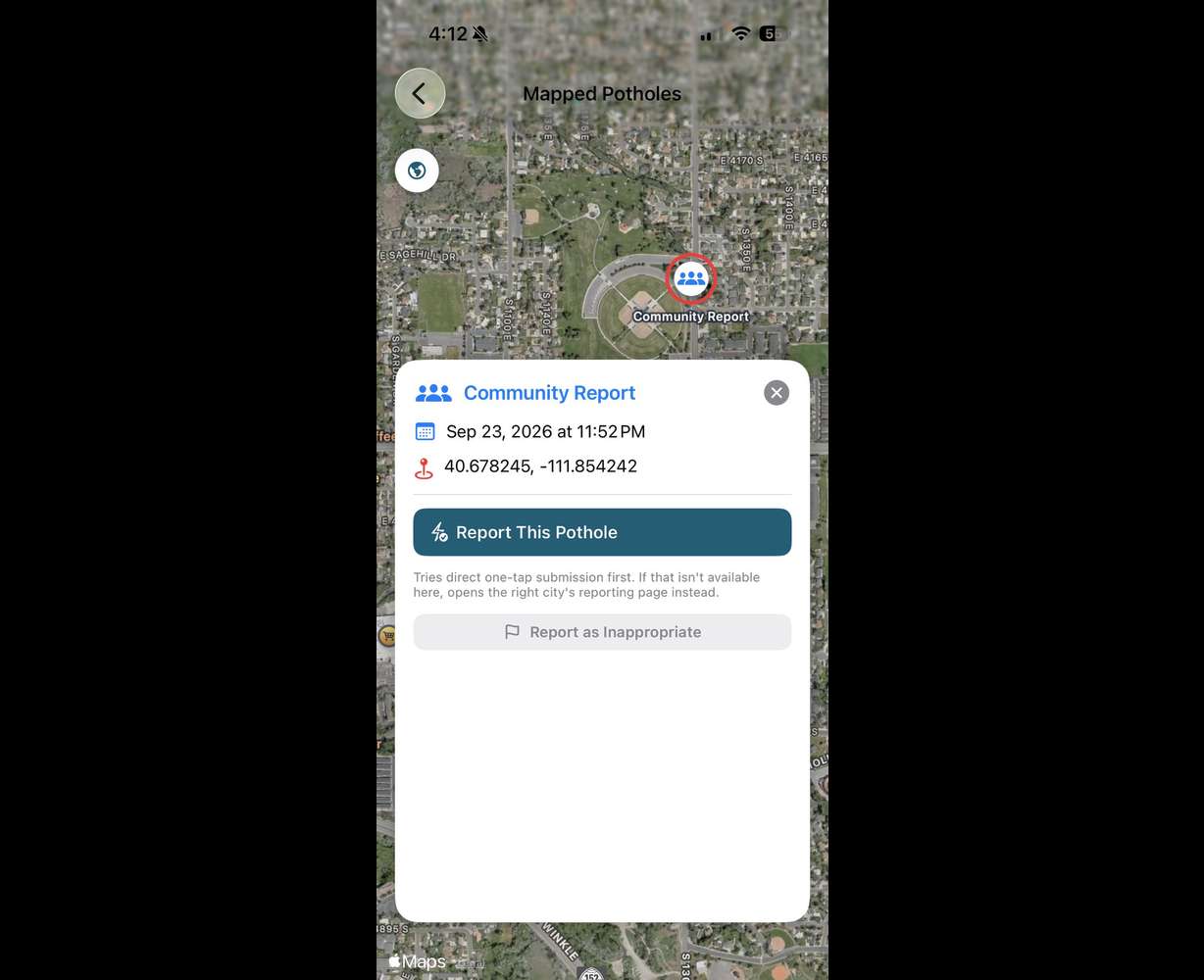
Beyond the app, Ivan said he hopes others will take the opportunity to research, learn and look for opportunities to solve problems today.
"I think it's just a wonderful opportunity for me, for people outside and for other kids who aspire to use technology or the skills that they learn, not just from school but outside of school to create these types of solutions to big, real-world problems," Turan said.
When it comes to Pothole AI, road infrastructure is just the beginning.
"I really think that these technologies, they're like the future of a lot of problems that we want to solve," Turan said. "Road infrastructure being one small problem out of the many that we can go ahead and solve."