'%3e%3cpath%20d='M34.1406%205.85938C30.3906%202.10547%2025.3047%200%2020%200C14.6953%200%209.60938%202.10547%205.85938%205.85938C2.10938%209.61328%200%2014.6953%200%2020C0%2025.3047%202.10547%2030.3906%205.85938%2034.1406C9.61328%2037.8906%2014.6953%2040%2020%2040C25.3047%2040%2030.3906%2037.8945%2034.1406%2034.1406C37.8906%2030.3906%2040%2025.3047%2040%2020C40%2014.6953%2037.8945%209.60938%2034.1406%205.85938ZM37.0117%2023.543H31.1602V13.5391H27.6328V19.9414C28.1211%2020.6914%2028.3711%2021.582%2028.3711%2022.5625V22.625C28.3711%2023.668%2028.1172%2024.6055%2027.6328%2025.4297V26.6094H36.082C33.4883%2032.9375%2027.2891%2037.3789%2020.0039%2037.3789C10.3711%2037.3789%202.62109%2029.6289%202.62109%2020C2.62109%2010.3711%2010.3711%202.62109%2020%202.62109C29.6289%202.62109%2037.3789%2010.3711%2037.3789%2020C37.3789%2021.1484%2037.2617%2022.2656%2037.0508%2023.3477C37.0391%2023.4141%2037.0234%2023.4766%2037.0117%2023.543Z'%20fill='white'/%3e%3cpath%20d='M22.3086%2018.5352C20.4336%2018.125%2019.9531%2017.8398%2019.9766%2017.1836V17.1406C19.9766%2016.6992%2020.3477%2016.2148%2021.4023%2016.2148C22.582%2016.2148%2023.8867%2016.6797%2025.0781%2017.4766L26.8516%2015.0195C25.4453%2013.8906%2023.707%2013.3398%2021.5547%2013.3398C18.5195%2013.3398%2016.4375%2015%2016.4063%2017.4766V17.5352C16.3633%2020.2617%2018.5859%2020.9805%2021.293%2021.6016C23.0391%2021.9766%2023.5703%2022.3164%2023.5703%2022.9609L23.5469%2022.9766C23.5469%2023.3906%2023.2578%2023.7031%2022.7852%2023.8359C22.5742%2023.9062%2022.1289%2023.9727%2021.5156%2023.9727C20.7617%2023.9727%2019.7539%2023.8633%2018.6328%2023.4844C18.0898%2023.2891%2017.4727%2023.0039%2016.8047%2022.6133L20.1406%2026.625C20.2813%2026.6602%2021.0977%2026.8516%2021.7734%2026.8516C25.0039%2026.8516%2027.0859%2025.2461%2027.1094%2022.6328V22.5703C27.1602%2020.1133%2025.2148%2019.1719%2022.3086%2018.5352Z'%20fill='white'/%3e%3cpath%20d='M5.24219%2013.5664V26.6133H8.75391V23.7578L10.2969%2021.9531L14.2031%2026.6133H18.3867L12.3555%2019.5195L17.4023%2013.5664H13.4531L8.75391%2019.0586V13.5664H5.24219Z'%20fill='white'/%3e%3c/g%3e%3cdefs%3e%3cclipPath%20id='clip0_97_2430'%3e%3crect%20width='40'%20height='40'%20fill='white'/%3e%3c/clipPath%3e%3c/defs%3e%3c/svg%3e)




- The Rocky Canyon Fire affected a critical wildlife habitat near East Canyon State Park.
- The fire burned over 13,600 acres, including a section Utah recently acquired for nearly $20 million.
- Wildlife biologists still unsure how the fire impacts deer, elk and grouse habitats in the area.
MORGAN — A large wildfire that sparked in the Wasatch Back on Friday has ripped through most of a vital big game winter range and habitat for a declining bird species, including areas the state recently acquired.
However, Utah wildlife biologists say they still don't know the full impact of the Rocky Canyon Fire on the East Canyon Wildlife Management Area.
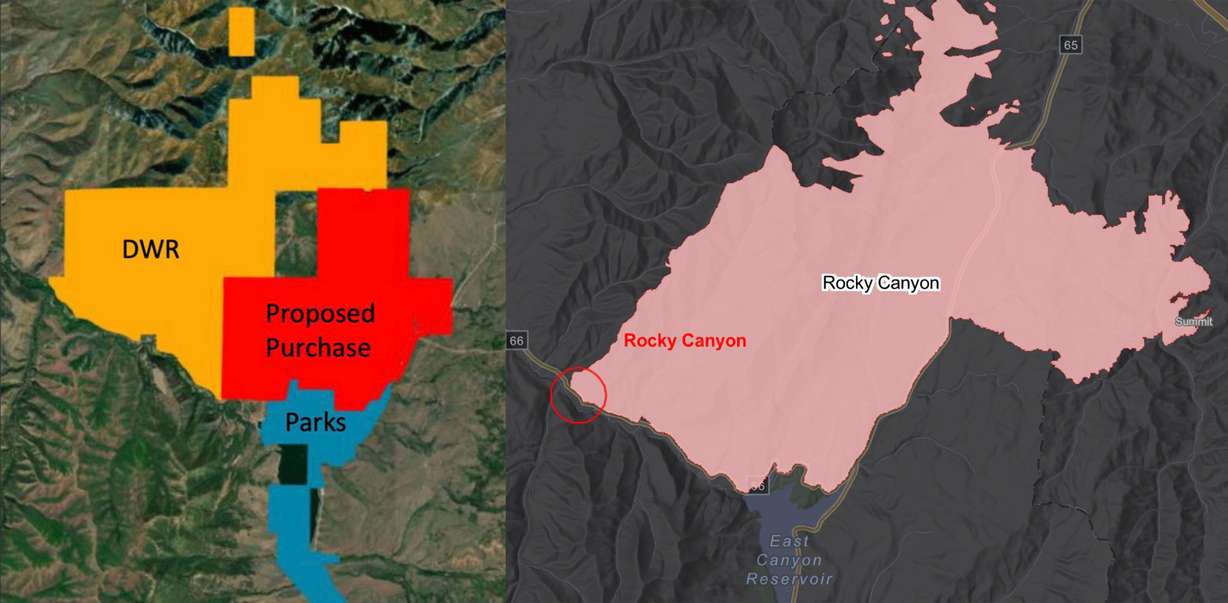
The fire reached most of the 6,200-acre protected area between Morgan and Summit counties, but biologists have yet to conduct an analysis of the burn area, Utah Division of Wildlife Resources officials told KSL.
The area is known for providing "critical winter range" for mostly deer and elk, but is also an important breeding ground and habitat for the sage, dusky and ruffed grouse.
"It's too early to know the full impacts until we see the burn intensity and see how much vegetation is left," said Faith Heaton Jolley, a spokesperson for the Utah Division of Wildlife Resources. "The burn encompassed crucial winter range and sage grouse lek and sage grouse habitat."
The Rocky Canyon Fire has burned more than 13,600 acres since sparking from an undetermined human cause.
Several homes and East Canyon State Park area are among the sections of the fire that are now contained, Sierra Hellstrom, a spokesperson for the U.S. Forest Service and Northern Utah Type 3 Incident Management Team, said on Tuesday.
State fire maps show that the fire burned through a section of land that the Utah Department of Natural Resources acquired for nearly $20 million in 2024. The state purchased the 2,500-acre property to drastically increase the size of the wildlife management area and expand East Canyon State Park.
The Utah Division of Wildlife Resources maintains over 130 management areas that total more than 620,000 acres across the state. They're meant to provide important habitat and winter ranges for all kinds of wildlife.
Division officials have yet to determine changes to East Canyon hunting permits after allocating 1,900 general buck permits this year. The division ran into a similar challenge last year, issuing emergency options to central Utah hunters when the Monroe Mountain Fire tore through another key big game area.
Planning the recovery process
East Canyon also isn't the only management area that has been damaged this year.
The Widemouth 2 Fire in central, the state's biggest fire this year, has consumed at least some parts of a bigger management area in Fillmore, said Alison Whitaker, habitat conservation coordinator for the Utah Division of Wildlife Resources. A fire also burned over 300 acres within the Middle Fork Wildlife Management Area in June.
While crews are racing to battle the flames, Whitaker and other state, federal and local habitat officials are quickly planning how to reseed and rehabilitate the hundreds of thousands of acres that have burned this year.
"We're going to be really busy this fall, working on things," she said, explaining that most of the work will be seeking to bring back vegetation the way it was before a fire, which can take years to accomplish.
Beyond total acreage, this year has burned a record number of acres within woodland and forest areas, University of Utah researchers determined earlier this month.
That has near-term impacts on wildlife, reducing forage and vegetation cover, but ultimately the fires can become beneficial in the long-term, Whitaker added. High-elevation fires can create "patchy" areas where some healthy habitat can recover quickly, with additional parts of the habitat recovering slowly over time.
Habitat experts usually don't begin monitoring their rehabilitation work until at least three years after because that's approximately how long it takes to notice any meaningful progress.
That's what the state anticipates will happen with the Cottonwood and Babylon fires that burned in southern Utah this year. Rehabilitating woodland areas can be trickier and take longer to complete, which is a concern with the Widemouth 2 Fire.
The Rocky Canyon Fire may create a mix of both, once the recovery process begins in the East Canyon area sometime after the fire is out.
"We're going to need to be doing some work on that, I'm sure," Whitaker said. "We'll have to go in and do some reseeding and planting, and try to get some of that shrub component back into the area."