'%3e%3cpath%20d='M34.1406%205.85938C30.3906%202.10547%2025.3047%200%2020%200C14.6953%200%209.60938%202.10547%205.85938%205.85938C2.10938%209.61328%200%2014.6953%200%2020C0%2025.3047%202.10547%2030.3906%205.85938%2034.1406C9.61328%2037.8906%2014.6953%2040%2020%2040C25.3047%2040%2030.3906%2037.8945%2034.1406%2034.1406C37.8906%2030.3906%2040%2025.3047%2040%2020C40%2014.6953%2037.8945%209.60938%2034.1406%205.85938ZM37.0117%2023.543H31.1602V13.5391H27.6328V19.9414C28.1211%2020.6914%2028.3711%2021.582%2028.3711%2022.5625V22.625C28.3711%2023.668%2028.1172%2024.6055%2027.6328%2025.4297V26.6094H36.082C33.4883%2032.9375%2027.2891%2037.3789%2020.0039%2037.3789C10.3711%2037.3789%202.62109%2029.6289%202.62109%2020C2.62109%2010.3711%2010.3711%202.62109%2020%202.62109C29.6289%202.62109%2037.3789%2010.3711%2037.3789%2020C37.3789%2021.1484%2037.2617%2022.2656%2037.0508%2023.3477C37.0391%2023.4141%2037.0234%2023.4766%2037.0117%2023.543Z'%20fill='white'/%3e%3cpath%20d='M22.3086%2018.5352C20.4336%2018.125%2019.9531%2017.8398%2019.9766%2017.1836V17.1406C19.9766%2016.6992%2020.3477%2016.2148%2021.4023%2016.2148C22.582%2016.2148%2023.8867%2016.6797%2025.0781%2017.4766L26.8516%2015.0195C25.4453%2013.8906%2023.707%2013.3398%2021.5547%2013.3398C18.5195%2013.3398%2016.4375%2015%2016.4063%2017.4766V17.5352C16.3633%2020.2617%2018.5859%2020.9805%2021.293%2021.6016C23.0391%2021.9766%2023.5703%2022.3164%2023.5703%2022.9609L23.5469%2022.9766C23.5469%2023.3906%2023.2578%2023.7031%2022.7852%2023.8359C22.5742%2023.9062%2022.1289%2023.9727%2021.5156%2023.9727C20.7617%2023.9727%2019.7539%2023.8633%2018.6328%2023.4844C18.0898%2023.2891%2017.4727%2023.0039%2016.8047%2022.6133L20.1406%2026.625C20.2813%2026.6602%2021.0977%2026.8516%2021.7734%2026.8516C25.0039%2026.8516%2027.0859%2025.2461%2027.1094%2022.6328V22.5703C27.1602%2020.1133%2025.2148%2019.1719%2022.3086%2018.5352Z'%20fill='white'/%3e%3cpath%20d='M5.24219%2013.5664V26.6133H8.75391V23.7578L10.2969%2021.9531L14.2031%2026.6133H18.3867L12.3555%2019.5195L17.4023%2013.5664H13.4531L8.75391%2019.0586V13.5664H5.24219Z'%20fill='white'/%3e%3c/g%3e%3cdefs%3e%3cclipPath%20id='clip0_97_2430'%3e%3crect%20width='40'%20height='40'%20fill='white'/%3e%3c/clipPath%3e%3c/defs%3e%3c/svg%3e)




- Utah teachers embrace AI in classrooms as new state guidelines take effect.
- AI personalizes learning but raises concerns about accuracy and responsible use.
- Educators emphasize verifying AI information and addressing potential cheating concerns.
SANDY — As students across Utah head back to school this week, teachers are preparing for a new challenge and opportunity: artificial intelligence.
New state guidelines are helping shape how AI will be used in schools, but much of the decision-making will be left to local districts. Educators say the technology has the potential to personalize learning, save teachers time and increase student engagement. At the same time, concerns remain about accuracy, safety and how students should use AI responsibly.
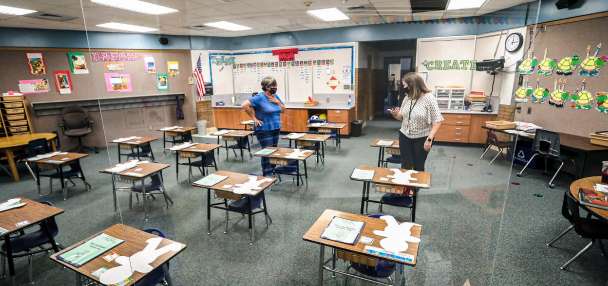
In the Canyons School District, AI training is already underway.
Teachers recently experimented with AI-generated lessons, including a song designed to help students learn how to round numbers.
"It's helping to personalize learning and make it make sense for that child in a way that was just not possible before," said Jonathan Stewart, a digital teaching and learning specialist.
Making learning more accessible
Stewart has seen AI's potential firsthand through his own daughter, who is dyslexic and has struggled with reading.
Using AI, he converted her textbooks into podcasts so she could listen to course materials rather than read them.
"She's like, 'Dad, Dad, no, I understand it. AI taught me history better than my teacher,'" Stewart said.
Educators believe tools like that could help level the playing field for students with different learning needs.
"It levels the playing field for our learners," Stewart said. "That's the hope and promise I see."
Teaching students to question AI
While teachers are excited about AI's possibilities, they are also learning its limitations.
John Arthur, a sixth-grade teacher and Utah legislator, recalled an incident in which a student asked a chatbot how to resolve a dispute with another student.
"AI told him to punch the kid in the face," Arthur said.
Fortunately, the student checked with a teacher before acting on the advice.
Stories like that highlight why state education leaders are emphasizing safety and caution as districts adopt AI tools.
"I think there's a lot of fear generally around AI right now," said Matt Winters, the Utah State Board of Education's AI specialist.
Winters helped develop the state's framework for district AI policies. Utah schools will use Google's Gemini platform, but local districts retain control over how extensively the technology is deployed.
"Some districts and charters are heavy into giving it only to their teachers," Winters said. "But other districts are doing some deployments with students."
In some cases, schools are using customized chatbots that operate under teacher-created rules and protections.
A new skill: verifying information
One lesson educators say is essential is teaching students not to trust every AI-generated response.
In Canyons District classrooms, students are learning to verify information, much like they would information found online.
"Depending on the data source, it may or may not be true, just like when you go online to a website," said Emma Moss, lead AI specialist for the Canyons District.
Teachers use examples to demonstrate the point. If AI generated an image of an orange shark, students would be encouraged to question it.
"Generally speaking, there aren't orange sharks," said Moss.
"You're going to want to verify what's there. Teaching them the skill set."
What about cheating?
One of the biggest concerns surrounding AI in education is whether students will use it to cheat.
However, researchers at Stanford University have found little evidence that advances in technology themselves increase cheating behavior.
Winters agrees.
"They're the same students who in the '90s would have gone to a paper mill, or in the '60s have someone else write it for them," he said.
More time for teaching
Teachers also look forward to the possibilities of AI to help them reclaim valuable time that could be spent with students.
A Gallup-Walton Family Foundation survey found teachers using AI save an average of 5.9 hours per week, the equivalent of about six work weeks per year.
AI is also creating new ways for students to engage with lessons. In one classroom demonstration, students interacted with an AI version of aviation pioneer Amelia Earhart, asking questions about her life and experiences.
"That's one of the things I love about AI right now," Moss said. "It has this potential to do a lot of good for education."
Learning together
Despite the optimism, uncertainty remains.
Many teachers are still working to understand what is expected of them as districts finalize policies and classroom practices.
Arthur has helped pass the bills surrounding AI use in schools, and even he is cautious that teachers are still learning the technology, while they're also teaching it to students.
He compares the process to driver's education.
"You don't just say, 'Oh, there are these new things called cars, let's give it a go,'" he said. "I've got to learn how to use it. I've got to learn how to teach you. You've got to learn piece by piece."
Ready or not, AI is becoming part of Utah classrooms. Educators, students and parents will now be navigating the technology together as schools work to balance innovation with safety.