'%3e%3cpath%20d='M34.1406%205.85938C30.3906%202.10547%2025.3047%200%2020%200C14.6953%200%209.60938%202.10547%205.85938%205.85938C2.10938%209.61328%200%2014.6953%200%2020C0%2025.3047%202.10547%2030.3906%205.85938%2034.1406C9.61328%2037.8906%2014.6953%2040%2020%2040C25.3047%2040%2030.3906%2037.8945%2034.1406%2034.1406C37.8906%2030.3906%2040%2025.3047%2040%2020C40%2014.6953%2037.8945%209.60938%2034.1406%205.85938ZM37.0117%2023.543H31.1602V13.5391H27.6328V19.9414C28.1211%2020.6914%2028.3711%2021.582%2028.3711%2022.5625V22.625C28.3711%2023.668%2028.1172%2024.6055%2027.6328%2025.4297V26.6094H36.082C33.4883%2032.9375%2027.2891%2037.3789%2020.0039%2037.3789C10.3711%2037.3789%202.62109%2029.6289%202.62109%2020C2.62109%2010.3711%2010.3711%202.62109%2020%202.62109C29.6289%202.62109%2037.3789%2010.3711%2037.3789%2020C37.3789%2021.1484%2037.2617%2022.2656%2037.0508%2023.3477C37.0391%2023.4141%2037.0234%2023.4766%2037.0117%2023.543Z'%20fill='white'/%3e%3cpath%20d='M22.3086%2018.5352C20.4336%2018.125%2019.9531%2017.8398%2019.9766%2017.1836V17.1406C19.9766%2016.6992%2020.3477%2016.2148%2021.4023%2016.2148C22.582%2016.2148%2023.8867%2016.6797%2025.0781%2017.4766L26.8516%2015.0195C25.4453%2013.8906%2023.707%2013.3398%2021.5547%2013.3398C18.5195%2013.3398%2016.4375%2015%2016.4063%2017.4766V17.5352C16.3633%2020.2617%2018.5859%2020.9805%2021.293%2021.6016C23.0391%2021.9766%2023.5703%2022.3164%2023.5703%2022.9609L23.5469%2022.9766C23.5469%2023.3906%2023.2578%2023.7031%2022.7852%2023.8359C22.5742%2023.9062%2022.1289%2023.9727%2021.5156%2023.9727C20.7617%2023.9727%2019.7539%2023.8633%2018.6328%2023.4844C18.0898%2023.2891%2017.4727%2023.0039%2016.8047%2022.6133L20.1406%2026.625C20.2813%2026.6602%2021.0977%2026.8516%2021.7734%2026.8516C25.0039%2026.8516%2027.0859%2025.2461%2027.1094%2022.6328V22.5703C27.1602%2020.1133%2025.2148%2019.1719%2022.3086%2018.5352Z'%20fill='white'/%3e%3cpath%20d='M5.24219%2013.5664V26.6133H8.75391V23.7578L10.2969%2021.9531L14.2031%2026.6133H18.3867L12.3555%2019.5195L17.4023%2013.5664H13.4531L8.75391%2019.0586V13.5664H5.24219Z'%20fill='white'/%3e%3c/g%3e%3cdefs%3e%3cclipPath%20id='clip0_97_2430'%3e%3crect%20width='40'%20height='40'%20fill='white'/%3e%3c/clipPath%3e%3c/defs%3e%3c/svg%3e)



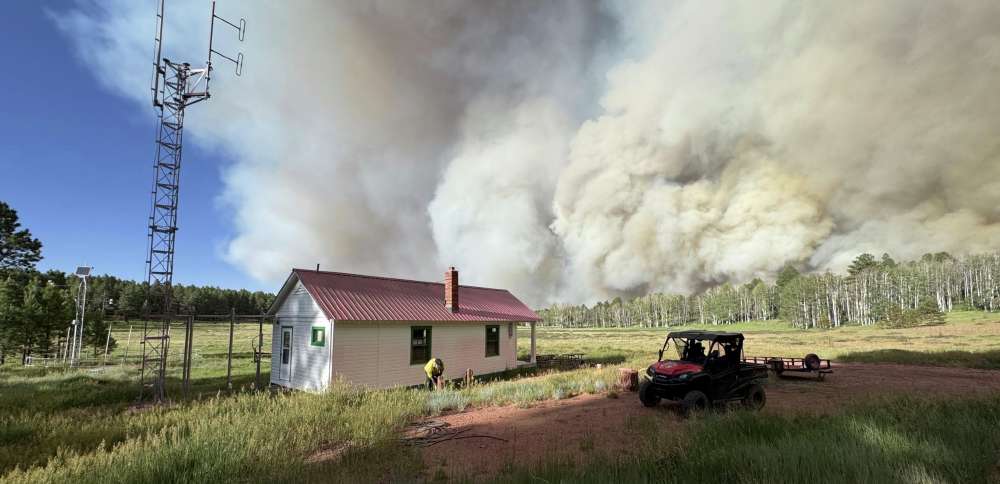
- Lightning caused Utah's Babylon Fire on June 25, according to the U.S. Forest Service.
- The fire is now 95% contained after burning over 107,000 acres and destroying five structures.
- Monsoonal rains have aided containment but caused flash flooding concerns.
MONTICELLO — Federal foresters have finally determined what sparked Utah's largest wildfire in nearly a decade.
The Babylon Fire within the Manti-La Sal National Forest was caused by lightning on June 25; however, smoke wasn't noticed until a day later, when it was first reported, the U.S. Forest Service revealed on Tuesday.
It has since burned over 107,000 acres in the area that's 25 miles southwest of Monticello but is now 95% contained after nearly a month of firefighting efforts and recent monsoonal moisture.
The agency's determination came from a review of the area and Enterprise Geospatial Portal data, a network that gathers information to help firefighters make management decisions when battling wildfires. Several lightning strikes were recorded at the forest's Monticello district on June 25.
"The examination documented extensive lightning indicators within the origin area, including multiple lightning‑struck trees, a blow hole at the base of a strike tree and historical evidence of prior lightning-caused fires. No human activity, ignition devices, equipment or other potential human-caused fire sources were identified," the agency wrote in a statement. "All other potential ignition sources were investigated and ruled out based on evidence at the scene."
However, it wasn't until the following afternoon that firefighters spotted the fire. Members of the Monticello-based Engine 351 were conducting regular patrol operations when they spotted smoke shortly after 2 p.m. on June 26.
Although air and ground resources were quickly dispatched, the fire had grown to 75 acres by that evening because of the dry conditions within the forest's grass, trees and shrubs, Forest Service officials said. Warm temperatures and strong winds only fanned the flames further, creating the need for a complex incident management team to oversee operations.
It destroyed five structures and then surpassed the 100,000-acre mark on July 7, becoming the first Utah fire to hit that mark since 2018. It was the largest active fire in the U.S. at the time, but that unwanted title has now shifted to the Hay Creek Complex Fire, which has now burned over 112,500 acres in eastern Oregon.
Utah's monsoonal return has helped firefighters gain greater control over the Babylon Fire since then, but storms have also posed new flash flooding threats in the area.
Crews are working this week to fix dirt roads that have been damaged by recent rainfall and heavy firefighting equipment, members of the Great Basin Incident Management Team 6 reported on Tuesday. That's on top of work to clear out other debris and other firefighting operations.
Over 580 wildfires have been reported in Utah this year, which have collectively burned nearly 380,000 acres of land across the state, according to state and federal firefighters. It's the most acreage burned since 2018, as well.