'%3e%3cpath%20d='M34.1406%205.85938C30.3906%202.10547%2025.3047%200%2020%200C14.6953%200%209.60938%202.10547%205.85938%205.85938C2.10938%209.61328%200%2014.6953%200%2020C0%2025.3047%202.10547%2030.3906%205.85938%2034.1406C9.61328%2037.8906%2014.6953%2040%2020%2040C25.3047%2040%2030.3906%2037.8945%2034.1406%2034.1406C37.8906%2030.3906%2040%2025.3047%2040%2020C40%2014.6953%2037.8945%209.60938%2034.1406%205.85938ZM37.0117%2023.543H31.1602V13.5391H27.6328V19.9414C28.1211%2020.6914%2028.3711%2021.582%2028.3711%2022.5625V22.625C28.3711%2023.668%2028.1172%2024.6055%2027.6328%2025.4297V26.6094H36.082C33.4883%2032.9375%2027.2891%2037.3789%2020.0039%2037.3789C10.3711%2037.3789%202.62109%2029.6289%202.62109%2020C2.62109%2010.3711%2010.3711%202.62109%2020%202.62109C29.6289%202.62109%2037.3789%2010.3711%2037.3789%2020C37.3789%2021.1484%2037.2617%2022.2656%2037.0508%2023.3477C37.0391%2023.4141%2037.0234%2023.4766%2037.0117%2023.543Z'%20fill='white'/%3e%3cpath%20d='M22.3086%2018.5352C20.4336%2018.125%2019.9531%2017.8398%2019.9766%2017.1836V17.1406C19.9766%2016.6992%2020.3477%2016.2148%2021.4023%2016.2148C22.582%2016.2148%2023.8867%2016.6797%2025.0781%2017.4766L26.8516%2015.0195C25.4453%2013.8906%2023.707%2013.3398%2021.5547%2013.3398C18.5195%2013.3398%2016.4375%2015%2016.4063%2017.4766V17.5352C16.3633%2020.2617%2018.5859%2020.9805%2021.293%2021.6016C23.0391%2021.9766%2023.5703%2022.3164%2023.5703%2022.9609L23.5469%2022.9766C23.5469%2023.3906%2023.2578%2023.7031%2022.7852%2023.8359C22.5742%2023.9062%2022.1289%2023.9727%2021.5156%2023.9727C20.7617%2023.9727%2019.7539%2023.8633%2018.6328%2023.4844C18.0898%2023.2891%2017.4727%2023.0039%2016.8047%2022.6133L20.1406%2026.625C20.2813%2026.6602%2021.0977%2026.8516%2021.7734%2026.8516C25.0039%2026.8516%2027.0859%2025.2461%2027.1094%2022.6328V22.5703C27.1602%2020.1133%2025.2148%2019.1719%2022.3086%2018.5352Z'%20fill='white'/%3e%3cpath%20d='M5.24219%2013.5664V26.6133H8.75391V23.7578L10.2969%2021.9531L14.2031%2026.6133H18.3867L12.3555%2019.5195L17.4023%2013.5664H13.4531L8.75391%2019.0586V13.5664H5.24219Z'%20fill='white'/%3e%3c/g%3e%3cdefs%3e%3cclipPath%20id='clip0_97_2430'%3e%3crect%20width='40'%20height='40'%20fill='white'/%3e%3c/clipPath%3e%3c/defs%3e%3c/svg%3e)


Estimated read time: 4-5 minutes
This archived news story is available only for your personal, non-commercial use. Information in the story may be outdated or superseded by additional information. Reading or replaying the story in its archived form does not constitute a republication of the story.
SALT LAKE CITY — Backing up to this time a year ago, we're asking Candice Hasenyager, director of the Utah Division of Water Resources, what she thought less likely to happen: The Jazz winning the NBA championship after trading away their two biggest stars; or, the state of Utah experiencing its wettest year ever after enduring three of the driest years in history.
"I'll let you comment on whether the Jazz could win the title," she answers diplomatically. "But what happened this winter, it was in nobody's prediction. I talked to a lot of climatologists and no one's model saw this coming; I mean we all hoped for a good winter but this knocked our socks off."
To review:
- The winter of 2022-23 was the snowiest ever recorded in Utah. In the mountains, Deer Valley, Alta, Snowbird, Solitude, Brighton and Snowbasin all saw record snowfalls. Alta recorded 903 inches, or 75.25 feet, eclipsing the old mark by more than 10 feet.
- The amount of water in all that snow (snow-water-equivalent) measured out to 30 inches, an all-time high that is nearly double the yearly average of 15.8 inches and more than quadruple the 7.2 inches recorded in 2020.
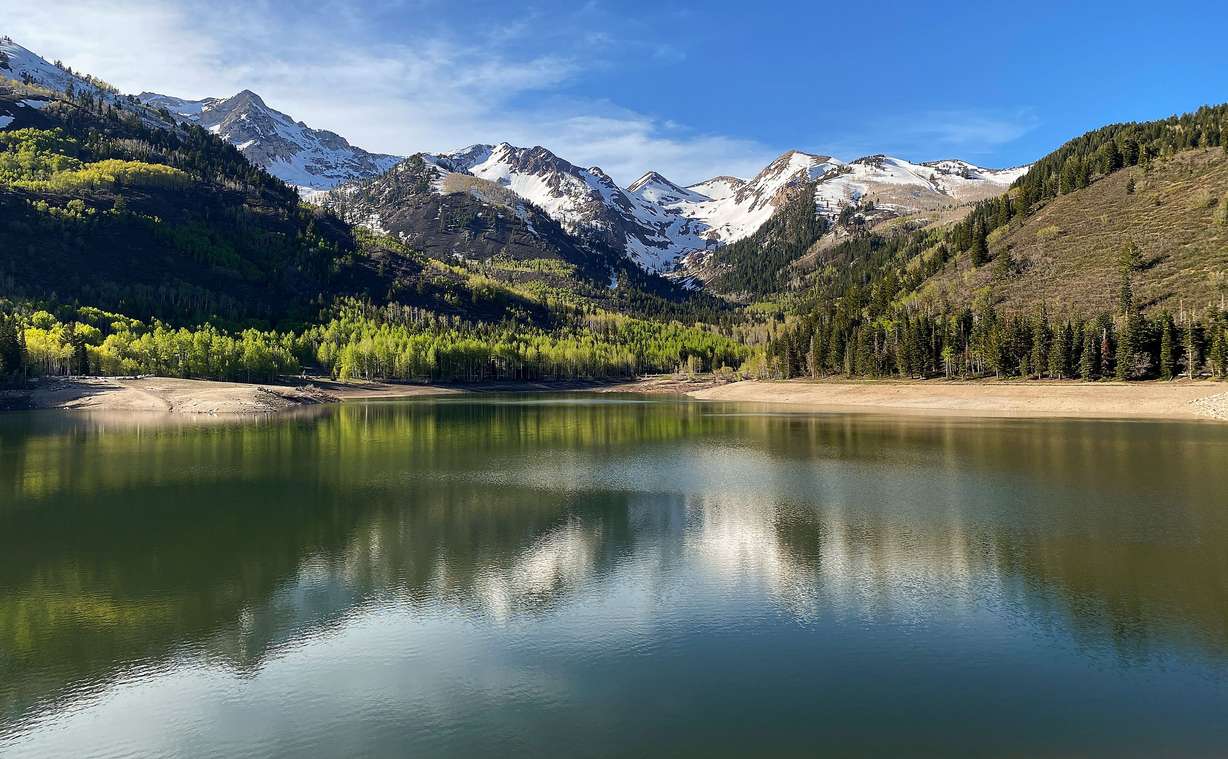
- Every reservoir in the state is at or near capacity, with the exception of Yuba Lake (due to construction repairs), Strawberry (currently 90%) and Lake Powell (39%).
- Lake Powell is expected to rise 65 feet.
- The Great Salt Lake has risen 5½ feet.
- A year ago, 99% of Utahns were living in drought conditions, at levels ranging from moderate to severe to extreme to exceptional; this year less than 3% of Utahns are living in drought conditions, all of them at the moderate, or lowest, level.
The entire state's mood has improved, and especially so in the Division of Water Resources.
"The winter before, meetings were so depressing," says Michael Sanchez, the division's public information officer. "This winter everyone was smiling."
"I did my share of snow dances; I kept cheering all winter," says Hasenyager, the state's water czar. "I know a lot of people, including my husband, were tired of shoveling but I didn't want it to stop."
When your job description is to plan, preserve, conserve and protect the state's water supply — in the second driest state in the union, no less (only Nevada is drier) — a big boost from mother nature gives you a lot more options.
Of course, any exulting over the epic winter is quickly followed by the qualifiers.
It was a record year, but …
The rivers and lakes are full, but …
The ground is saturated, but …
"It won't last if we don't make it last," Hasenyager says.
She's in just her second year as director, but she's been in the water resources department for nearly 16 years, ever since she joined as an intern when she was a junior at the University of Utah.
So she's well aware of the haphazard nature of water, especially in the 21st century as temperatures continue to rise.
Water strategy
The fact that the wettest year in 128 years of record-keeping occurred only three years after the driest year on record tells volumes about the volatile times we're living in.
"If you talk to climate scientists, they tell us climate change means we're going to have more extremes," says Hasenyager, "we're going to see drier dries and wetter wets."
She continues, "We need to build a resilient water supply in a world of extremes. We could have two more (dry) years like the last two and be in the exact same position we were in last year."
So what is the best and most important thing Utahns can do to help craft a water strategy built for the future?
Hasenyager has a one-word answer:
"Care."
"I think it's really important that people care," she says. "Awareness isn't enough. You can be aware of something and still not care. At the end of the day, when we truly care about where our water comes from and understand our relationship to it, then we'll look at how we're using water now and how we'll use it in the future."
Working together
And ideally we should all pull in the same direction.
"We can't pit one user against the other, the 'I'll do it when they do it' mentality," she says. "We need to work at this together."
Nor does it make sense to spend time debating about what's causing the wacky extreme weather.
"We're seeing higher temperatures, we're living this, that's the reality," she says.
If the storms of 2023 have shown us anything, it's that the water future is awfully hard to predict.
We could be at the start of a wet trend, or heading back to the drought.
Hasenyager is hoping for the former.
"I'm a positive person," she says. "I've got a new goal. I want a new problem of having to turn on the Great Salt Lake pumps."

Related stories
Most recent Utah stories
Related topics
 Lee Benson





