'%3e%3cpath%20d='M34.1406%205.85938C30.3906%202.10547%2025.3047%200%2020%200C14.6953%200%209.60938%202.10547%205.85938%205.85938C2.10938%209.61328%200%2014.6953%200%2020C0%2025.3047%202.10547%2030.3906%205.85938%2034.1406C9.61328%2037.8906%2014.6953%2040%2020%2040C25.3047%2040%2030.3906%2037.8945%2034.1406%2034.1406C37.8906%2030.3906%2040%2025.3047%2040%2020C40%2014.6953%2037.8945%209.60938%2034.1406%205.85938ZM37.0117%2023.543H31.1602V13.5391H27.6328V19.9414C28.1211%2020.6914%2028.3711%2021.582%2028.3711%2022.5625V22.625C28.3711%2023.668%2028.1172%2024.6055%2027.6328%2025.4297V26.6094H36.082C33.4883%2032.9375%2027.2891%2037.3789%2020.0039%2037.3789C10.3711%2037.3789%202.62109%2029.6289%202.62109%2020C2.62109%2010.3711%2010.3711%202.62109%2020%202.62109C29.6289%202.62109%2037.3789%2010.3711%2037.3789%2020C37.3789%2021.1484%2037.2617%2022.2656%2037.0508%2023.3477C37.0391%2023.4141%2037.0234%2023.4766%2037.0117%2023.543Z'%20fill='white'/%3e%3cpath%20d='M22.3086%2018.5352C20.4336%2018.125%2019.9531%2017.8398%2019.9766%2017.1836V17.1406C19.9766%2016.6992%2020.3477%2016.2148%2021.4023%2016.2148C22.582%2016.2148%2023.8867%2016.6797%2025.0781%2017.4766L26.8516%2015.0195C25.4453%2013.8906%2023.707%2013.3398%2021.5547%2013.3398C18.5195%2013.3398%2016.4375%2015%2016.4063%2017.4766V17.5352C16.3633%2020.2617%2018.5859%2020.9805%2021.293%2021.6016C23.0391%2021.9766%2023.5703%2022.3164%2023.5703%2022.9609L23.5469%2022.9766C23.5469%2023.3906%2023.2578%2023.7031%2022.7852%2023.8359C22.5742%2023.9062%2022.1289%2023.9727%2021.5156%2023.9727C20.7617%2023.9727%2019.7539%2023.8633%2018.6328%2023.4844C18.0898%2023.2891%2017.4727%2023.0039%2016.8047%2022.6133L20.1406%2026.625C20.2813%2026.6602%2021.0977%2026.8516%2021.7734%2026.8516C25.0039%2026.8516%2027.0859%2025.2461%2027.1094%2022.6328V22.5703C27.1602%2020.1133%2025.2148%2019.1719%2022.3086%2018.5352Z'%20fill='white'/%3e%3cpath%20d='M5.24219%2013.5664V26.6133H8.75391V23.7578L10.2969%2021.9531L14.2031%2026.6133H18.3867L12.3555%2019.5195L17.4023%2013.5664H13.4531L8.75391%2019.0586V13.5664H5.24219Z'%20fill='white'/%3e%3c/g%3e%3cdefs%3e%3cclipPath%20id='clip0_97_2430'%3e%3crect%20width='40'%20height='40'%20fill='white'/%3e%3c/clipPath%3e%3c/defs%3e%3c/svg%3e)


Estimated read time: 4-5 minutes
This archived news story is available only for your personal, non-commercial use. Information in the story may be outdated or superseded by additional information. Reading or replaying the story in its archived form does not constitute a republication of the story.
CAPE CANAVERAL, Fla. — NASA's Orion capsule made a blisteringly fast return from the moon Sunday, parachuting into the Pacific off of Mexico to conclude a test flight that should clear the way for astronauts on the next lunar flyby.
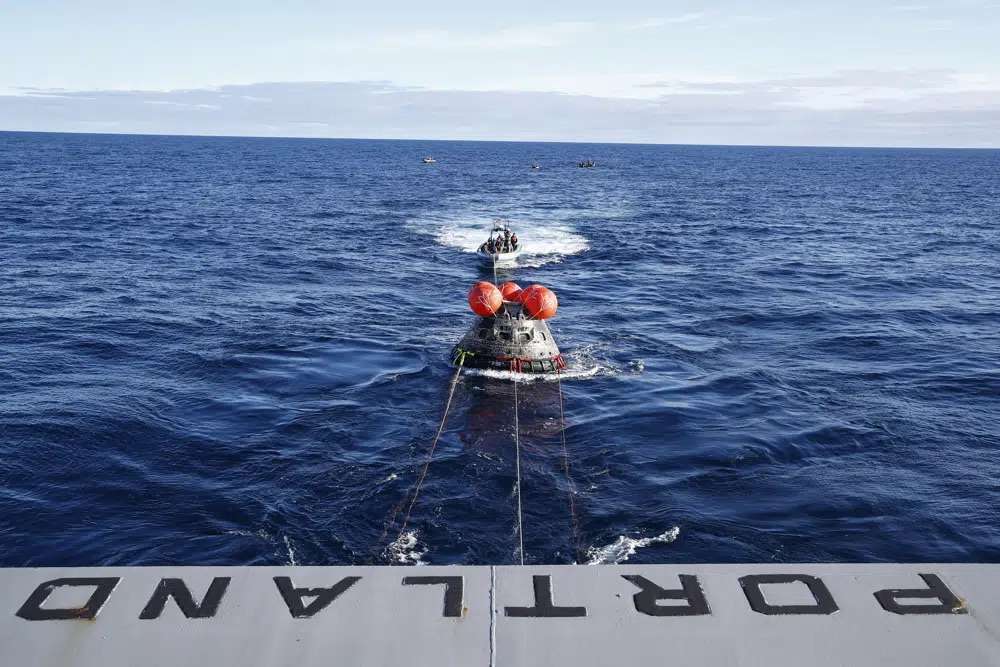
The incoming capsule hit the atmosphere at Mach 32, or 32 times the speed of sound, and endured reentry temperatures of 5,000 degrees Fahrenheit before splashing down west of Baja California near Guadalupe Island. A Navy ship quickly moved in to recover the spacecraft and its silent occupants — three test dummies rigged with vibration sensors and radiation monitors.
NASA hailed the descent and splashdown as close to perfect, as congratulations poured in from Washington.
"I'm overwhelmed," NASA Administrator Bill Nelson said from Mission Control in Houston. "This is an extraordinary day. ... It's historic because we are now going back into space — deep space — with a new generation."
The space agency needed a successful splashdown to stay on track for the next Orion flight around the moon, targeted for 2024 with four astronauts who will be revealed early next year. That would be followed by a two-person lunar landing as early as 2025 and, ultimately, a sustainable moon base. The long-term plan would be to launch a Mars expedition by the late 2030s.
Astronauts last landed on the moon 50 years ago. After touching down on Dec. 11, 1972, Apollo 17′s Eugene Cernan and Harrison Schmitt spent three days exploring the valley of Taurus-Littrow, the longest stay of the Apollo era. They were the last of the 12 moonwalkers.
Orion was the first capsule to visit the moon since then, launching on NASA's new mega moon rocket from Kennedy Space Center on Nov. 16. It was the first flight of NASA's new Artemis moon program, named after Apollo's mythological twin sister.
"From Tranquility Base to Taurus-Littrow to the tranquil waters of the Pacific, the latest chapter of NASA's journey to the moon comes to a close. Orion back on Earth," announced Mission Control commentator Rob Navias.
While no one was on the $4 billion test flight, NASA managers were thrilled to pull off the dress rehearsal, especially after so many years of flight delays and busted budgets. Fuel leaks and hurricanes conspired for additional postponements in late summer and fall.
In an Apollo throwback, NASA held a splashdown party at Houston's Johnson Space Center on Sunday, with employees and their families gathering to watch the broadcast of Orion's homecoming. Next door, the visitor center threw a bash for the public.
Getting Orion back intact after the 25-day flight was NASA's top objective. With a return speed of 25,000 mph — considerably faster than coming in from low-Earth orbit — the capsule used a new, advanced heat shield never tested before in spaceflight. To reduce the gravity or G loads, it dipped into the atmosphere and briefly skipped out, also helping to pinpoint the splashdown area.
All that unfolded in spectacular fashion, officials noted, allowing for Orion's safe return.
"I don't think any one of us could have imagined a mission this successful," said mission manager Mike Sarafin.
Further inspections will be conducted once Orion is back at Kennedy by month's end. If the capsule checks find nothing amiss, NASA will announce the first lunar crew amid considerable hoopla in early 2023, picking from among the 42 active U.S. astronauts stationed at Houston's Johnson Space Center.
"People are anxious, we know that," Vanessa Wyche, Johnson's director, told reporters. Added Nelson: "The American people, just like (with) the original seven astronauts in the Mercury days, are going to want to know about these astronauts."
The capsule splashed down more than 300 miles south of the original target zone. Forecasts calling for choppy seas and high wind off the Southern California coast prompted NASA to switch the location.
Orion logged 1.4 million miles as it zoomed to the moon and then entered a wide, swooping orbit for nearly a week before heading home.
It came within 80 miles of the moon twice. At its farthest, the capsule was more than 268,000 miles from Earth.

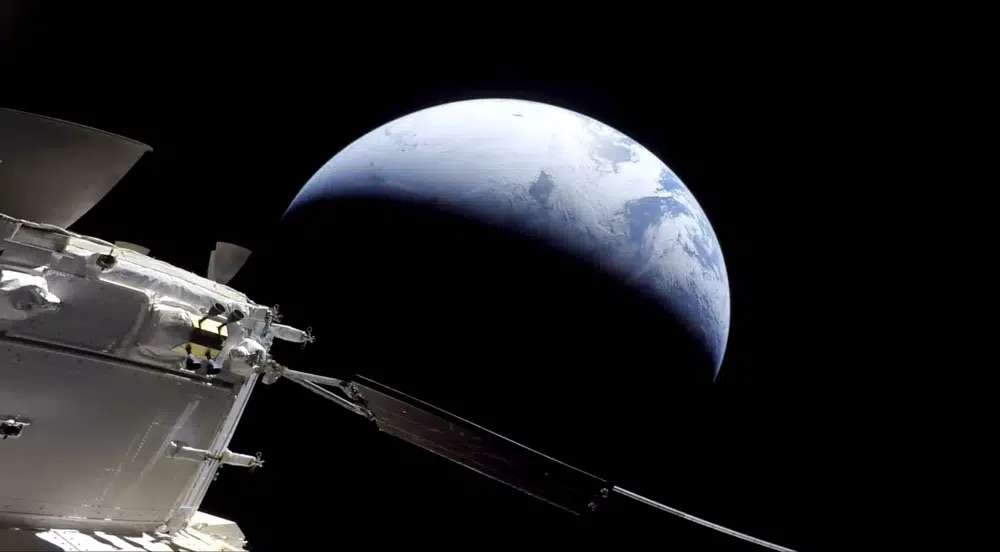
Orion beamed back stunning photos of not only the gray, pitted moon, but also the home planet. As a parting shot, the capsule revealed a crescent Earth — Earthrise — that left the mission team speechless.
Nottingham Trent University astronomer Daniel Brown said the flight's many accomplishments illustrate NASA's capability to put astronauts on the next Artemis moonshot.
"This was the nail-biting end of an amazing and important journey for NASA's Orion spacecraft," Brown said in a statement from England.
The moon has never been hotter. Just hours earlier Sunday, a spacecraft rocketed toward the moon from Cape Canaveral. The lunar lander belongs to ispace, a Tokyo company intent on developing an economy up there. Two U.S. companies, meanwhile, have lunar landers launching early next year.
Editor's note: The Associated Press Health and Science Department receives support from the Howard Hughes Medical Institute's Science and Educational Media Group. The AP is solely responsible for all content.