'%3e%3cpath%20d='M34.1406%205.85938C30.3906%202.10547%2025.3047%200%2020%200C14.6953%200%209.60938%202.10547%205.85938%205.85938C2.10938%209.61328%200%2014.6953%200%2020C0%2025.3047%202.10547%2030.3906%205.85938%2034.1406C9.61328%2037.8906%2014.6953%2040%2020%2040C25.3047%2040%2030.3906%2037.8945%2034.1406%2034.1406C37.8906%2030.3906%2040%2025.3047%2040%2020C40%2014.6953%2037.8945%209.60938%2034.1406%205.85938ZM37.0117%2023.543H31.1602V13.5391H27.6328V19.9414C28.1211%2020.6914%2028.3711%2021.582%2028.3711%2022.5625V22.625C28.3711%2023.668%2028.1172%2024.6055%2027.6328%2025.4297V26.6094H36.082C33.4883%2032.9375%2027.2891%2037.3789%2020.0039%2037.3789C10.3711%2037.3789%202.62109%2029.6289%202.62109%2020C2.62109%2010.3711%2010.3711%202.62109%2020%202.62109C29.6289%202.62109%2037.3789%2010.3711%2037.3789%2020C37.3789%2021.1484%2037.2617%2022.2656%2037.0508%2023.3477C37.0391%2023.4141%2037.0234%2023.4766%2037.0117%2023.543Z'%20fill='white'/%3e%3cpath%20d='M22.3086%2018.5352C20.4336%2018.125%2019.9531%2017.8398%2019.9766%2017.1836V17.1406C19.9766%2016.6992%2020.3477%2016.2148%2021.4023%2016.2148C22.582%2016.2148%2023.8867%2016.6797%2025.0781%2017.4766L26.8516%2015.0195C25.4453%2013.8906%2023.707%2013.3398%2021.5547%2013.3398C18.5195%2013.3398%2016.4375%2015%2016.4063%2017.4766V17.5352C16.3633%2020.2617%2018.5859%2020.9805%2021.293%2021.6016C23.0391%2021.9766%2023.5703%2022.3164%2023.5703%2022.9609L23.5469%2022.9766C23.5469%2023.3906%2023.2578%2023.7031%2022.7852%2023.8359C22.5742%2023.9062%2022.1289%2023.9727%2021.5156%2023.9727C20.7617%2023.9727%2019.7539%2023.8633%2018.6328%2023.4844C18.0898%2023.2891%2017.4727%2023.0039%2016.8047%2022.6133L20.1406%2026.625C20.2813%2026.6602%2021.0977%2026.8516%2021.7734%2026.8516C25.0039%2026.8516%2027.0859%2025.2461%2027.1094%2022.6328V22.5703C27.1602%2020.1133%2025.2148%2019.1719%2022.3086%2018.5352Z'%20fill='white'/%3e%3cpath%20d='M5.24219%2013.5664V26.6133H8.75391V23.7578L10.2969%2021.9531L14.2031%2026.6133H18.3867L12.3555%2019.5195L17.4023%2013.5664H13.4531L8.75391%2019.0586V13.5664H5.24219Z'%20fill='white'/%3e%3c/g%3e%3cdefs%3e%3cclipPath%20id='clip0_97_2430'%3e%3crect%20width='40'%20height='40'%20fill='white'/%3e%3c/clipPath%3e%3c/defs%3e%3c/svg%3e)




- Utah's air quality official says Great Salt Lake dust is a perceived problem based on current metrics.
- Dust hasn't exceeded federal PM2.5 and PM10 standards despite several dust events.
- Utah plans more monitoring sites to assess health impacts of lake's dust, which remains unknown.
Editor's note: This article is published through the Great Salt Lake Collaborative with funding from Love the Lake, an initiative of the nonprofit Great Salt Lake Alliance. Editorial decisions are made independently by the Collaborative and partner newsrooms.
SALT LAKE CITY — Dust blowing off the Great Salt Lake remains one of the biggest threats from the lake's decline, but it might be a "perceived" problem at the moment, Utah's top air quality official says.
But that comes with a big caveat.
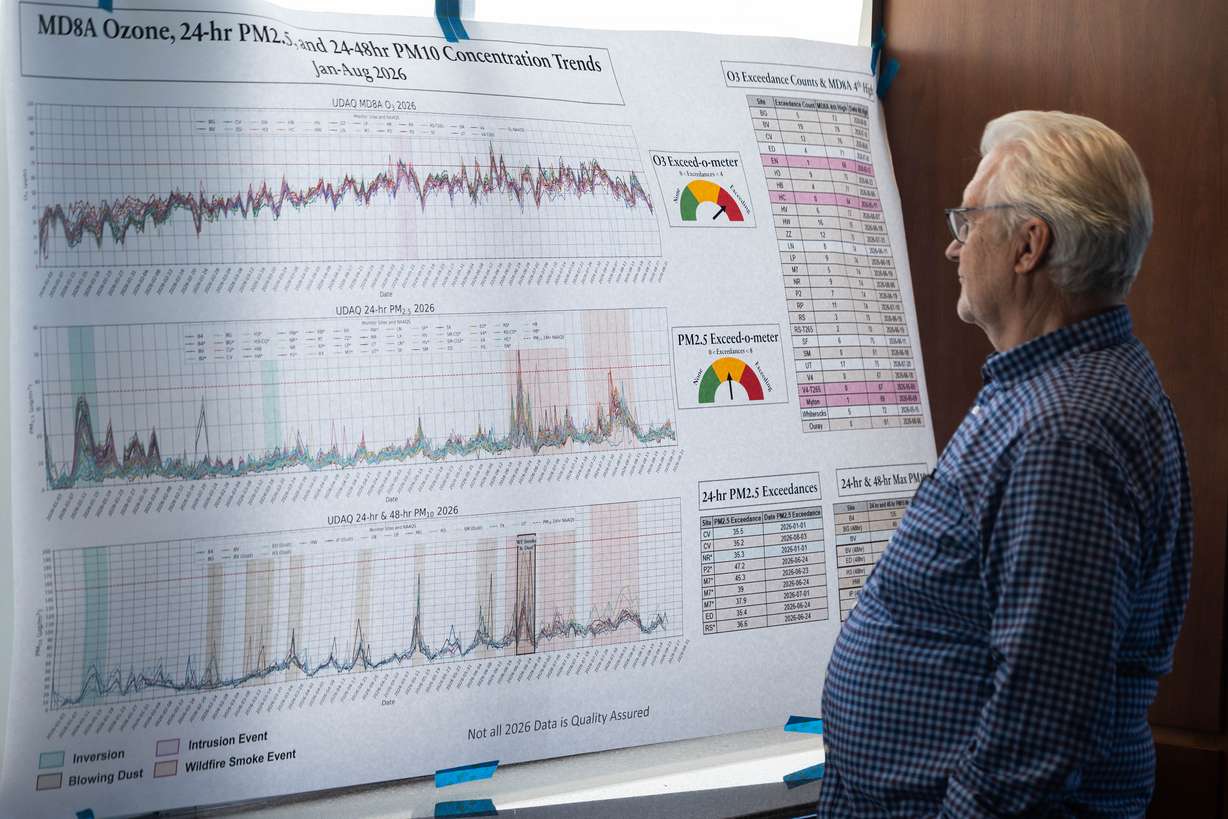
Despite several dust-blowing events this year, dust from the lake has yet to produce 24-hour PM2.5 and PM10 levels that exceed federal standards this year.
There was a short span in late June when PM10 levels neared Environmental Protection Agency standards, but that was largely because dust mixed in with wildfire smoke at the time, said Bryce Bird, the director of the Utah Division of Air Quality, as he pointed to a series of graphs in front of him.
The graphs showed particulate matter and ozone counts at various monitoring sites, and how they relate to EPA standards.
PM10 counts only spiked five other times between Jan. 1 and Aug. 31 — all from wind events — but none of those met EPA concerns, and levels dropped down quickly. Ozone levels continue to be a bigger air quality problem in the Salt Lake Valley this year, producing 19 days surpassing the EPA limit.
Bird brought the graph to illustrate his point during a panel discussion about Great Salt Lake dust that the Great Salt Lake Alliance hosted on Monday.
"Most of our dust events are well below the health standard," he told KSL after the event. "We're not approaching nonattainment. We're not violating federal health standards."
The caveat? Great Salt Lake's dust contains 13 substances that raise concerns, including arsenic, cadmium, cobalt, copper, lead, mercury and thallium, all of which come from natural and manmade sources — and Utah isn't entirely sure how much of those is in the dust blowing in from the lake.
Great Salt Lake's dust
Utah Division of Air Quality officials have started installing new monitoring equipment to track dust emissions, and Bird expects to have 10 sites up by this winter. Those will ultimately reveal how much of those substances, if any, are making it into the communities surrounding the lake.
Thus, the data collected to this point indicates there is a "potential problem" from the lake.
However, while the EPA has healthy standards for PM2.5, PM10 and ozone levels, it doesn't have any one-hour or daily air quality thresholds for something like arsenic. So even if there is arsenic blowing into communities, the division will likely have to work with health researchers to determine what the threshold should be for it.
"Right now, it would just be a number," Bird said, of anything collected at sites. "(EPA standards) set a level that's protecting the public health with an adequate margin of safety. As long as you're below that standard, you're meeting the EPA requirements."

It's not entirely clear when a threshold will be established either, so the timeline for having a network and thresholds is, in a sense, up in the air.
The EPA is aware of the issue, but it's likely not a high priority compared to other air quality sources impacting larger populations, he added. Its research wing was recently split up and relocated to different programs, meaning the state has to sift through the changes to receive assistance.
At the same time, the federal government's share of air quality project funding in Utah has gone down since the 1980s. Federal sources accounted for approximately 60% of air quality funding at its peak, but it's now closer to 20%.
Finding state funding gets tricky when it faces shortfalls, such as the $300 million one it recently dealt with.
Any kind of dust is sort of dangerous and horrible if you're exposed to it for too long.
–David Parrott, assistant director of the Great Salt Lake Institute at Westminster University
Other experts who attended Monday's discussion said there's great benefit to curbing the lake's dust, even if it isn't regularly breaking PM10 standards.
Dust events also push various microbes to communities, which create many of the health impacts of dust, said David Parrott, assistant director of the Great Salt Lake Institute at Westminster University. That's a subject he's only scratched the surface on with his colleagues.
Researchers are also aware of other issues, such as dust's ability to prematurely melt snowpack, which could impact water supply, including getting water to the lake, said Derek Mallia, a research associate professor in the Department of Atmospheric Sciences at the University of Utah.
"Any kind of dust is sort of dangerous and horrible if you're exposed to it for too long," Parrott said, summing it up.
All three appeared to agree that getting water to the lake is the best solution, but that's easier said than done.
Repeating history?
The state's future dust network may help determine a new health standard for Great Salt Lake's dust, and it could also help residents prepare for future dust events. Bird suggested working with meteorologists to create alerts when weather events will likely blow dust into communities.
Utah's goal, he said, is to figure out what the health impacts are and mitigate them before the federal government swoops in through any air quality standards, as it has done for particulate matter and ozone levels.
As he puts it, the state doesn't want to wait for the federal hammer to take action.
If there's a silver lining in all of this, Utah's air quality has improved from other challenges. Utah's particulate matter and ozone levels have gradually improved with better technology and tracking of the issue, Bird said.
That includes vehicle and building emissions, but also dust from other sources, such as gravel pits, construction sites, mines and other dried lakebeds.
"I'm confident that as we look at these new and emerging concerns, we can apply the same processes and have the same successes over time," he said.