'%3e%3cpath%20d='M34.1406%205.85938C30.3906%202.10547%2025.3047%200%2020%200C14.6953%200%209.60938%202.10547%205.85938%205.85938C2.10938%209.61328%200%2014.6953%200%2020C0%2025.3047%202.10547%2030.3906%205.85938%2034.1406C9.61328%2037.8906%2014.6953%2040%2020%2040C25.3047%2040%2030.3906%2037.8945%2034.1406%2034.1406C37.8906%2030.3906%2040%2025.3047%2040%2020C40%2014.6953%2037.8945%209.60938%2034.1406%205.85938ZM37.0117%2023.543H31.1602V13.5391H27.6328V19.9414C28.1211%2020.6914%2028.3711%2021.582%2028.3711%2022.5625V22.625C28.3711%2023.668%2028.1172%2024.6055%2027.6328%2025.4297V26.6094H36.082C33.4883%2032.9375%2027.2891%2037.3789%2020.0039%2037.3789C10.3711%2037.3789%202.62109%2029.6289%202.62109%2020C2.62109%2010.3711%2010.3711%202.62109%2020%202.62109C29.6289%202.62109%2037.3789%2010.3711%2037.3789%2020C37.3789%2021.1484%2037.2617%2022.2656%2037.0508%2023.3477C37.0391%2023.4141%2037.0234%2023.4766%2037.0117%2023.543Z'%20fill='white'/%3e%3cpath%20d='M22.3086%2018.5352C20.4336%2018.125%2019.9531%2017.8398%2019.9766%2017.1836V17.1406C19.9766%2016.6992%2020.3477%2016.2148%2021.4023%2016.2148C22.582%2016.2148%2023.8867%2016.6797%2025.0781%2017.4766L26.8516%2015.0195C25.4453%2013.8906%2023.707%2013.3398%2021.5547%2013.3398C18.5195%2013.3398%2016.4375%2015%2016.4063%2017.4766V17.5352C16.3633%2020.2617%2018.5859%2020.9805%2021.293%2021.6016C23.0391%2021.9766%2023.5703%2022.3164%2023.5703%2022.9609L23.5469%2022.9766C23.5469%2023.3906%2023.2578%2023.7031%2022.7852%2023.8359C22.5742%2023.9062%2022.1289%2023.9727%2021.5156%2023.9727C20.7617%2023.9727%2019.7539%2023.8633%2018.6328%2023.4844C18.0898%2023.2891%2017.4727%2023.0039%2016.8047%2022.6133L20.1406%2026.625C20.2813%2026.6602%2021.0977%2026.8516%2021.7734%2026.8516C25.0039%2026.8516%2027.0859%2025.2461%2027.1094%2022.6328V22.5703C27.1602%2020.1133%2025.2148%2019.1719%2022.3086%2018.5352Z'%20fill='white'/%3e%3cpath%20d='M5.24219%2013.5664V26.6133H8.75391V23.7578L10.2969%2021.9531L14.2031%2026.6133H18.3867L12.3555%2019.5195L17.4023%2013.5664H13.4531L8.75391%2019.0586V13.5664H5.24219Z'%20fill='white'/%3e%3c/g%3e%3cdefs%3e%3cclipPath%20id='clip0_97_2430'%3e%3crect%20width='40'%20height='40'%20fill='white'/%3e%3c/clipPath%3e%3c/defs%3e%3c/svg%3e)





- The Cottonwood Fire in southern Utah has destroyed Eagle Point Resort.
- Gov. Spencer Cox calls it potentially the most destructive fire in state history.
- Fire remains 0% contained, threatening over hundreds of primary and secondary homes.
BEAVER — A fast-moving fire burning through southern Utah could be one of the most destructive in state history after sweeping through a private resort and an area filled with hundreds of mountain cabins and condominiums, Gov. Spencer Cox said after touring the area on Wednesday.
The Cottonwood Fire destroyed parts of Eagle Point Resort and other buildings east of Beaver, although it's still unclear how many structures have been lost because the fire has burned so intensely and quickly that crews have yet to make official assessments, the governor said. Those assessments are expected to be made as early as Thursday.
"There's a very good chance this is already the most destructive fire in the state's history. ... It's certainly catastrophic," he said. "We know it's going to impact this community for a long, long time."
The fire, which ignited Monday evening, consumed thousands of acres by Wednesday evening, surpassing 61,000 acres. It remained 0% contained at that time, according to the U.S. Forest Service. The cause is still under investigation.
Weather conditions and the area's dry vegetation have created "limited opportunities" to attack the fire thus far, federal firefighters said in a video on the fire posted Wednesday afternoon.
"There's no end in sight to this fire right now," Cox added. "It's really just trying to save everything we can, and there's no timetable for how this will be put out."
Shane Gadbaw, owner at Eagle Point Resort, confirmed earlier Wednesday that the resort and surrounding area suffered "significant property loss." Eagle Point Resort is a private ski resort in the Tushar Mountains, which, according to its website, was established in the 1970s.
"We are thankful that to our knowledge, there have been no human casualties from the fire," he said.
Gadbaw added that the resort would "be closed for a considerable time to recover from the catastrophe." The resort said it would release an update once conditions become safer and it has assessed the extent of damage.
Ski Utah is "heartbroken by the situation facing Eagle Point Resort," said Nathan Rafferty, president of the organization, in a statement to KSL.
"An independent mountain and genuine community pillar, Eagle Point is a source of recreation, livelihoods and local identity for the region it calls home. The impact of this fire will be felt across Beaver County and throughout the Utah ski industry," Rafferty continued. "Our gratitude goes to the firefighters, first responders and volunteers who have worked under extraordinarily difficult conditions to protect lives and structures in the area."
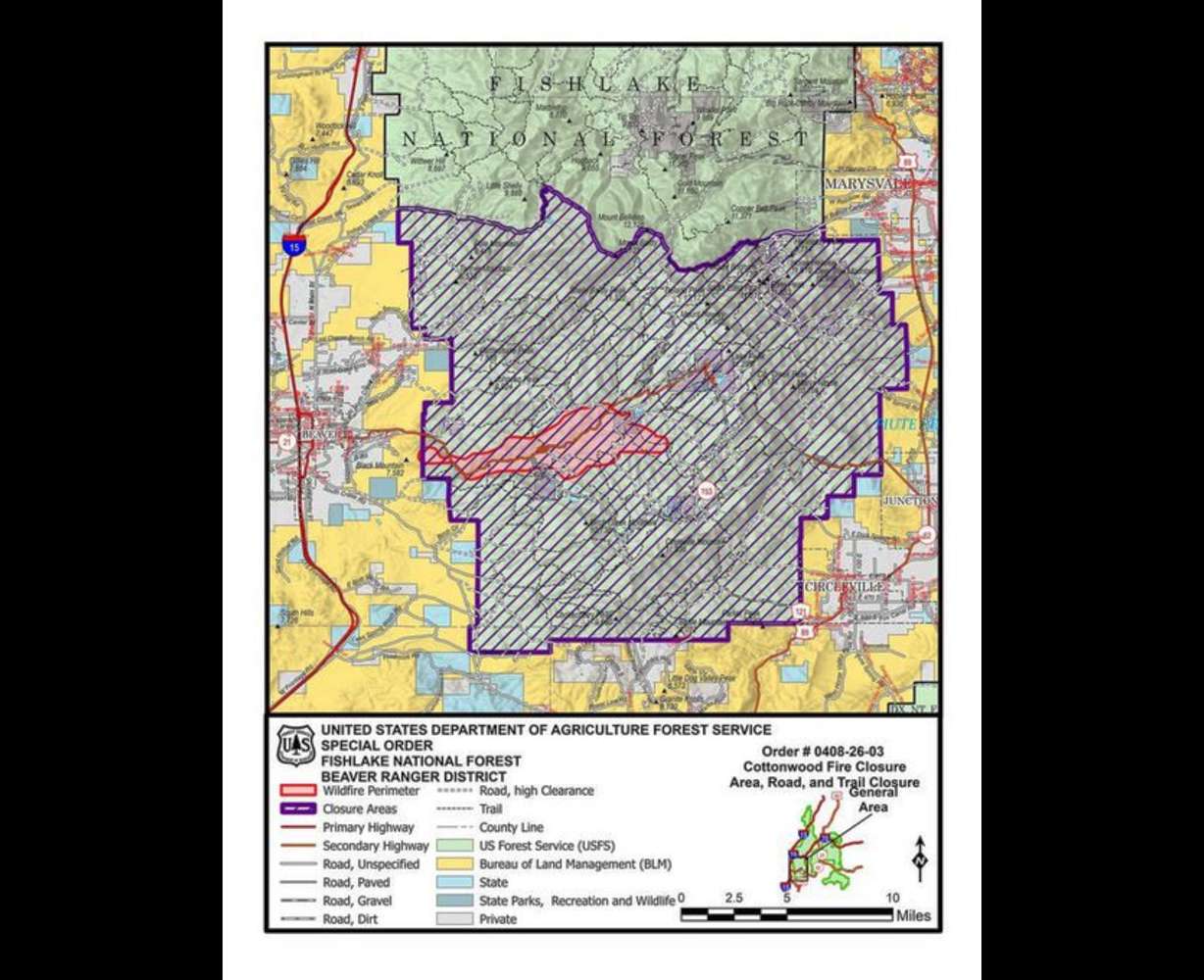
Federal officials reported there were more than 300 homes in the area threatened by the fire, although that estimate came when the fire had burned approximately 27,000 acres. Mandatory evacuations remained in place for Eagle Point, Merchant Valley, HiLo Estates, Arrowhead Summer Homes and surrounding areas.
Early Wednesday, the Piute County Sheriff's Office said in a social media post that Junction and Circleville were in ready status and should prepare to leave the area if necessary. State Route 153 was also closed in both directions.
Marysvale was also notified to be ready to evacuate on Wednesday, the Piute County Sheriff's Office announced around 1:35 p.m. The sheriff's office also said Rocky Mountain Power deenergized power lines in Piute County due to the fire.
"At this time, we don't have a time frame of how long the power will be off," the sheriff's office said. "Please be prepared for a prolonged outage."
In a Facebook post on Wednesday night, the sheriff's office said that out of precaution, courts in Garfield and Piute counties are temporarily suspended until further notice. The suspension came after both county facilities lost power due to the wildfire. Additionally, the post stated the facility in Garfield County does not have internet access nor access to "essential court systems."
"The temporary closures are necessary to ensure the safety of court personnel and the public and because the affected facilities are unable to support essential court functions," the post read.
The sheriff's office said at this time, it cannot determine when the courts will reopen.
FEMA has approved Utah's Fire Management Assistance Grant for the Cottonwood Fire, which will help cover 75% of the state's eligible firefighting costs. The agency approved a similar grant for the Iron Fire burning in Utah, Juab, and Tooele counties.
Utah's surging acreage loss
The Cottonwood Fire is a major contributor to Utah's rising fire activity, which has surged in late June. The number of acres burned across Utah has increased 10 times over the past week.
More than 141,500 acres have now burned across Utah this year, per data released by state and federal firefighters updated Wednesday afternoon. The number jumped past the 100,000-acre mark on Tuesday, after being listed at 13,300 acres on June 17.
"It's been a no-good, very bad week here in the state of Utah," Cox said, adding that he's never seen crews "this concerned" about fire conditions in the dozen years he's dealt with wildfires.
This season's running total is already the second-largest acreage burned since 2021, following last year's nearly 165,000 acres. At least three-quarters of all of this year's fires have been human-caused, including at least two of the state's three biggest fires so far this year, according to Kayli Guild, fire prevention and communications coordinator for the Utah Division of Forestry, Fire and State Lands.
"These numbers highlight the important reality: Many wildfires can be prevented," she said in an update on the state's wildfire situation on Wednesday, adding that dry vegetation and strong winds this week have fueled much of the new fire growth.
Cox said Utah's fire resources have been "stretched as thin as possible" because of the intense fire activity, which is why he's urging Utahns to be careful around dry vegetation over the coming weeks.
Forecast could complicate firefighting efforts
The forecast for the rest of the week may not help, either.
A high-pressure system near the Texas Panhandle and a low-pressure system off the California coast are helping push scattered storms into Utah on Wednesday and Thursday, said KSL meteorologist Matt Johnson. The quasi-monsoonal system could bring beneficial rain, but also produce gusty winds and lightning that can spark new fires or help spread existing ones.
"The hope is we get more rain than we do wind and lightning, but there's a pretty good risk right now ... that we see some microburst winds along with some dry lightning across northern and central Utah," he said.
National Weather Service models don't project much precipitation accumulation with the system, but with strong high-end potential near half an inch. That's because dry air underneath the cloud base can evaporate any rain before it touches the ground, especially in the early monsoon season, Johnson explained. This activity also increases the risk of microbursts and dry lightning.
He hopes the rain can break through the barrier, especially near active fires. If not, it could create more challenges.
Fire conditions may worsen on Friday and Saturday. A deep low-pressure system will move in from the Pacific Northwest to close out the week, bringing strong and dry winds across most of Utah as it approaches. Southern Utah is projected to experience a 36-hour window of critical-to-extreme fire weather due to strong winds and low relative humidity.
The National Weather Service also issued a red flag warning for most of Utah, in effect from Friday through early Sunday, due to a cold front expected to bring strong winds of 20-30 mph, with gusts up to 40-50 mph.
"Critical fire weather conditions are expected," the agency warned. "Any new fire starts or existing fires may spread rapidly."
Northernly wind on the other end of it could help clear out the smoke along the Wasatch Front for at least a few days, Johnson said. The system may create more thunderstorms, but high temperatures could also drop from the mid-90s on Friday to the low 70s on Sunday.
Areas closer to St. George are also forecast to experience a 10-degree drop in temperature.
Contributing: Alex Cabrero, Devan Masciulli, Mary Culbertson and Devin Oldroyd