
Estimated read time: 5-6 minutes
This archived news story is available only for your personal, non-commercial use. Information in the story may be outdated or superseded by additional information. Reading or replaying the story in its archived form does not constitute a republication of the story.
SALT LAKE CITY — Kenosha, Wisconsin, this week may be the only place in the U.S. where you can find crowds of people who both willingly display their political leanings — wearing them in fact on lanyards around their necks — and mingle happily, conservatives and liberals, independents and the unaffiliated, walking in small groups and discussing politics, but smiling broadly and listening politely even if they disagree.
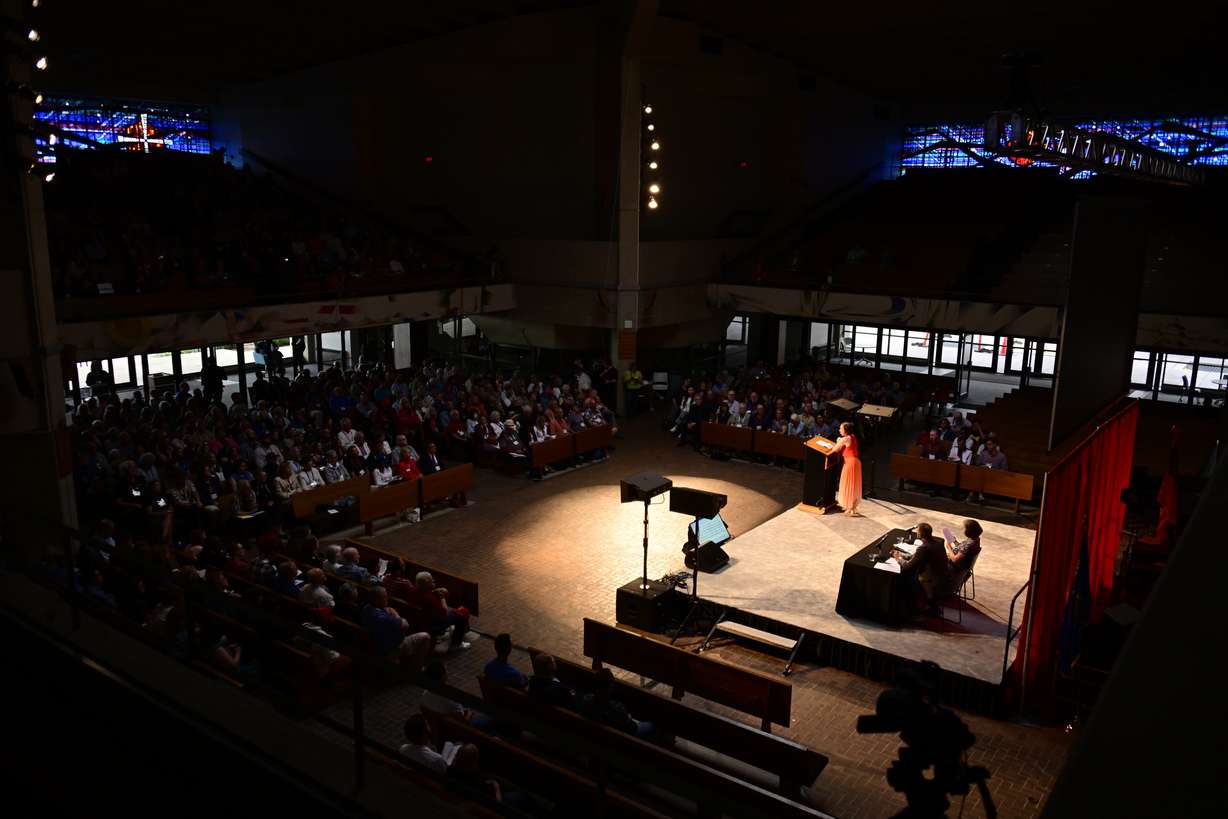
Just yards from Lake Michigan Thursday afternoon in a chapel on historic Carthage College campus — where Abraham Lincoln once served on the board of trustees — members of all and no political persuasions stood side by side, more than 500 strong, and sang four verses of "America the Beautiful." It began life as a poem and was on this day an acknowledgement that Americans can disagree heartily and still consider each other to be both patriots and friends.
Welcome to Braver Angels, a nonprofit organization dedicated to depolarizing America's politics. For the fourth time, the group has welcomed hundreds to a multiday conference dedicated to the idea that discussion is good, that disagreement — done nicely — is essential to building a strong nation, and that compromise and respect are how a country moves forward in turbulent times.
Roughly 700 people, ranging from teens to those in at least their 80s, registered for the immersive gathering, which includes panel discussions, songwriting sessions, art exhibits and film displays. But the focus is on genuine back-and-forth that highlights the power of talking things out and really listening to people who hold all kinds of opinions, not just those one holds dear.
The proper attitude, as speakers noted, is curiosity: Why do you think this way?
Red and blue talk it out
The principles are not unlike those that George Washington credited with making the Constitutional Convention in Philadelphia a success after its very bumpy start: a spirit of amity, of mutual deference and of concession, according to Thomas Griffith, a former federal judge on the U.S. Court of Appeals for the D.C. Circuit and one of the keynote speakers. The successful creation of the Constitution has been called the "Miracle of Philadelphia," but Griffith balks at that. Miracles defy explanation, he said, but we know those three traits allowed the delegates back then to complete their task. And they are still needed to sustain the country.
The nonprofit Braver Angels and organizations in its network or those that are simply like-minded have held hundreds of mostly online conversations around the country involving strangers who disagree with each other, but who want America to thrive. People who don't always agree on how to get things done or which policies would be best, but who believe the country will be stronger if we work together, talk and listen, instead of tearing each other apart, as the group's Monica Guzman put it. "What is really intolerable," she said, "is what we have allowed to go on out there."
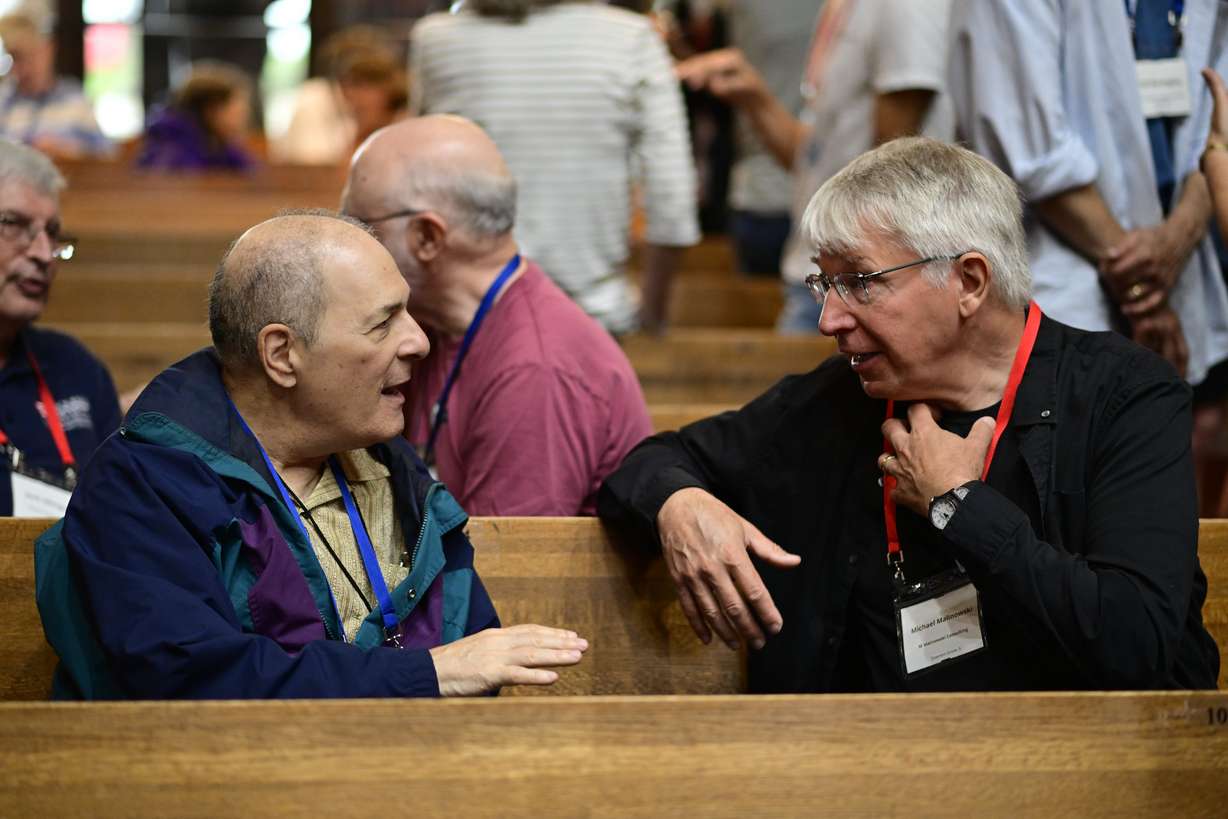
Conversations like the one between Gabriella Timmis, who lives in New York, and her dad Jerry Timmis, who's from Michigan. They sat side by side, she in a blue baseball cap and he sporting red, and revealed how much they love each other and how often they disagree. "Our song is 'No Hard Feelings,'" she said. "We get into it."
They weren't always so easygoing about the chasm they sometimes face when it comes to politics. In 2020, she told him she couldn't hang out with him; it was just too hard. He told her their relationship should always be more important. You do what you need to do to reconcile with your family.
Always.
Jerry, father of four and part of a good-sized extended family, said the women are all blue, the men "various shades of red." But they don't intend to let politics break them up.
The event and Braver Angels itself are proudly partisan in a nonpartisan way. Cameron Swallow, a gathering co-chair, is a left leaner from Kenosha. Her counterpart is right-leaning Matt Hausman of Pesotum, Illinois. Among the group's principles is valuing both red and blue patriotism, and being sure they're equally well represented, said David Blankenhorn, founder and president of the Institute for American Values and co-founder of Braver Angels.
The group was born after the 2016 election, when Blankenhorn and David Lapp were talking about how people were feeling in New York and in southwest Ohio, where the two, respectively, lived. They thought it would be interesting to get 10 Hillary Clinton and 10 Donald Trump supporters together to talk about that for a couple of days. They asked their friend, Bill Doherty, a licensed family and marriage therapist in the St. Paul area, to facilitate. They didn't have a big strategic plan, said Doherty, who told Deseret News the story. But the three went on to co-found Braver Angels afterward.
While they try hard to balance red and blue, not favoring one above the other, Braver Angel Gary Holland, a self-described "rabble rouser" from Ridgefield, Connecticut, hopes to add what he's calling a Purple Caucus, though he wants a better name. He loves Braver Angels, but wants to see more intentional effort to attract those describing themselves as independent or unaffiliated, too.
Hope vs. optimism
COO Barbara Thomas said that many Americans are concerned about the "toxicity pervading our discourse." She warned that it's weakening us in the world's eyes. Yet many feel that toxicity is something happening to them, not something they feed and can help fix.
The trick, said Doherty, is preparing constructively. You prepare emotionally — the relationship is the most important thing — and then prepare rationally.
"If you think everybody is either ignorant, unethical or was duped by leaders and you can't image a rational person voting for the other candidate, you need to expand your horizons," he said. "Form relationships with people who think differently," and don't dismiss them.