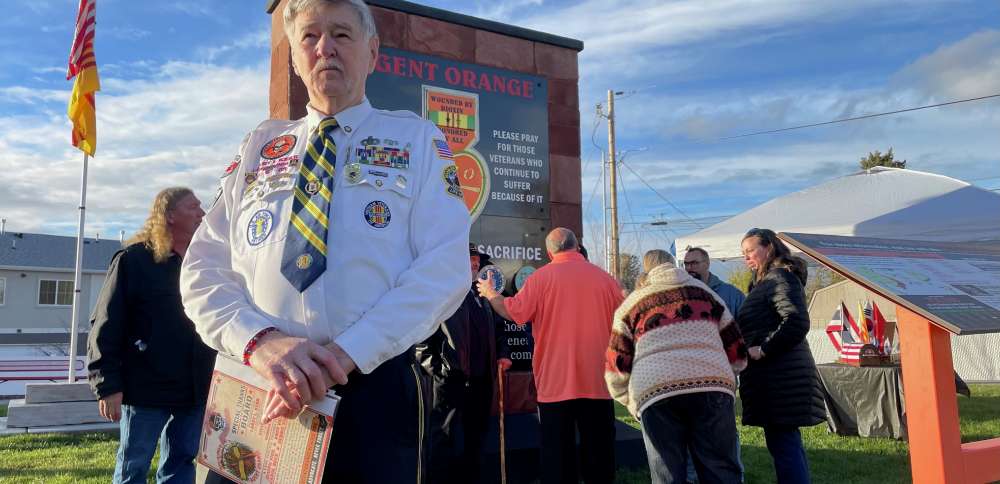
- Military veterans and others gathered in Sunset to dedicate a new monument that honors veterans affected by Agent Orange, an herbicide used in the Vietnam War.
- Larry Kerr, a U.S. Air Force veteran who spearheaded the effort, thinks it's the largest memorial of its type in the country.
- The monument underscores the impact Agent Orange has had on those affected by it and their families.
SUNSET — For many veterans who survived the Vietnam War, the battles didn't end upon returning home.
"In some cases, it continued to take things from them long after they believed their service was behind them," said Hannah Smalling. "Some came home carrying memories of what they had seen, and others came home carrying something they couldn't see at all — Agent Orange, an exposure that would become a lifelong battle for some of these men and their families."
Agent Orange was a defoliant — an herbicide that causes leaves to fall off plants — used by U.S. forces during the Vietnam War.
Smalling's dad, Robert Smalling, served in Vietnam for the U.S. Air Force and is now battling the aftereffects of Agent Orange, like many others. She spoke at a ceremony Friday to dedicate a memorial at Sunset City Veterans Memorial Park that honors those, like her father, impacted by exposure to the chemical. She hopes the new monument — one of only a handful around the United States dedicated to the victims of Agent Orange — serves as a place where veterans can commiserate and where the public can learn.
"May it give the next generation a place to learn, a place to remember and a place to understand that freedom has a human cost," she said.
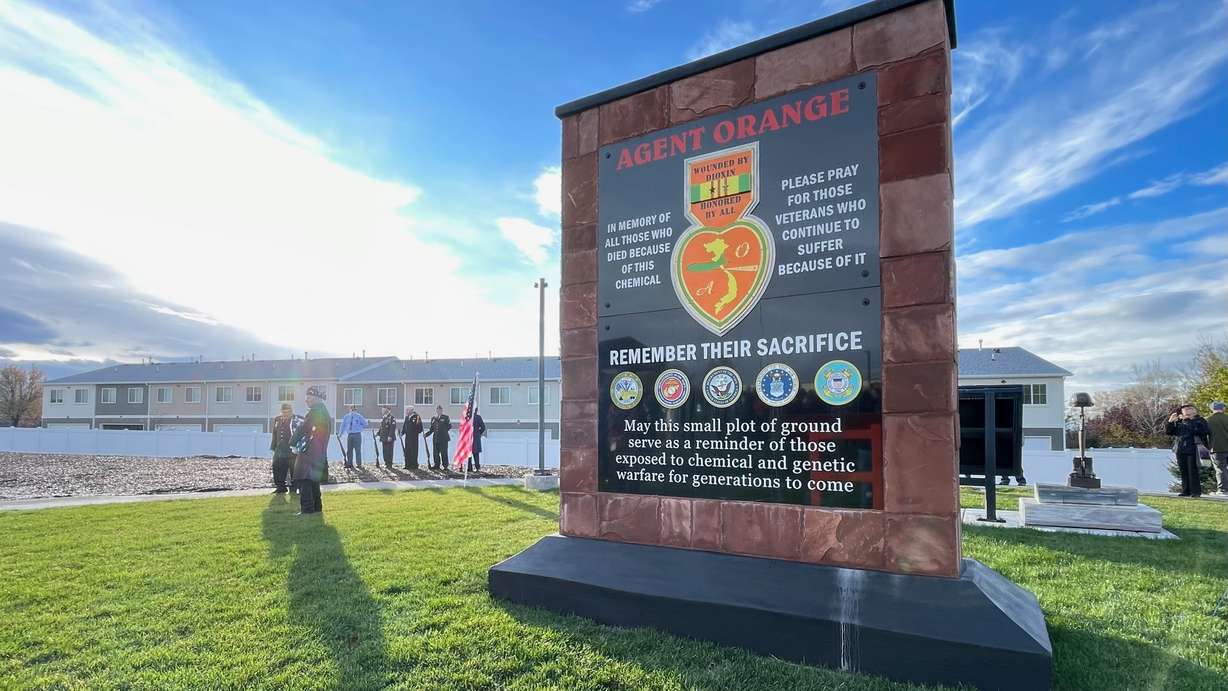
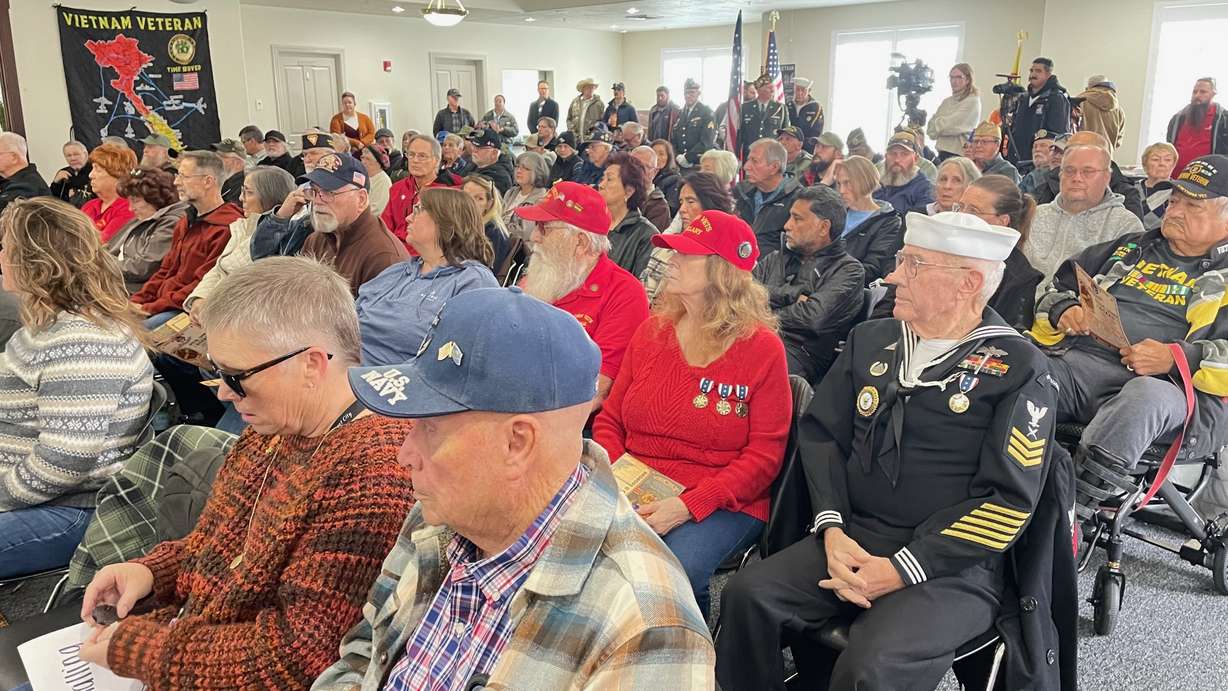
Efforts to create the memorial date back three years, and a crowd of military veterans and others gathered for Friday's ceremony. The large orange and black monument, with accompanying informational panels, provides information about Agent Orange and the war.
"In memory of all those who died because of this chemical. Please pray for those veterans who continue to suffer because of it," it reads. The monument also pays homage to those exposed to burn pits and other toxic substances in military operations after 1990 connected to the Persian Gulf War and Afghanistan War.
Smalling helps with fundraising for the Utah Agent Orange Veterans Foundation, which spearheaded efforts to create the memorial, and Larry Kerr leads the organization. He served in the U.S. Air Force during the Vietnam War, where he was exposed to Agent Orange, and continues to battle the health effects of the substance.
"I didn't think I was going to make it," he said, noting a recent cancer diagnosis, one of many ailments he's suffered over the years linked to Agent Orange.
But he did survive, and his hope now is that the memorial serves as an educational tool for younger generations. As far as he knows, the monument, behind Sunset City Hall at 200 W. 1300 North, is the largest in the country dedicated to those who contended or are contending with Agent Orange.
"I hope this will be a place for children and families to come and remember," he said.
'Duty to the veterans'
According to an informational kiosk that accompanies the memorial, around 750,000 U.S. military veterans have died due to exposure to Agent Orange. The chemical was used to defoliate trees and plants in Vietnam, thus reducing enemy cover, and to destroy enemy crops. But it can also cause a wide range of ailments — information that only came out later.
Marlene Summers, a retired U.S. Army colonel who addressed the group, said the U.S. military used 19 million gallons of herbicides during the Vietnam War, mostly Agent Orange. The substance caused a range of cancers and neurological disorders to those exposed to it, she said, and also generated birth defects among the children of some of them.
"Words are not sufficient to fully describe the horrors these veterans have faced and endured for decades. Most have not heard anyone say, 'I'm sorry you were exposed to that danger.' You're hearing that today," she said.
She spoke of the hostility some Vietnam War veterans faced on returning home to the United States and noted, with chagrin, that the Sunset monument came into being due to the efforts of Kerr and others.
"Today, the local monument being dedicated to our Vietnam veterans, unfortunately, is happening because those same veterans are the ones who had to find the resources to make this happen, so that their service and that of their fellow Vietnam veterans would not go unnoticed," she said. "My apologies you had to do that for yourself."
At the same time, she lauded them for their efforts.
"In spite of this solemn and embarrassing history, here you are today, once again displaying impeccable patriotism and commitment to freedom for every human being on the planet. What an example you are to all of us," she said.
Bill Orris, a retired lieutenant colonel and Green Beret in the U.S. Army, also addressed the group, noting the relative ease of being exposed to Agent Orange during the war. His dad, who served in the jungles of Vietnam during the war, later died from a disease linked to Agent Orange, as did his brother-in-law.
"Exposure, and this is unique, could occur from just the skin, touching it, breathing it, or accidentally ingesting it while you're eating or drinking. We learned that military personnel generally did not use chemical-protective clothing," he said. "They were just in their dirty fatigues, walking around, and got exposed."
Like Kerr, he hopes the monument serves as an educational tool for younger generations.
"We need to tell them what the chemicals were, why they were used, and what the consequences have been and what remains uncertain. We should tell them the names of the people who served," he said, and teach them that the nation has a "duty to the veterans."