

- Utah's higher education offers great value with low tuition and generous grant aid.
- Many students miss financial aid by not completing the FAFSA.
- A degree boosts earnings significantly; Utah graduates earn $12,000-$25,000 more annually.
SALT LAKE CITY — The current state of higher education, particularly in the Beehive State, reflects a system in flux.
Its own leaders would say so, too.
In fact, "transformation" was the word that the Utah Commissioner of Higher Education used when asked to describe the future of higher education in the state with a single word.
Commissioner Geoffrey Landward's answer came Wednesday during a panel discussion hosted by the Kem C. Gardner Policy Institute focused on the shifting economics of higher education.
So, what exactly is the current economic landscape of higher education in Utah?
'Incredible value'
Michael Kofoed, an economics professor at the University of Tennessee's Haslam College of Business and research fellow at the Institute of Labor Economics, said Utah's higher education system provides "incredible value and an incredibly low price to the student."
But Kofoed emphasized that there's a difference between the "sticker price" — the prices in a course catalog — and the price a student actually pays.
"When we go out and talk, especially to first-generation students, they think that, first, the sticker price is like $100,000 a year because they read this stuff ... and they think that they're going to have to take $500,000 worth of debt," Kofoed said. "And what they don't understand is no one actually pays the sticker price."
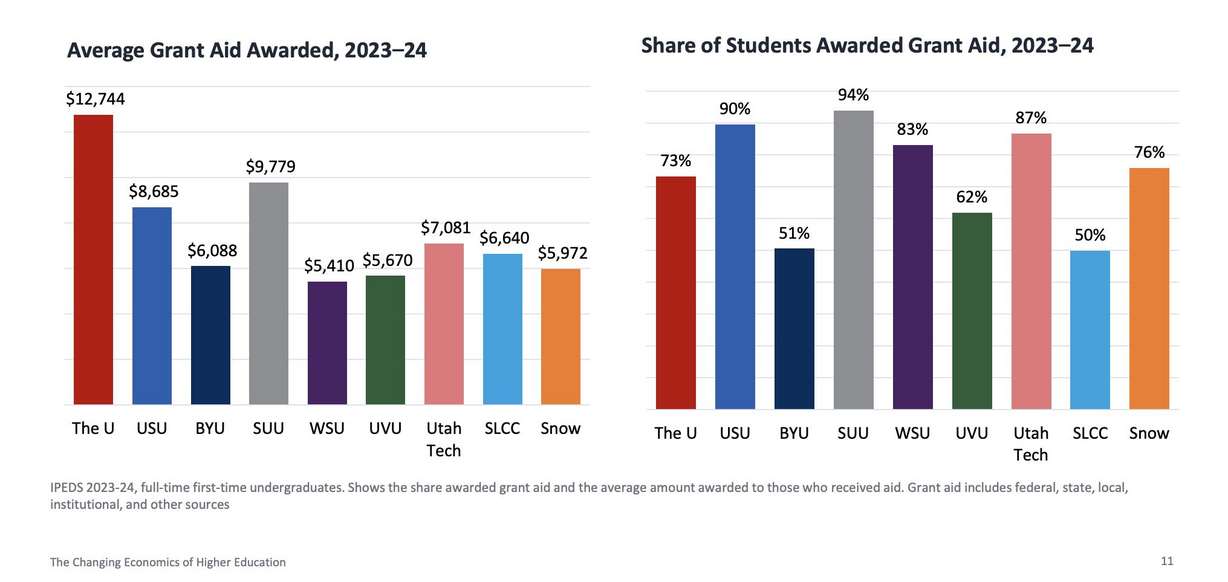
A lot of that is due to grant aid that helps students offset tuition and fees.
And in Utah, Kofoed said grant aid is both generous and plentiful, with data from the National Center for Education Statistics showing that the average grant aid awarded on a per-student basis ranges from $5,972 at Snow College to $12,744 at the University of Utah.
At Utah State University and Southern Utah University, at least 90% of students received grant aid.
"Essentially, if I'm a low-income, highly able student in the state of Utah, I essentially ought to be in college because of the generosity of both the low tuition fees and the high aid that's available," Kofoed said.
Money on the table
While Kofoed detailed Utah's higher education affordability and grant generosity, he also pointed out that many miss out on thousands of dollars by not completing the Free Application for Federal Student Aid.
Of Utah's 2025 high school seniors, only 42.3% completed the FAFSA, the second-lowest total in the nation, ahead of only Alaska, according to data from the National FAFSA Tracker.
Completing the FAFSA directly correlates to college affordability for many students, as it is the only way to receive federal Pell Grants — essentially free money for college — and federally subsidized student loans. Additionally, FAFSA completion is often a requirement for many scholarships, including the Utah Promise Scholarship, which covers tuition and fees for up to two years.
These low completion rates lead to students missing out on financial assistance, with Utah high school seniors leaving millions of dollars on the table every year.
What's in a degree?
But why should Utahns want to earn a degree?
A 2024 report from the Gardner Institute said higher education is often an indicator of both individual and societal well-being.
Data from the report shows those with a bachelor's degree enjoy median earnings $20,000 higher than those with only a high school diploma. That number jumps to nearly $50,000 for anyone with a graduate or professional degree. Logically, poverty and unemployment rates decline according to the levels of educational attainment.
Additionally, data from the Gardner Institute's latest report shows that Utah graduates earn $12,000-$25,000 more a year after earning a degree.