'%3e%3cpath%20d='M34.1406%205.85938C30.3906%202.10547%2025.3047%200%2020%200C14.6953%200%209.60938%202.10547%205.85938%205.85938C2.10938%209.61328%200%2014.6953%200%2020C0%2025.3047%202.10547%2030.3906%205.85938%2034.1406C9.61328%2037.8906%2014.6953%2040%2020%2040C25.3047%2040%2030.3906%2037.8945%2034.1406%2034.1406C37.8906%2030.3906%2040%2025.3047%2040%2020C40%2014.6953%2037.8945%209.60938%2034.1406%205.85938ZM37.0117%2023.543H31.1602V13.5391H27.6328V19.9414C28.1211%2020.6914%2028.3711%2021.582%2028.3711%2022.5625V22.625C28.3711%2023.668%2028.1172%2024.6055%2027.6328%2025.4297V26.6094H36.082C33.4883%2032.9375%2027.2891%2037.3789%2020.0039%2037.3789C10.3711%2037.3789%202.62109%2029.6289%202.62109%2020C2.62109%2010.3711%2010.3711%202.62109%2020%202.62109C29.6289%202.62109%2037.3789%2010.3711%2037.3789%2020C37.3789%2021.1484%2037.2617%2022.2656%2037.0508%2023.3477C37.0391%2023.4141%2037.0234%2023.4766%2037.0117%2023.543Z'%20fill='white'/%3e%3cpath%20d='M22.3086%2018.5352C20.4336%2018.125%2019.9531%2017.8398%2019.9766%2017.1836V17.1406C19.9766%2016.6992%2020.3477%2016.2148%2021.4023%2016.2148C22.582%2016.2148%2023.8867%2016.6797%2025.0781%2017.4766L26.8516%2015.0195C25.4453%2013.8906%2023.707%2013.3398%2021.5547%2013.3398C18.5195%2013.3398%2016.4375%2015%2016.4063%2017.4766V17.5352C16.3633%2020.2617%2018.5859%2020.9805%2021.293%2021.6016C23.0391%2021.9766%2023.5703%2022.3164%2023.5703%2022.9609L23.5469%2022.9766C23.5469%2023.3906%2023.2578%2023.7031%2022.7852%2023.8359C22.5742%2023.9062%2022.1289%2023.9727%2021.5156%2023.9727C20.7617%2023.9727%2019.7539%2023.8633%2018.6328%2023.4844C18.0898%2023.2891%2017.4727%2023.0039%2016.8047%2022.6133L20.1406%2026.625C20.2813%2026.6602%2021.0977%2026.8516%2021.7734%2026.8516C25.0039%2026.8516%2027.0859%2025.2461%2027.1094%2022.6328V22.5703C27.1602%2020.1133%2025.2148%2019.1719%2022.3086%2018.5352Z'%20fill='white'/%3e%3cpath%20d='M5.24219%2013.5664V26.6133H8.75391V23.7578L10.2969%2021.9531L14.2031%2026.6133H18.3867L12.3555%2019.5195L17.4023%2013.5664H13.4531L8.75391%2019.0586V13.5664H5.24219Z'%20fill='white'/%3e%3c/g%3e%3cdefs%3e%3cclipPath%20id='clip0_97_2430'%3e%3crect%20width='40'%20height='40'%20fill='white'/%3e%3c/clipPath%3e%3c/defs%3e%3c/svg%3e)


Estimated read time: 5-6 minutes
- Plínio Trump, a helicopter pilot, channels Donald Trump in Brazil's elections.
- Brazil's tradition of joke candidates includes figures like Mick Jagger and Samurai Taxi Driver.
- These candidates attract disillusioned voters but inadvertently strengthen political parties they oppose.
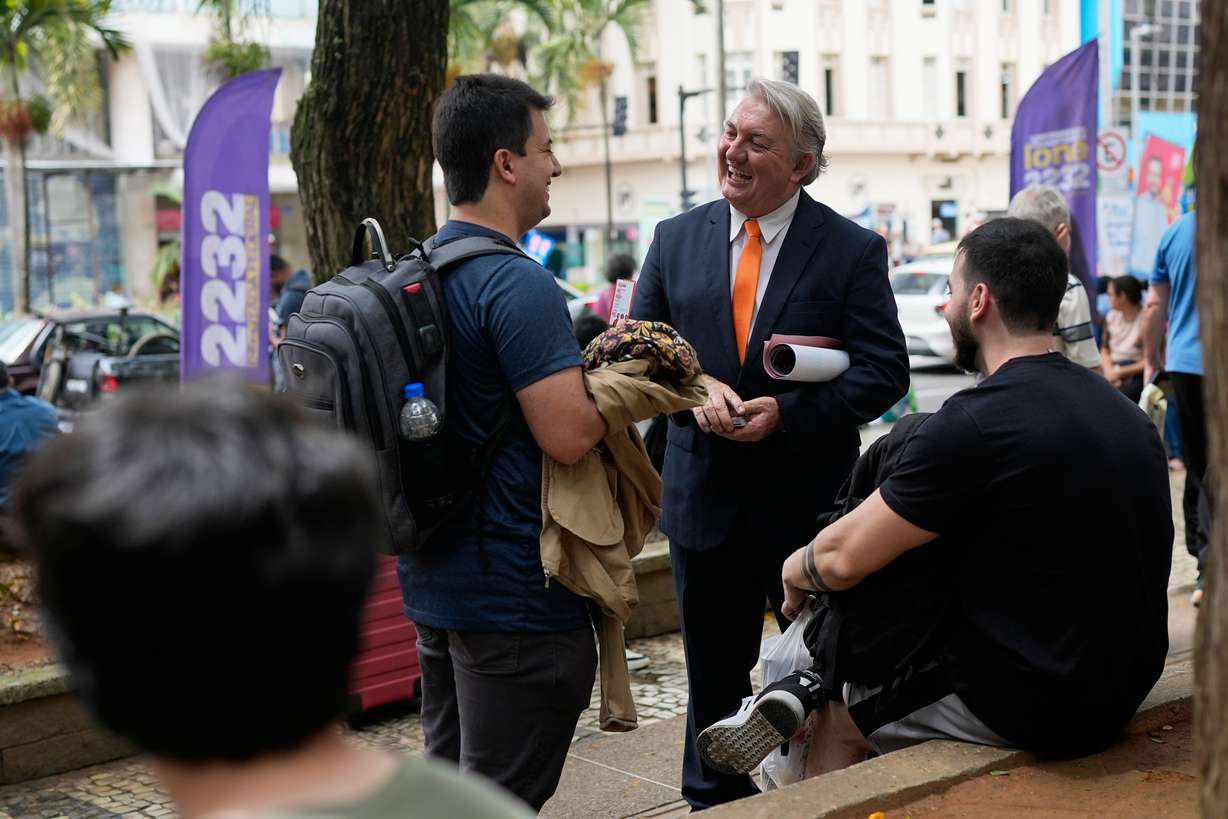
JUIZ DE FORA, Brazil — When helicopter pilot Plínio Vicentin Júnior drives his vintage Pontiac Grand Ville through the streets of Brazil's southeastern state of Minas Gerais, an American flag fluttering near his windshield like a presidential motorcade, onlookers stop and stare.
Júnior, 59, is running for Congress for the first time. But until Oct. 4, he is Plínio Trump, channeling U.S. President Donald Trump with his hairstyle, long orange tie, firm handshake and even his stride.
"(Trump) is likeable, iconic," Plínio Trump told The Associated Press late Monday after campaigning in Juiz de Fora, a city of 570,000 residents 111 miles west of Rio de Janeiro. "Few people sneered at me. Most people smile and hug me."
Candidates like Plínio Trump are part of a Brazilian tradition that spans nearly eight decades. Whether called protest candidates or joke candidates, they bring a surreal element to congressional elections. To run, they must belong to one of Brazil's 30 political parties and meet the same eligibility requirements as other candidates, including the country's clean-record rules.
This year, a few hundred of those are among more than 7,800 candidates running for a seat in Congress, with even more running for state legislatures.
Paradoxically, while these entertaining figures can attract voters disillusioned with traditional politics, the ballots cast for them also add to their parties' total under Brazil's electoral system. More votes for joke candidates can translate into more seats in Congress — and more public funds for the very apparatus that protest voters are trying to reject.

Trump is not the only U.S. politician with admirers in Brazil's congressional race.
Henrique Barack Obama, born Cláudio Henrique dos Anjos, has even loftier ambitions. After previous runs for office in Rio de Janeiro, he is seeking one of the two Senate seats at stake in the Federal District, home to Brazil's capital, Brasilia. But even those who have seen him up close acknowledge that the 57-year-old bears little resemblance to the former U.S. president.
"It is more about his posture," said Claudio Santos, 33, who knows the Brazilian Obama from his time in Rio. "He also likes the attention that the name brings, obviously. When he wasn't running for office, he would pose as Obama during Flamengo soccer games."
Another novelty candidate, Mick Jagger, whose real name is Walcy Calixto Vieira, is again running for a seat in the legislature of the central state of Goias. He is no rock'n'roll front man, but a 66-year-old carpenter with shaggy hair and brow-skimming bangs.
Other candidates skip celebrity impersonations and opt instead for catchy aliases. "Tsunami Grandmother," whose real name is Scheile Aparecida Soares Brandão, is seeking a seat in the Minas Gerais state legislature. "Who Who," born Francisco das Chagas Costa Oliveira, is running for the legislature in the northeastern state of Piauí.
"Lonely Boy," or Marcelo da Rosa, is a truck driver from Paraná state seeking a seat in Congress, and then there is Severino Cardoso Sobrinho, better known as Samurai Taxi Driver, a nunchaku master featured in Instagram videos who is running for the state legislature in Pernambuco, the home state of President Luiz Inácio Lula da Silva.
Brazil's tradition of novelty candidates dates back to 1959, when roughly 100,000 voters in São Paulo wrote the name of Cacareco, a female rhinoceros from the city zoo, on their paper ballots in a city council election. Electoral authorities later invalidated the votes.
Such political stunts disappeared during Brazil's military dictatorship from 1964 to 1985. But the country's return to national elections in 1989 featured one of its most memorable presidential candidates: Dr. Enéas Carneiro, a respected cardiologist who delivered rapid-fire, complex speeches in 15-second radio and television spots. Many Brazilians found his breathless delivery hilarious.
"My name is Enéas!" he shouted into the camera at the end of every ad. Carneiro pulled in 360,000 votes in Brazil's first direct presidential election since 1960.
Five years later, with voters still angered with the corruption scandal that led to President Fernando Collor's impeachment, Carneiro finished third, drawing 4.6 million votes behind Lula and eventual winner Fernando Henrique Cardoso.
The movement reached a new high in 2010, when Tiririca, a circus clown and comedian, won a congressional seat for São Paulo with more than 1.3 million votes. His campaign slogans included, "It can't get any worse" and, "What does a federal congressman do? I really don't know. Vote for me and I will find out for you!"
Francisco Everardo Oliveira Silva, nicknamed Tiririca by his mother for looking perpetually angry as a child, served four consecutive terms. He is seeking a fifth, representing his native Ceara state in Brazil's northeast. In 2022, he secured 70,000 votes to retain his job.
Carlos Melo, a political science professor at Insper university in São Paulo, said candidates like Tiririca punch above their weight because of Brazil's proportional representation system. Votes for candidates go to their party and are then distributed proportionally.
"Some of these candidates have enough votes to win their own seats, but others just add 1,000 or 2,000 votes to their parties. They don't get seats, but they help their parties secure a bigger slice of Congress and public funds," Melo said. "Nowadays, we see many more of these bizarre candidates because traditional political leadership is decomposing. People who would normally fill these roles are opting out of institutional politics."
As Plínio Trump wrapped up campaigning in Juiz de Fora and prepared to return to Varginha — a city 248 miles west of Rio de Janeiro nationally famous for its alleged UFO landing site — he acknowledged that his decision to campaign as the U.S. president goes beyond physical resemblance.
"We have few options on the right in Brazil," he said. "For me, Trump is a right-wing reference."