'%3e%3cpath%20d='M34.1406%205.85938C30.3906%202.10547%2025.3047%200%2020%200C14.6953%200%209.60938%202.10547%205.85938%205.85938C2.10938%209.61328%200%2014.6953%200%2020C0%2025.3047%202.10547%2030.3906%205.85938%2034.1406C9.61328%2037.8906%2014.6953%2040%2020%2040C25.3047%2040%2030.3906%2037.8945%2034.1406%2034.1406C37.8906%2030.3906%2040%2025.3047%2040%2020C40%2014.6953%2037.8945%209.60938%2034.1406%205.85938ZM37.0117%2023.543H31.1602V13.5391H27.6328V19.9414C28.1211%2020.6914%2028.3711%2021.582%2028.3711%2022.5625V22.625C28.3711%2023.668%2028.1172%2024.6055%2027.6328%2025.4297V26.6094H36.082C33.4883%2032.9375%2027.2891%2037.3789%2020.0039%2037.3789C10.3711%2037.3789%202.62109%2029.6289%202.62109%2020C2.62109%2010.3711%2010.3711%202.62109%2020%202.62109C29.6289%202.62109%2037.3789%2010.3711%2037.3789%2020C37.3789%2021.1484%2037.2617%2022.2656%2037.0508%2023.3477C37.0391%2023.4141%2037.0234%2023.4766%2037.0117%2023.543Z'%20fill='white'/%3e%3cpath%20d='M22.3086%2018.5352C20.4336%2018.125%2019.9531%2017.8398%2019.9766%2017.1836V17.1406C19.9766%2016.6992%2020.3477%2016.2148%2021.4023%2016.2148C22.582%2016.2148%2023.8867%2016.6797%2025.0781%2017.4766L26.8516%2015.0195C25.4453%2013.8906%2023.707%2013.3398%2021.5547%2013.3398C18.5195%2013.3398%2016.4375%2015%2016.4063%2017.4766V17.5352C16.3633%2020.2617%2018.5859%2020.9805%2021.293%2021.6016C23.0391%2021.9766%2023.5703%2022.3164%2023.5703%2022.9609L23.5469%2022.9766C23.5469%2023.3906%2023.2578%2023.7031%2022.7852%2023.8359C22.5742%2023.9062%2022.1289%2023.9727%2021.5156%2023.9727C20.7617%2023.9727%2019.7539%2023.8633%2018.6328%2023.4844C18.0898%2023.2891%2017.4727%2023.0039%2016.8047%2022.6133L20.1406%2026.625C20.2813%2026.6602%2021.0977%2026.8516%2021.7734%2026.8516C25.0039%2026.8516%2027.0859%2025.2461%2027.1094%2022.6328V22.5703C27.1602%2020.1133%2025.2148%2019.1719%2022.3086%2018.5352Z'%20fill='white'/%3e%3cpath%20d='M5.24219%2013.5664V26.6133H8.75391V23.7578L10.2969%2021.9531L14.2031%2026.6133H18.3867L12.3555%2019.5195L17.4023%2013.5664H13.4531L8.75391%2019.0586V13.5664H5.24219Z'%20fill='white'/%3e%3c/g%3e%3cdefs%3e%3cclipPath%20id='clip0_97_2430'%3e%3crect%20width='40'%20height='40'%20fill='white'/%3e%3c/clipPath%3e%3c/defs%3e%3c/svg%3e)



Estimated read time: 5-6 minutes
- Colin Hilton, former Utah Olympic Legacy Foundation CEO, is remembered after his passing.
- Hilton's leadership expanded youth sports programs and secured Utah's 2034 Winter Games.
- The Colin Hilton Legacy Community Care Initiative supports mental health and youth scholarships.
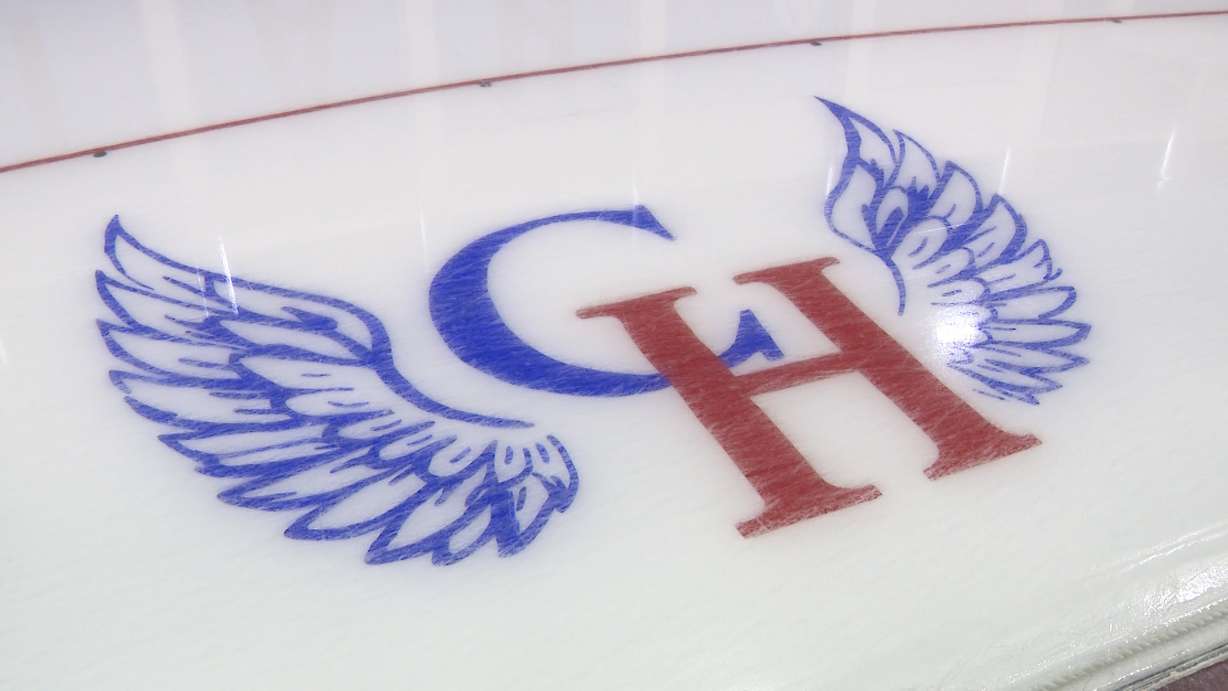
KEARNS — There is something beneath the ice at the Utah Olympic Oval that wasn't there just a few weeks ago.
It's a logo honoring Colin Hilton, the longtime president and CEO of the Utah Olympic Legacy Foundation, who died by suicide last month at the age of 58.
For those who worked with Hilton, though, the logo represents much more than a memorial.
It's a reminder of a man whose influence can be seen throughout Utah's Olympic and Paralympic community, as well as the work now being done to carry his legacy forward.
"He absolutely believed in the mission," said Lisa Bennion Rasmussen, the chief revenue officer with the Utah Olympic Legacy Foundation, who worked with Hilton for more than ten years. "He really lived that legacy day in and day out."
Hilton spent decades helping shape Utah's Olympic legacy, from keeping venues built for the 2002 Winter Games open and accessible to the public, to developing training facilities for elite athletes and helping Utah secure another Olympic and Paralympic Winter Games in 2034.
"I really attribute us getting the Games back to Utah 2034 to Colin," said Rasmussen. "His vision, it wasn't just about a 17-day event. He knew we were going to be here before the Games, during the Games and after the Games."
For Hilton, Rasmussen said, maintaining Utah's Olympic venues wasn't simply about preserving what happened in 2002.
We always wanted to do better because Colin pushed us to do better.
–Lisa Bennion Rasmussen, the chief revenue officer with the Utah Olympic Legacy Foundation
It was about what could happen in them next.
Under Hilton's leadership, the Utah Olympic Legacy Foundation expanded programs designed to introduce children to winter sports and make the venues accessible to people of different ages and abilities.
The Foundation launched its Healthy Communities program in 2018 with the goal of providing children with access to sports and scholarship opportunities.
"When we first started in 2018, there were 750 kids. Now we have over 3,200 kids that are competing in sports. When I say competing, I mean, it's beautiful and wonderful that we have Olympic and Paralympic athletes training at our venues, but he really broke down all the barriers and wanted opportunities for everybody, regardless of your age or your ability," said Rasmussen. "He did that with such grace and care, and he just truly lived and died and breathed our mission."
Hilton's death has been deeply felt by those who worked alongside him.
"It's tough not to get emotional," said Rasmussen. "He was our boss. He was our leader. He was so gracious. He was so passionate. I really am going to miss that every single day. We always wanted to do better because Colin pushed us to do better."
Now, an initiative created in Hilton's name is designed to continue some of the work he cared most about while also helping people who may be struggling with their mental health.
The Colin Hilton Legacy Community Care Initiative was established with the help of an anonymous donor.
Rasmussen said the initiative has four components: supporting mental health and well-being for Utah Olympic Legacy Foundation employees and athletes; expanding youth scholarship programs; creating a permanent memorial to Hilton at Utah Olympic Park; and supporting the celebration of life held for Hilton last week.
For Hilton's family, Rasmussen said, the mental health component is especially important.
"We were honored when his family said, 'We want to share this because we want to help somebody else,'" she said. "Hopefully we can help somebody that doesn't go through the same struggle that Colin did."
She said that goal reflects the same philosophy Hilton brought to his work.
"That's what he was about, right? Helping people and providing opportunities for anyone and everyone. So, if we can do that in Colin's name, he would be so proud of that," said Rasmussen.
A little Olympic and a little Buffalo Bills
At the Utah Olympic Oval, employees found their own way to remember Hilton.
It happened as crews were preparing the Oval's long-track ice for the new season.
Todd Porter, general manager of the Utah Olympic Oval, said employees wanted to do something for Hilton but weren't initially sure what that could be.
"They all kind of felt a piece of it and wanted to try something that they could do," said Porter.
Then someone realized they had a unique canvas right in front of them.
The crew began coming up with designs that could be painted beneath the ice.
And because Hilton was a passionate Buffalo Bills fan, Porter said, some of the early ideas had a distinct Buffalo flavor.
"We kicked around a bunch of different ideas involving the Buffalo Bills, which Colin was huge on," said Porter.
Ideas included a buffalo with wings before employees eventually settled on the design now frozen beneath the Oval's ice, a logo with the initials "CH" surrounded by wings.
The logo is red, white and blue, which is appropriate for a man who dedicated so much of his professional life to Team USA and the Olympic movement.
But those who knew Hilton recognize another meaning behind the colors.
"You could say it's USA red, white and blue, but some of us know it's a little bit Buffalo," said Porter with a laugh.
The logo will remain beneath the ice for the entire season.
For Porter, it's a fitting tribute to a boss who made a point of knowing the people who worked at the venues he oversaw.
Hilton was responsible for three Utah Olympic Legacy Foundation venues, but Porter said whenever Hilton visited the Oval, he didn't simply attend a meeting and leave.
"Every time he was down here at the Oval, he made time to make sure he walked around, stopped at the front desk, talked to everybody," said Porter. "He would just talk to them and go to the back to the operations room and just touch base with everybody. I think that's huge. It's an important piece of being a leader."
Those conversations, he said, were another example of Hilton's leadership style.
He wanted to know not only how someone's work was going, but how they and their families were doing.
Now, Hilton's name will remain beneath the ice at one of the venues he spent so much of his career supporting.
"We always wanted to do better because Colin pushed us to do better," said Rasmussen.
Suicide prevention resources
If you or someone you know is struggling with thoughts of suicide, call 988 to connect with the 988 Suicide and Crisis Lifeline.
Crisis hotlines
- Huntsman Mental Health Institute Crisis Line: 801-587-3000
- SafeUT Crisis Line: 833-372-3388
- 988 Suicide and Crisis LifeLine at 988
- Trevor Project Hotline for LGBTQ teens: 1-866-488-7386
Online resources
- NAMI Utah: namiut.org
- SafeUT: safeut.org
- SafeUTFrontline: SafeUT Frontline.org
- SafeUTNG: SafeUTNG.org
- Suicide and Crisis Lifeline: 988lifeline.org
- American Foundation for Suicide Prevention, Utah chapter: afsp.org/chapter/utah
- Encircle Utah.org LGBTQ+ family and youth resource center.
- Utah Pride Center.org empowers Utah's diverse LGBTQ+ community.
- U.S. Department of Veterans Affairs Mental Health suicide prevention
- Centers for Workplace Mental Health offers suicide prevention and response for employers.
Warning signs of suicide
- Talking about wanting to die
- Looking for a way to kill oneself
- Talking about feeling hopeless or having no purpose
- Talking about feeling trapped or in unbearable pain
- Talking about being a burden to others
- Increasing the use of alcohol or drugs
- Acting anxious, agitated or recklessly
- Sleeping too little or too much
- Withdrawing or feeling isolated
- Showing rage or talking about seeking revenge
- Displaying extreme mood swings
The more of these signs a person shows, the greater the risk. Warning signs are associated with suicide but may not be what causes a suicide.
Information from the American Foundation for Suicide Prevention.What to do if you see warning signs of suicide
- Do not leave the person alone
- Remove any firearms, alcohol, drugs or sharp objects that could be used in a suicide attempt
- Call the U.S. National Suicide Prevention Lifeline at 800-273-TALK (8255)
- Take the person to an emergency room or seek help from a medical or mental health professional