'%3e%3cpath%20d='M34.1406%205.85938C30.3906%202.10547%2025.3047%200%2020%200C14.6953%200%209.60938%202.10547%205.85938%205.85938C2.10938%209.61328%200%2014.6953%200%2020C0%2025.3047%202.10547%2030.3906%205.85938%2034.1406C9.61328%2037.8906%2014.6953%2040%2020%2040C25.3047%2040%2030.3906%2037.8945%2034.1406%2034.1406C37.8906%2030.3906%2040%2025.3047%2040%2020C40%2014.6953%2037.8945%209.60938%2034.1406%205.85938ZM37.0117%2023.543H31.1602V13.5391H27.6328V19.9414C28.1211%2020.6914%2028.3711%2021.582%2028.3711%2022.5625V22.625C28.3711%2023.668%2028.1172%2024.6055%2027.6328%2025.4297V26.6094H36.082C33.4883%2032.9375%2027.2891%2037.3789%2020.0039%2037.3789C10.3711%2037.3789%202.62109%2029.6289%202.62109%2020C2.62109%2010.3711%2010.3711%202.62109%2020%202.62109C29.6289%202.62109%2037.3789%2010.3711%2037.3789%2020C37.3789%2021.1484%2037.2617%2022.2656%2037.0508%2023.3477C37.0391%2023.4141%2037.0234%2023.4766%2037.0117%2023.543Z'%20fill='white'/%3e%3cpath%20d='M22.3086%2018.5352C20.4336%2018.125%2019.9531%2017.8398%2019.9766%2017.1836V17.1406C19.9766%2016.6992%2020.3477%2016.2148%2021.4023%2016.2148C22.582%2016.2148%2023.8867%2016.6797%2025.0781%2017.4766L26.8516%2015.0195C25.4453%2013.8906%2023.707%2013.3398%2021.5547%2013.3398C18.5195%2013.3398%2016.4375%2015%2016.4063%2017.4766V17.5352C16.3633%2020.2617%2018.5859%2020.9805%2021.293%2021.6016C23.0391%2021.9766%2023.5703%2022.3164%2023.5703%2022.9609L23.5469%2022.9766C23.5469%2023.3906%2023.2578%2023.7031%2022.7852%2023.8359C22.5742%2023.9062%2022.1289%2023.9727%2021.5156%2023.9727C20.7617%2023.9727%2019.7539%2023.8633%2018.6328%2023.4844C18.0898%2023.2891%2017.4727%2023.0039%2016.8047%2022.6133L20.1406%2026.625C20.2813%2026.6602%2021.0977%2026.8516%2021.7734%2026.8516C25.0039%2026.8516%2027.0859%2025.2461%2027.1094%2022.6328V22.5703C27.1602%2020.1133%2025.2148%2019.1719%2022.3086%2018.5352Z'%20fill='white'/%3e%3cpath%20d='M5.24219%2013.5664V26.6133H8.75391V23.7578L10.2969%2021.9531L14.2031%2026.6133H18.3867L12.3555%2019.5195L17.4023%2013.5664H13.4531L8.75391%2019.0586V13.5664H5.24219Z'%20fill='white'/%3e%3c/g%3e%3cdefs%3e%3cclipPath%20id='clip0_97_2430'%3e%3crect%20width='40'%20height='40'%20fill='white'/%3e%3c/clipPath%3e%3c/defs%3e%3c/svg%3e)



This archived news story is available only for your personal, non-commercial use. Information in the story may be outdated or superseded by additional information. Reading or replaying the story in its archived form does not constitute a republication of the story.
- Graphic images of Charlie Kirk's shooting were seen by over a third of U.S. adults.
- Utahns were more likely to have viewed the images than the national average.
- Experts warn that exposure to such content can cause trauma even if not viewed live.
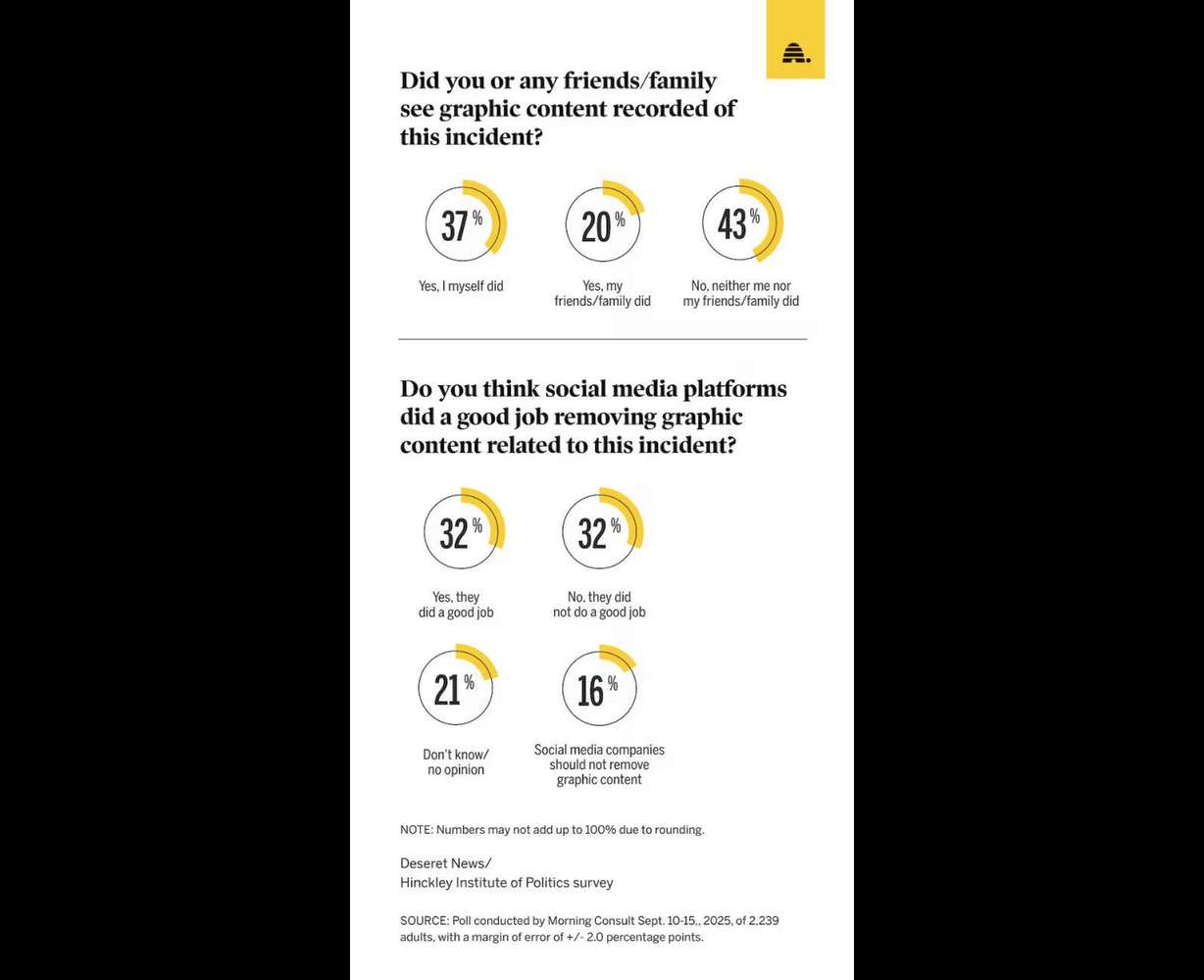
SALT LAKE CITY — More than a third of U.S. adults saw the graphic, violent images of conservative political activist Charlie Kirk's murder online. And when their friends and family members are added to the numbers, nearly 6 in 10 say they or someone close to them viewed the violent images of his fatal shooting at Utah Valley University on Sept. 10.
Thirty-seven percent of those surveyed for Deseret News and the University of Utah's Hinckley Institute of Politics said they personally saw the graphic content. Twenty percent said friends and family saw it.
Just 43% said neither they nor their friends and family saw images from the shooting.
More men than women nationally saw graphic content online themselves, 41% to 33%. The share of young adults ages 18 to 34 who saw the images themselves (42%) was nearly identical to those in the 35 to 44 age group (41%). Among those 45 to 64, the share dropped to 37%, while among adults 65 and older, 28% saw graphic images themselves.
Those are among the findings of a nationally representative Morning Consult poll. The survey of 2,239 adults has a margin of error of plus or minus 2%. A separate poll of Utah adults was also conducted.
Kirk was fatally shot before a crowd estimated at 3,000 people while appearing in Orem as part of his "Prove Me Wrong" college tour.
After the shooting, Gov. Spencer Cox called social media and its ability to foment fury and then deliver horrifying images "a cancer on our society right now." He described the murder as "one so gruesomely displayed on camera in all of our hands and in all of our pockets. We are not wired as human beings biologically; historically, we have not evolved in a way that we are capable of processing those types of violent imagery."
Experts told Deseret News that the trauma generated by the murder will impact even those who didn't see it in person but viewed the gruesome images that were captured and circulated online.
Viewed on social media
Adults are evenly divided on whether social media platforms did a good job of removing graphic content related to Kirk's death, with 32% saying yes and 32% saying no. Another 16% said social media companies should not remove graphic content, while 21% said they didn't know or had no opinion.
The majority of respondents (51%) said they did not believe the images of the event were AI-generated. Another 10% said AI did generate images, while 39% said they didn't know or had no opinion.
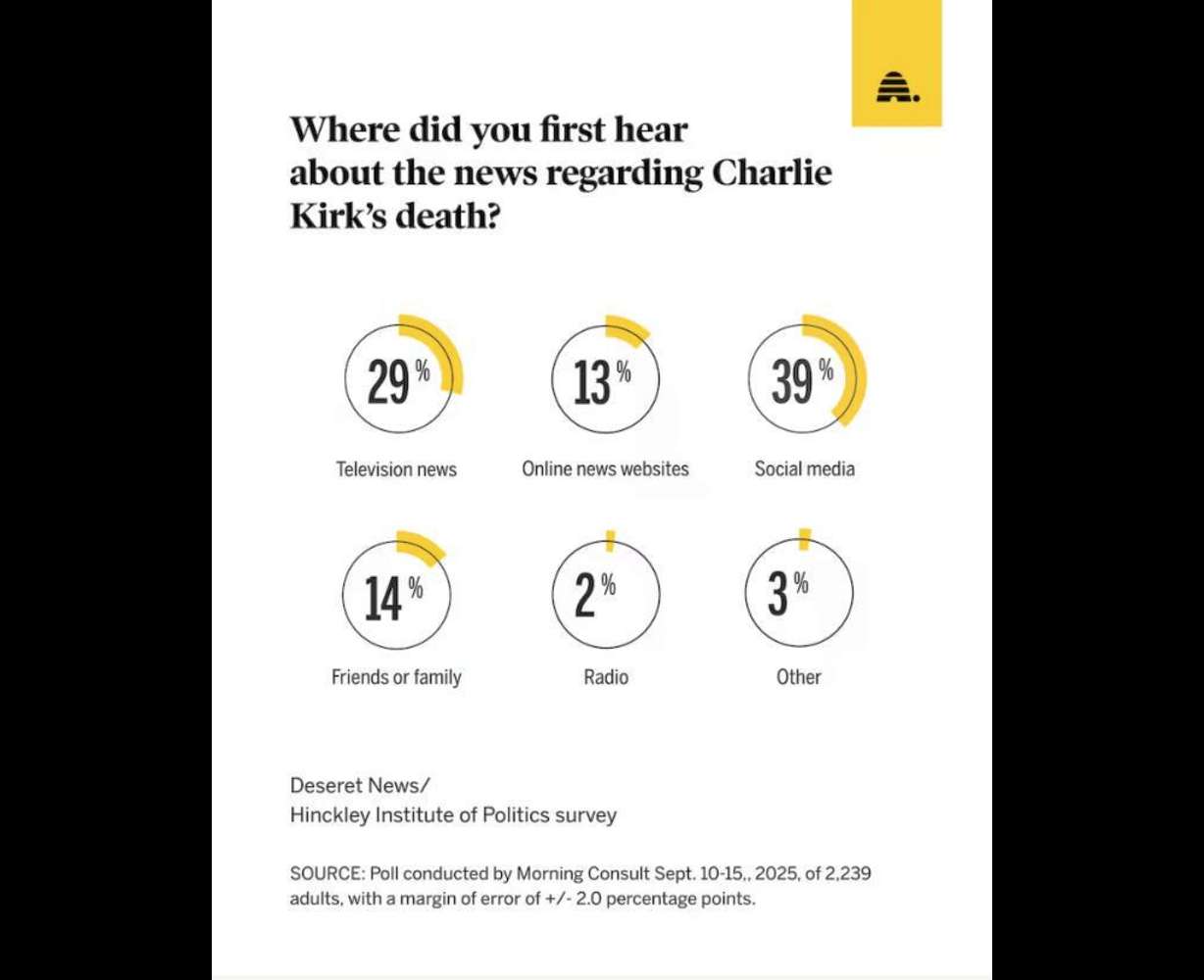
Social media is also how the largest segment of adults first heard of the murder, at 39%, followed by television news (29%), friends or family (14%), and online news websites (13%). Radio informed 2%.
What Utahns say about the images
A separate survey that included 502 Utah adults found that 35% of Utahns first learned of the shooting online, while 32% were informed by friends or family, 17% received the news from television and 10% first heard of the shooting from online news websites.
A higher share of Utahns — 47% — viewed the images themselves, compared to U.S. adults as a whole, while 24% of their family members and friends did. Just 28% said neither they nor those close to them saw images of the killing.
Utah men were more likely to have viewed the images themselves than were women, 56% versus 38%. Not quite 6 in 10 young adults ages 18 to 34 (58%) viewed the images themselves, compared to 52% of those ages 35 to 44, 39% of those ages 45 to 64 and 34% of those 65 and older.
Utahns were more likely at 36% to say that social media platforms did not do a good job of removing graphic content related to the shooting, while 31% said the social media companies did. Ten percent of Utahns polled said the graphic content should not be removed, while 24% said they didn't know or had no opinion.
Very few of the Utah adults polled believe content around the killing was AI-generated, at 14%, while 55% believe it was genuine. Nearly one-third (31%) said they didn't know or had no opinion.
Trauma at a distance is still trauma
Over the course of many tragedies, from school shootings to Kirk's killing, experts have told Deseret News that viewing graphic images can create trauma.
Don Grant, a Los Angeles-area psychologist, author and researcher, is among the American Psychological Association's experts on social media and technology and how those impact mental health.
He has, on different occasions, including right after the Kirk shooting, told Deseret News that exposure to images that are graphic can throw people off balance and traumatize them. But he acknowledged social media is part of society's fabric now, so it's not likely folks will simply turn it off completely — or be able to stay on but filter out all harmful images. Even if you're not looking, he said, it's easy to stumble on graphic violence.
It can show up in your feed or be shared when you don't expect it.
Grant said he believes that social media companies have a responsibility to do some filtering of extremely damaging content. And he includes gruesome images from Kirk's murder in that group.
Individual traits, including personality and age, as well as other factors, all matter when it comes to the impact of viewing traumatic events. Some people can move on easily, while others cannot. And sometimes the impact surfaces over time or unexpectedly, according to mental health experts.
Read the full story at Deseret News.
Read more:

Investigation into the killing of Charlie Kirk
Click here to read the latest news on the investigation into the killing of Charlie Kirk. The conservative activist and co-founder of Turning Point USA was shot and killed during a Sept. 10 appearance on the campus of Utah Valley University in Orem.